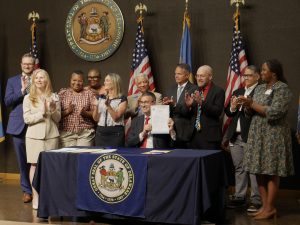
WILMINGTON—Today, Governor Matt Meyer signed six bills aimed at supporting the healthcare of vulnerable populations, protecting Delawareans from harmful substances, and strengthening accountability in healthcare and housing.
“Every Delawarean deserves the opportunity to live a safe, healthy, and dignified life,” said Governor Matt Meyer. “These new laws expand access to quality healthcare, ensure safer housing by reducing lead exposure, protect our communities from dangerous substances, and provide essential support for mothers and individuals impacted by the opioid crisis. With these actions, we’re not only addressing immediate challenges but building a compassionate foundation where every person, no matter their circumstances, can thrive.”

House Substitute 2 with House Amendment 1 and Senate Amendment 2 for House Bill 70, sponsored by Rep. Kerri Evelyn-Harris, improves safety in Delaware’s rental units by requiring stricter certification of lead-free housing.
“This legislation is a critical step forward in protecting families from the dangers of lead exposure, particularly in older rental housing,” said House Majority Leader Kerri Evelyn Harris. “Equally important is the built-in feasibility study, which ensures we implement these protections in a way that’s both effective and practical. By taking the time to assess workforce capacity, funding needs, and landlord readiness, we’re committing to smart, sustainable policy that puts health and housing stability first.”
“As a social worker and a legislator, building a stronger future starts with long-term solutions to strengthen community wellness,” said Sen. Marie Pinkney, Senate Sponsor for HB70. “A holistic approach to public health must protect and support Delawareans from every corner of our state, especially the most vulnerable – and these bills do just that.”
House Bill 205 with House Amendments 1 and 2, sponsored by Rep. Cyndie Romer, adds additional protections for medical providers from lawsuits or investigations coming from other states. This extends to reproductive and gender-affirming care providers and mirrors an Executive Order signed by Governor Meyer in June.
“Delaware’s medical providers should never have to worry about being prosecuted or targeted for offering care that’s legal, evidence-based, and compassionate, just because other states have chosen to politicize medicine,” said Rep. Cyndie Romer. “With these protections in place, I’m hopeful that we’ll be able to give our medical professionals the peace of mind they need to keep focusing on what matters most: the health and wellbeing of their patients.”
Senate Bill 129, sponsored by Sen. Stephanie Hansen, updates Senate Bill 166 passed by the 152nd General Assembly in 2022, which was created a fund to manage opioid settlement money from companies—not individuals—since personal claims, like those against the Sacklers, were tied up in bankruptcy. But in 2024, the U.S. Supreme Court ruled the Sacklers couldn’t avoid liability through bankruptcy, leading Delaware to negotiate a direct settlement. Now, the law is being updated to include individuals like the Sacklers so Delaware can fully benefit from the agreement.
“Through these bills, we honor the grief of families who have lost a loved one to addiction and ensure that we maximize resources available for remediating the opioid crisis,” said Sen. Stephanie Hansen. “Both here in Delaware and around the world, addiction devastates families and communities of all backgrounds. Building a healthier future starts with acknowledging the crushing toll of overdose and working to ensure that prevention, support, and recovery are not only possible, but openly accessible to everyone in need.”
Senate Joint Resolution 9, also sponsored by Sen. Stephanie Hansen, designates August 31st, 2025, as International Overdose Day in Delaware to recognize those who have died of overdose and the impact on their community.
House Bill 3, sponsored by Rep. Deshanna Neal, creates a breastfeeding and lactation program for women in Delaware Department of Correction custody, allowing women to collect and send breast milk to their infant or toddler through an approved person.
“As a proud mother of four, I had the privilege of breastfeeding my children. And the bond that came from that was incredible. I want to help every mother experience that, no matter what their circumstances are,” said Rep. DeShanna Neal. “Incarcerated people are severely underseen and understudied, and that has cascading effects that can be seen in the lack of policies supporting their health and wellbeing. The breastfeeding and lactation program that HB 3 is creating is the first of its kind in our state and represents another step toward treating incarcerated mothers and their babies with the respect, dignity, and care that they deserve as human beings.”
House Bill 53 with House Amendment 1, sponsored by Rep. Eric Morrison, expands resources managed by the Office of the Deaf and Hard of Hearing, allowing people with hearing or speech disabilities to more easily access necessary supplies such as communication or emergency devices.
“House Bill 53 came directly from listening to the needs of our deaf and hard-of-hearing (DAHH) community; a community that, sadly, hasn’t always gotten the support or resources they deserve,” said Rep. Eric Morrison. “By expanding access to assistive technology and equipment, we’re helping to make everyday tasks easier, communication more accessible, and taking a meaningful step toward more independence and inclusion for so many Delawareans. I’m proud that I was able to work with the Delaware Office of the Deaf and Hard of Hearing, other state agencies, and DAHH advocates to make it happen.”
For additional photos from the signings, click here.
For any questions or to schedule a one-on-one interview with Governor Meyer, please email govcomm@delaware.gov.