Governor also signs legislation to protect tenant rights and remove medical debt from credit reports
NEW CASTLE — Today, Governor Matt Meyer announced a partnership between the State of Delaware and national nonprofit Undue Medical Debt, leveraging $500,000 in state funds to purchase and eliminate up to $50 million in medical debt for an estimated 17,000 or more Delawareans. This initiative was a key piece of Governor Meyer’s FY2026 budget.
Governor Meyer also signed legislation protecting tenant records and removing medical debt from credit reporting to help Delawareans improve economic stability.
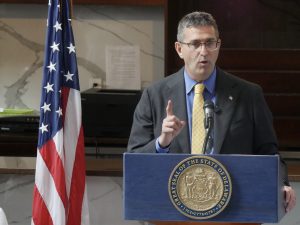
“Eliminating medical debt restores hope, stability, and dignity to people who’ve been unfairly burdened for seeking care,” said Governor Matt Meyer. “This partnership and the legislation we signed are part of a larger commitment to break down the structural barriers that keep people from getting ahead and building the secure, healthy lives they deserve. We’re building a state where your worst day doesn’t define your future.”
Undue Medical Debt will purchase bundled medical debt portfolios from providers like hospitals and commercial debt buyers to then abolish that debt at pennies on the dollar. There is no application process. Qualifying residents will receive a letter from Undue Medical Debt notifying them that their medical debt has been relieved.
“I’m incredibly grateful to Governor Meyer and the state of Delaware for the bold leadership in tackling the medical debt crisis at this critical moment,” said Undue Medical Debt CEO and president Allison Sesso. “With recent federal policy changes threatening millions of families’ access to health insurance and care in general, partnerships like this one become even more essential in providing relief to those most burdened who might otherwise avoid necessary healthcare for fear of the cost. This program will offer both financial and emotional relief to families who never chose to get sick or face medical emergencies and we look forward to leveraging state funding to erase qualifying medical debts in the near future.”
To qualify for debt relief, Delaware residents must have annual household income at or below 400% of the federal poverty level (about $100,000 for a family of three) or have medical debt that equals 5% or more of their annual household income. Medical debt relief will be announced in waves in the coming months.
“Delaware’s leaders refuse to accept a reality where working families are crippled by medical debt, as demonstrated today,” said Lt. Governor Kyle Evans Gay. “I am proud to stand with Governor Meyer, Senator Mantzavinos, and Representative Williams as our state tackles a problem burdening thousands of our neighbors. As we celebrate this win, we remain dedicated to further expanding access to affordable quality healthcare in the First State.”
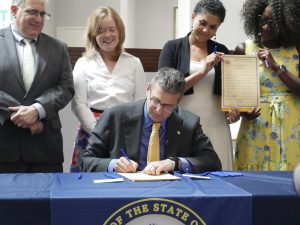
Senate Bill 156, sponsored by Sen. Spiros Mantzavinos and Rep. Kim Williams, prohibits any reporting of medical debt to consumer credit reporting agencies, ensuring that such debt cannot appear on consumer reports used in credit, housing, or employment decisions. The act reinforces that medical debt should not be used to disadvantage individuals in accessing housing, credit, or jobs, and takes effect 90 days after the governor signs.
“This legislative session, we were laser focused on lowering skyrocketing costs for Delaware families, and signing Senate Bill 156 today keeps us in alignment with that ongoing goal,” said Sen. Spiros Mantzavinos. “By ensuring medical debt can’t be used to deny someone housing, employment, credit, or other essential opportunities, we’re doing more than providing necessary relief to those in need, we’re also upholding fairness and compassion for everyone who calls Delaware home.”
“We are in challenging times and know that financial stress can be an extreme burden on people’s overall health and wellness,” said Brian Frazee, President & CEO of the Delaware Healthcare Association. “Our hospitals see the realities of this every day which is why we provide robust charity care and financial assistance opportunities to those in need. We also recognize that more work needs to be done to ensure healthcare affordability in the First State. DHA looks forward to continuing our collaboration with Governor Meyer, Lt. Governor Gay, the General Assembly, and our stakeholder partners on a vision that will build upon our #1 in hospital quality ranking and ensure healthcare access and affordability for all Delawareans.”
Senate Bill 115, sponsored by Sen. Tizzy Lockman, allows individuals in Delaware to petition the court to have certain past eviction records shielded from public view, making them inaccessible in background checks and housing applications. The goal is to reduce long-term barriers to housing and employment, especially for those who faced eviction due to temporary hardship or have maintained a clean record since.
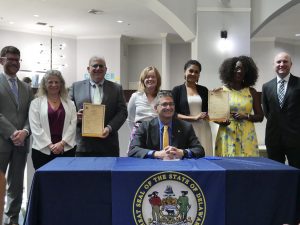
“With the signing of SB 115, we are taking a meaningful step forward in breaking the cycle of housing insecurity,” said Sen. Elizabeth “Tizzy” Lockman. “This legislation offers targeted, practical reform that addresses real barriers faced by too many Delawareans – especially single mothers and families of color. I’m grateful to Rep. Johnson for her partnership, and to Gov. Meyer for standing with those who believe housing is not a right for some, but a privilege for all.”
“Our country is built on opportunity. Yet those same opportunities are next to impossible to reach without access to stable housing. This bill’s purpose is not to grant exceptions to frequent flyers but instead, to give a genuine opportunity to those who may not have gotten the best start,” said Rep. Kendra Johnson, House Prime sponsor of SB 115. “The path to self-actualization is not a race, but a journey, and we cannot expect anyone to take that journey if we make no effort to dismantle the barriers that continue to deny them a fighting chance.”
“At the Hope Center, we see every day how a second chance can change someone’s life,” said New Castle County Executive Marcus Henry. “These efforts will help more New Castle County residents overcome past challenges and move toward stability and opportunity.”
For any questions or to schedule a one-on-one interview with Governor Meyer, please email govcomm@delaware.gov.