WILMINGTON— Today, Governor Matt Meyer signed 11 bills improving public health across Delaware. Joined by legislators at the Carvel State Office Building in Wilmington, Gov. Meyer and state leaders made it clear that these bills were necessary to improve health equity, support families, and protect healthcare workers in every community.
“Delawareans deserve an affordable healthcare system that puts patients first and isn’t stifled by red tape,” said Governor Matt Meyer. “With the Delaware Pre-Authorization Act of 2025, we’re cutting the wait and the paperwork by setting clear timelines, expanding electronic processing, and increasing transparency so people get timely, evidence-based care. This is not the only step — and it won’t be the last — but it is an important step as we keep working across the aisle to lower costs and expand access, alongside new laws that protect our healthcare workforce, modernize emergency planning, and help rein in prescription drug costs for public employees and retirees.” 
Senate Bill 12, also known as the Delaware Pre-Authorization Act of 2025, sponsored by Senate Majority Leader Bryan Townsend and Sen. Nicole Poore, House Speaker Melissa Minor-Brown, and Rep. Krista Griffith, speeds up and standardizes health-insurance prior authorizations, expands electronic processing, and sets clearer timelines and transparency so patients get timely, evidence-based care.
“Too often, patients leave their doctor’s office without knowing whether they’ll be able to access the medications or tests they need; not because of medical uncertainty, but because of insurance delays,” said Sen. Bryan Townsend, primary sponsor of SB 12. “The current system puts an unfair burden on patients and providers alike, creating unnecessary stress and delays for everyone. SB12 is a vital step toward a more responsive and patient-centered healthcare system. I’m grateful for all the stakeholders and legislators who helped make this progress possible for Delawareans, and I am committed to additional legislative progress in 2026.”
House Bill 169, sponsored by House Speaker Melissa Minor-Brown and Sen. Ray Seigfried, expands the charge of Behavioral Health Consortium & Prescription Opioid Distribution Commission, improving coordination and accountability. It also adds term limits for appointed members and adds representation from the Maternal and Child Death Review Board and Delaware’s Veteran community.
House Bill 173, sponsored House Speaker Melissa Minor-Brown and Sen. Marie Pinkney, protects surgical teams from hazardous smoke by requiring health-care employers to use smoke-evacuation systems during procedures that generate surgical smoke.
House Speaker Melissa Minor-Brown and Sen. Marie Pinkney also sponsored House Bill 148, enacts updates to the Board of Nursing, allowing the board to issue confidential letters of concern about medical providers who have not violated the Board’s statute or regulations but have acted in a questionable manner.
“As a nurse, I have seen firsthand how severe the public health needs of our state truly are – and the loss of federal funding and life-saving programs have not helped to improve this. Both the people of Delaware and the healthcare systems that they rely on are being strained beyond their limits. But here in Delaware, we don’t shy away from finding solutions to impossible situations,” said Speaker Melissa Minor-Brown. “Together, my colleagues and I were able to work collaboratively with healthcare providers and families across the state to develop multiple pieces of legislation that work to improve conditions for our healthcare workers, dedicate more healthcare resources to our most vulnerable communities, and overall put more tools in our public health toolbox that allow us to meet people where they are.”
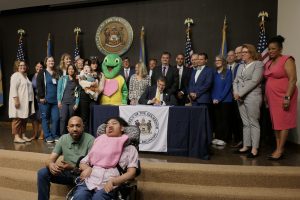 House Bill 118, sponsored by Rep. Cyndie Romer and Sen. David Sokola, keeps Exceptional Care for Children, a pediatric skilled-nursing facility, exempt from the nursing-facility quality assessment once its “Bridge Unit” is opened, helping individuals who turn 21 while in ECC’s care transition from a pediatric to an adult setting.
“ECC has truly earned its name with the high-level of specialized medical care that they’ve been able to provide Delaware families. This Bridge Unit is going to guarantee that these young individuals with challenging medical situations are kept in the care of a facility that can actually meet their needs as they transition into adulthood,” said Rep. Cyndie Romer. “Truthfully, I believe this bill should be called ‘Brianna’s Bill’, named after one of the patients in ECC’s care who turns 21 on August 28th. Without this bill, Brianna and her family would not be able to rely on the vital, high-quality care she’s been receiving during her time at ECC and would have to face the difficult challenge of finding comparable care in our already small and stretched-thin state.”
House Bills 156, 157, and 158 are sponsored by Rep. Frank Burns and Sen. Ray Seigfried.
House Bill 156 updates the Healthcare-Associated Infections Disclosure Act to align with current CDC/NHSN standards and terminology so hospitals and the state are using the same up-to-date definitions and reporting practices.
House Bill 157, repeals Hearing Aid Loan Bank Program, which is no longer operational.
And House Bill 158 modernizes public-health emergency planning, renames and updates the Public Health Emergency Planning Commission to the Public Health Emergency Planning Council, requires the statewide plan to be refreshed every two years, and — via HA 1 — requires the Council to meet within 15 days of a declared public-health emergency.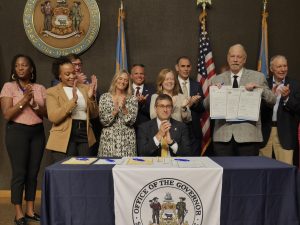
“Over the last 8 months, despite still recovering from a global pandemic and dealing with frequent climate disasters, the Trump Administration has stripped our nation of its emergency planning capabilities. This is unacceptable, but I am proud that here in Delaware, we are recognizing this as the problem that it is and are actively working to address it,” said Rep. Frank Burns. “HB 118 helps to make sure that we are ready to face any public health emergency that comes our way – giving a new life to the Public Health Emergency Planning Council and ensuring that we as a state are communicating and remain actively prepared for the worst.”
Senate Bill 109, sponsored by Sen. Marie Pinkney and Reps. Nnamdi Chukwuocha and Rae Moore, enters Delaware into the Social Work Licensure Compact, allowing qualified social workers to practice across compact states, improving workforce mobility and access to mental-health and social-work services for Delawareans.
“Part of being a social worker is having the ability to adapt to any situation you may come across. Whether it be working with a family of 6 struggling to find permanent housing or helping an individual battle substance abuse – it is our job to find solutions that are tailored to every individuals’ needs,” said Rep. Nnamdi Chukwuocha. “But the needs in our communities are high, and we need more social workers. By entering into the Social Work Licensure Compact, we are joining 24 other states in an agreement that will allow any social worker with a multistate license to practice within our state. It is my hope that this helps to attract more social workers to Delaware and allow us to work collaboratively across state lines to find the best care possible for everyone who seeks it.”
Senate Bill 131, sponsored by Sen. Marie Pinkney, Senate Majority Leader Bryan Townsend, and House Majority Leader Kerri Evelyn, lets dental hygienists administer local anesthesia with dentist supervision, expanding hygienists’ scope, helping more patients get cleanings and periodontal care quickly while keeping safety standards set by the Board of Dentistry & Dental Hygiene.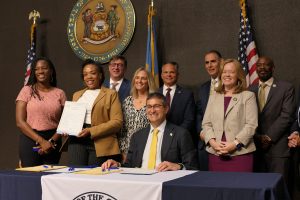
“Today, Delaware joins the 24 other states that have joined the Social Work Licensure Compact – expanding the opportunity for healthcare providers to serve Delawareans in a higher capacity,” said Sen. Marie Pinkney, primary sponsor of SB 109. “As a Licensed Clinical Social Worker, I know what a critical part of the healthcare system we are. We provide counseling, emotional support, and connect patients with resources and plans to enhance their well-being. Social workers are found in every part of the healthcare system and provide support in all areas of the lives they touch. I am proud to stand with social colleagues today, including one of my graduate school professors from Delaware State University, as Gov. Meyer signs this legislature into law.”
Senate Joint Resolution 7, sponsored by Sen. Ray Seigfried, Senate Majority Leader Bryan Townsend, and House Speaker Melissa Minor-Brown, directs the State Employee Benefits Committee to use proven strategies when contracting with Pharmacy Benefit Managers, including independent expertise and supply-chain tactics, to reduce drug costs for state employees and retirees.
“No one should have to choose between paying for medication or paying their bill,” said Sen. Ray Seigfried, primary sponsor of SJR 7. “State employees and retirees have dedicated their careers to serving Delaware, and Delaware should be supporting them in return. I am thankful to Gov. Meyer and my colleagues in the House and Senate for believing in this legislation and helping me bring lower-cost pharmaceuticals to Delawareans.”
For any questions or to schedule a one-on-one interview with Governor Meyer, please email govcomm@delaware.gov.