Delaware Forest Service Joins Regional Partners in Renewing Chesapeake Bay Shared Stewardship Agreement

DOVER — Delaware State Forester Kyle Hoyd joined forestry leaders from across the Chesapeake Bay watershed and the U.S. Forest Service last week to renew the Chesapeake Bay Shared Stewardship Agreement, reaffirming a regional commitment to conserve, restore, and actively manage forests throughout the watershed.

The renewed Memorandum of Understanding (MOU) builds upon the initial Chesapeake Bay Shared Stewardship Agreement signed in 2020. It brings together the U.S. Forest Service and state forestry agencies from Delaware, Maryland, New York, Pennsylvania, Virginia, and West Virginia, along with Washington D.C., to advance shared stewardship and coordinate forest management and restoration efforts across jurisdictional boundaries.
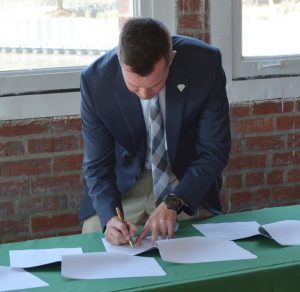
Kyle Hoyd, Delaware State Forester, signs the Chesapeake Bay Shared Stewardship Agreement at the Anacostia River Center, in Washington, D.C., on Wednesday, Sept. 16. (Forest Service Photo/Dominic Cumberland)

“The saying, ‘work for the land and it will work for you,’ fits this agreement perfectly,” Hoyd said. “From wood products we use daily to clean water, it is our job as forestry leaders to ensure working forests remain a viable option to support our forest ecosystems.”

Forests are the backbone of the Chesapeake Bay restoration effort, and active forest management is essential to keeping those forests healthy and resilient. For decades, federal, state, and local partners have coordinated restoration efforts through the Chesapeake Bay Program. The renewed Shared Stewardship Agreement strengthens that collaboration and provides a framework for forestry partners to work across boundaries to manage, conserve, and restore forests throughout the watershed.

The agreement also supports the forestry goals established in the revised 2025 Chesapeake Bay Watershed Agreement, which elevated conservation and established Healthy Forests and Trees as a key component of the region’s long-term restoration strategy.

At the heart of Delaware’s implementation of the agreement is a commitment to science-based silvicultural practices that support healthy, resilient, and productive forests. These practices will guide forest management at a regional level on both public and private lands, regardless of individual funding sources. By working from a shared foundation of sound forestry science, participating states and partners can better address forest health, regeneration, water quality, wildlife habitat and the long-term sustainability of working forests across the Chesapeake Bay watershed.

The Chesapeake Bay watershed encompasses approximately 64,000 square miles and is home to more than 18 million people. Forests extend from the Appalachian Mountains to the coastal plains and are essential to protecting water quality, providing wildlife habitat, supporting recreation and sustaining the region’s forest economy.

Most of the watershed’s forests – approximately 80 percent – are privately owned, making private forest landowners essential partners in maintaining forest health and keeping forests on the landscape. Between 2013 and 2022, approximately 176,845 acres of forest were lost to development across the watershed, underscoring the importance of conserving working forests and maintaining forestland as forestland.

The Chesapeake Bay watershed is also home to more than 83,000 farms, demonstrating the close relationship among forests, agriculture, rural economies, and water quality. State forestry agencies support this landscape through technical assistance, forest management and conservation programs while leveraging state and federal resources for coordinated cross-boundary restoration.

The forestry sector also provides significant economic value throughout the watershed, with an estimated $26 billion in direct economic output annually, in addition to approximately $15.3 billion in annual ecosystem-service benefits. Healthy working forests provide renewable forest products while delivering clean water, wildlife habitat, recreation, and other benefits to communities throughout the region.

Approximately 30 percent of Delaware lies within the Chesapeake Bay watershed, extending across portions of all three counties. Although Delaware does not directly border the bay, waterways originating in the state ultimately drain into the Chesapeake, making Delaware an important partner in broader watershed conservation efforts.

“The Delaware Forest Service is proud to be part of a regional agreement that focuses on using forestry-based practices to enhance the Chesapeake Bay,” Hoyd said. “These practices will help ensure the lands and waterways throughout the Bay region remain healthy and resilient for years to come.”

For the Delaware Forest Service, the renewed agreement strengthens opportunities to work collaboratively with neighboring states and federal partners while supporting Delaware landowners and maintaining healthy, productive forests.

Through the renewed agreement, participating forestry agencies will continue coordinating expertise, resources, and management strategies to address forest health challenges and advance conservation across the Chesapeake Bay watershed.


Delaware Forest Service Suppression Module Mobilized to Minnesota

The Delaware Forest Service mobilized a 17-member wildland firefighting Suppression Module (SMOD) on Saturday, July 25, to assist with ongoing lightning-caused wildfires in Minnesota as part of the national wildfire response system.

The crew mobilized from Blackbird State Forest at 6 a.m. for a 14-day assignment. Their first operational shift is expected to begin on Monday, July 27, with their final shift scheduled for Sunday, Aug. 9.

Wildland Fire Supervisor Sam Topper will serve as the Crew Boss, leading the Delaware Suppression Module during the assignment.

Unlike an engine crew, a Suppression Module is a highly trained team of wildland firefighters capable of completing a wide range of fireline operations. The crew’s specific assignments will be determined by incident management upon arrival and may include constructing fireline, protecting structures, improving containment lines, mop-up operations, or other critical wildfire suppression tasks based on operational needs.

The Delaware Forest Service Type 6 Engine E-613 and its three-person engine crew that mobilized one week ago, are already assigned to the same general area in Minnesota. Their current assignment is expected to conclude on Sunday, Aug. 2.

“Every time our firefighters mobilize, they represent not only the Delaware Forest Service, but the people of Delaware,” said Delaware State Forester Kyle Hoyd. “This suppression module reflects the professionalism, training, and commitment of our wildland fire program. We are proud to contribute skilled personnel to the national response effort and stand alongside our partners as they protect communities and natural resources across the country.”

Delaware firefighters are part of a nationwide network of trained wildland firefighters who respond to incidents across the country through mutual aid agreements, providing critical support during periods of heightened wildfire activity.


Delaware Forest Service Crew Mobilized to Bear Trap Fire in Minnesota

The Delaware Forest Service has mobilized Type 6 Wildland Fire Engine (E-613) and a three-person wildland firefighting crew to assist with suppression efforts on the Bear Trap Fire in northern Minnesota.

The Delaware crew includes Engine Boss Adam Keever, Engine Boss Jim Charney, and Firefighter Type II Ryan Brown. The crew will support ongoing firefighting and structure-protection operations on the Superior National Forest.

The Bear Trap Fire was first reported on the afternoon of Tuesday, July 7 near the Bear Trap River, north of Sunday Lake in the Boundary Waters Canoe Area Wilderness. The fire is burning in remote, difficult-to-access terrain approximately 20 miles north of Ely, Minn. It later merged with the nearby Dark Fire and has burned approximately 34,545 acres.

Recent operations have focused on protecting homes, private properties, and other structures near Big Lake. Crews are continuing structure-protection work around Big Lake and along the Echo Trail. Firefighters and equipment are also clearing and widening portions of the Echo Trail to improve access.

“Delaware’s wildland firefighters are highly trained and prepared to assist wherever their skills and resources are needed,” said Delaware State Forester Kyle Hoyd. “We are proud of Adam, Jim, and Ryan for answering the call to support firefighters and communities in Minnesota. We wish them a safe and successful assignment.”

Through national and regional mutual-aid agreements, Delaware Forest Service personnel and equipment may be mobilized to assist with wildfire incidents across the country. These assignments provide critical assistance to affected communities while giving Delaware firefighters valuable experience that strengthens the state’s own wildfire-response capabilities.

Updates about the Bear Trap Fire are available through the Superior National Forest and InciWeb.


Delaware Forest Service celebrates student creativity at 2026 Statewide Arbor Day Ceremony

The Delaware Forest Service (DFS) hosted its 2026 Statewide Arbor Day Ceremony today at the Lewes Public Library, bringing together students, educators, community leaders, and forestry professionals to celebrate the importance of trees and environmental stewardship across the First State.

The annual ceremony recognized the creativity and environmental awareness of more than 7,000 Delaware students who participated in this year’s Arbor Day Poster Contest. Open to students in kindergarten through fifth grade, the contest invited participants to illustrate the 2026 theme: “Trees are Terrific… for People and Places.”

Twelve student winners, four each from New Castle, Kent, and Sussex counties, were honored for their outstanding artwork and thoughtful interpretations of the theme. Shuvam Kaity from North Star Elementary in Hockessin was named the overall winner.

“The first step towards any successful conservation effort is to foster appreciation for and understanding of the natural world,” said Ashley Melvin, Delaware Forest Service Education Specialist. “Young people who have developed a personal connection with nature will make life decisions that align with sustainability and proactive care for the environment. The annual Arbor Day Poster Contest provides Delaware students with the opportunity to express how ‘Trees are Terrific’ to them. The poster contest empowers students to raise awareness for the importance of environmental stewardship through creative visual messaging.”

The ceremony also featured remarks from Dan Lambe, chief executive of the Arbor Day Foundation, who joined the celebration to recognize Delaware’s continued commitment to forestry and conservation.

“Delaware is a national leader with the amazing projects its Forest Service and Urban & Community Forestry program are undertaking,” Lambe said. “Everyone throughout the state should be proud of their efforts.”

2026 Arbor Day Poster Contest Winners

New Castle County

  • Kindergarten: Saanvi Komatineni – Cedar Lane Early Childhood Center, Middletown
  • Grades 1 & 2: Jishnu Shankar – North Star Elementary, Hockessin
  • Grades 3 & 4: Miki Thantharanont – Lancashire Elementary, Wilmington
  • Grade 5: Shuvam Kaity – North Star Elementary, Hockessin

Kent County

  • Kindergarten: Amaya Fruits – McIlvaine Early Childhood Center, Magnolia
  • Grades 1 & 2: Liam Rivera – Sunnyside Elementary, Smyrna
  • Grades 3 & 4: Sophie Benjamin – Nellie Stokes Elementary, Camden
  • Grade 5: Theresa Sherman – Campus Community School, Dover

Sussex County

  • Kindergarten: Iyla Gordon – St. John’s Preschool, Seaford
  • Grades 1 & 2: Conor Petrie – Lord Baltimore Elementary, Ocean View
  • Grades 3 & 4: Sunny Smith – Rehoboth Elementary, Rehoboth
  • Grade 5: Emma Berry – Southern Delaware School of the Arts, Selbyville

The Delaware Forest Service’s Arbor Day Poster Contest remains a cornerstone of its education and outreach efforts, helping to inspire the next generation of environmental stewards. By connecting students to the value of trees through creative expression, the program reinforces the agency’s mission to conserve, protect, and enhance Delaware’s forests.

The Arbor Day Ceremony serves not only as a celebration of student achievement, but also as a reminder that investing in environmental education today helps ensure a healthier, more resilient Delaware for generations to come.


Delaware Forest Service Celebrates Arbor Day 2026

Arbor Day is celebrated annually on the last Friday in April, serving as a reminder of the vital role trees play in improving air and water quality, supporting wildlife habitat, strengthening communities, and enhancing the quality of life for all Delawareans.

The Delaware Forest Service (DFS), within the Delaware Department of Agriculture, continues to advance its mission to conserve, protect, and enhance Delaware’s forests through strategic investments in communities and landscapes across the state. Through a combination of grant programs, technical assistance, and partnerships, DFS provides critical support to landowners, municipalities, and organizations working to expand and sustain Delaware’s tree canopy.

Annually, the Delaware Forest Service facilitates the planting of more than 100,000 trees statewide across all forest service programs, contributing to forest resiliency and community well-being. These efforts are supported by millions of dollars in investments and cost-share assistance aimed at improving forest health, increasing the urban tree canopy, and promoting sustainable land stewardship.

“Arbor Day is an opportunity to recognize the lasting impact trees have on our communities and our environment,” said Kyle Hoyd, State Forester. “Through strategic partnerships, sound forest management, and continued investment in our programs, we are ensuring that Delaware’s forests remain healthy, productive, and accessible for generations to come.”

Urban & Community Forestry: Growing Stronger Communities

A key component of Delaware’s Arbor Day impact is the work of the Urban & Community Forestry (U&CF) Program, which supports local tree initiatives across towns, cities, and neighborhoods statewide.

In 2026, the Delaware Forest Service continues to partner with multiple municipalities, with more than 25 communities recognized as Tree City USA participants throughout Delaware. Lewes, Rehoboth, Georgetown, Milford, Dover, Odessa, New Castle, and Ardentown are among those recognized. All these communities actively celebrate Arbor Day by hosting local events, tree plantings, and educational programs, demonstrating a shared commitment to urban and community forestry.

“The Urban and Community Forestry program plays an important role in strengthening communities and expanding tree canopy across the state,” said Taryn Davidson, the Delaware Forest Service’s Urban Forest Coordinator. “They provide critical financial and technical support that enables municipalities, HOAs, and non-profit organizations to implement tree planting and maintenance projects that might not otherwise be possible. Grant funding also helps build local capacity by encouraging communities to plan, prioritize, and invest in long-term urban forestry efforts, while providing environmental and community benefits such as improved stormwater management, reduced urban heat island effects, enhanced wildlife habitat, and increased property values.”

Statewide Arbor Day Celebration

Delaware’s official Arbor Day celebration will be held on Friday, May 1,  at the Lewes Public Library in Lewes, where the Delaware Forest Service will recognize student winners of the annual Arbor Day Poster Contest.

This year’s contest, themed “Trees are Terrific… for People and Places,” highlights the creativity and environmental awareness of Delaware students in grades K–5. A total of 12 student winners, representing communities across the state, will be honored during the ceremony.

Special guest Dan Lambe, CEO of the Arbor Day Foundation, will be joining Delaware Forest Service at the Statewide Arbor Day celebration.

“Arbor Day is more than a date on the calendar, it’s a call to action,” said Lambe. “As our communities and ecosystems face growing environmental challenges, this holiday reminds us how important it is to care for the planet. We can all play a part in shaping a better future, and we’re grateful for the many tree champions who are stepping up to meet the moment. The local impact of organizations like the Delaware Forest Service helps drive the collective effort to grow and protect our nation’s forests.”

The annual celebration reinforces the importance of engaging the next generation in conservation and stewardship while recognizing the vital role trees play in everyday life.