Gov. Markell, Sen. Carper join DNREC in celebrating opening of Artillery Park at the Fort Miles Museum

Ceremony highlights ‘Mighty Mo’s’ 16-inch gun, along with other historic artillery, and commemorates the 71st anniversary of the end of World War II
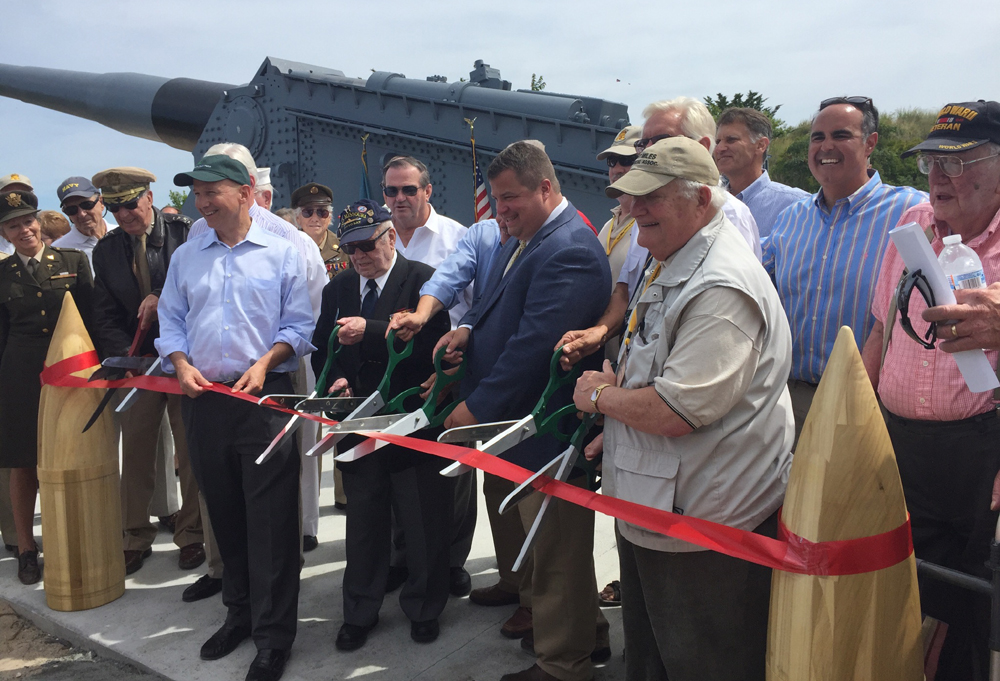
Local dignitaries and veterans join Senator Carper and Governor Markell (center of photo with hands on ribbon) for the opening of the Fort Miles Artillery Park at Cape Henlopen State Park, with a commemorative event marking the 71st anniversary of the end of WWII. /DNREC photo: Jennifer Fitzsimmons

CAPE HENLOPEN STATE PARK – Among scenic dunes overlooking the Atlantic Ocean, the Fort Miles Museum’s newest exhibit, the World War II Artillery Park, was officially opened with DNREC and the Fort Miles Historical Association hosting Governor Jack Markell, US Senator Tom Carper, local dignitaries and military veterans including honored guest Robert Sauppee, who was reunited with his personal history Friday morning in Cape Henlopen State Park. The ribbon-cutting ceremony was held beneath the centerpiece of the Artillery Park – one of “Mighty Mo’s” original 16-inch guns, a giant artillery piece mounted on the battleship U.S.S. Missouri (the “Mighty Mo”) when the Japanese surrendered 71 years ago today, on Sept. 2, 1945, ending WWII. Mr. Sauppee, who traveled to the commemorative ceremony from his home in Reading, Pa., was also aboard the “Mighty Mo” that day as a young US serviceman.

“The Fort Miles Artillery Park preserves an important part of Delaware’s wartime history and honors the courage and heroism of the men and women who defended our country during World War II,” said Gov. Jack Markell. “The historic treasures and new amenities here will attract families and visitors to the beautiful shores of Cape Henlopen State Park and boost the local economy. The Fort Miles Museum’s unique features exemplify why Delaware State Parks was recognized nationally this year with the Gold Award as the best-managed park system in the nation.”

Today’s event took place at Fort Miles, which during WWII served as the East Coast’s largest combat-ready post and a key piece in the nation’s coastal defense. In 1964, 543 acres of the Fort were returned to the State of Delaware, forming the heart of Cape Henlopen State Park. In April 2005 Fort Miles was added to the National Register of Historic Places.

“Delaware has a long history of protecting our nation, and Fort Miles is a big part of that history,” said U.S. Senator Tom Carper, a 23-year veteran of the U.S. Navy. “‘Mighty Mo’s’ gun was saved from becoming scrap metal after a like-minded group came together including folks from the Fort Miles Historical Association, DNREC and my office, to bring it to Delaware. Attractions like this allow the First State’s rich military history to live on, honoring the more than 73,000 veterans living in Delaware today.”

“The Fort Miles Artillery Park, with ‘Mighty Mo’s’ gun and other WWII artillery, is representative of the armaments that were stationed here for coastal defense,” said DNREC Secretary David Small. “We are incredibly appreciative of the Fort Miles Historical Association members, whose spirit and dedication are reminiscent of this country’s ‘Greatest Generation’ who built and manned Fort Miles and protected the region during WWII. Now, veterans, families, students, visitors and history buffs can relive an important part of Delaware history surrounded by the buildings and artifacts that will help make the experience come alive.”

Among the largest pieces of U.S. Naval artillery ever made, “Mighty Mo’s” 16-inch gun weighs more than 116 tons and is 66 feet long. The huge 16-inch barrel could hurl 2,700 pound shells more than 23 miles in 50 seconds, with pinpoint accuracy, in support of U.S. ground troops. Two similar guns were housed at Fort Miles’ Battery Smith during WWII, but later relocated elsewhere.

“The Fort Miles Historical Association is proud and honored to partner with Delaware State Parks on the completion of the World War II Artillery Park,” said FMHA President Gary Wray. “With ‘Mighty Mo’s’ gun as the centerpiece, the Artillery Park is the largest exhibit of its kind in the country. The Fort Miles Museum, when completed, will be the best World War II museum inside a World War II facility in the U.S.”

“With more than a million visitors a year, Cape Henlopen State Park is beloved by Delawareans and tourists from throughout the country,” said DNREC Parks & Recreation Director Ray Bivens. “The Fort Miles Artillery Park is a wonderful attraction that tells the story of the U.S. Army Coast Artillery Corps that played a vital role in protecting the region’s coastline during WWII. DNREC appreciates the tremendous efforts of the Fort Miles Historical Association and the thousands of volunteer hours that members have contributed to the Fort Miles Museum.”

“Mighty Mo’s” gun was scheduled to be cut up and sold for scrap if a suitable home for it could not be found. Through a joint plan written by the Fort Miles Historical Association (FMHA) and DNREC, the gun was donated to DNREC’s Division of Parks & Recreation by the U.S. Naval Systems Command. FMHA’s U.S.S. Missouri Gun Fundraising Committee raised $113,000 through private donations and several key grants from the GM Foundation, Sussex County Council and the Delaware Tourism office, to move the gun by barge and rail from the naval yard in Norfolk to the Artillery Park.

“The U.S.S. Missouri’s big gun symbolizes our local military history and is a fitting centerpiece for the Fort Miles Artillery Park,” said Nick Carter, chair of the U.S.S. Missouri Gun Fundraising Committee and a U.S. Navy veteran who served two tours in Vietnam. “Because of my family’s World War II military service here in Lewes, I was asked to chair the fundraising committee that brought ‘Mighty Mo’s’ gun to Delaware. My sincere appreciation to the organizations and individuals who donated funding and to my wife, Laurie, who coordinated the logistics of moving the gun to Fort Miles.”

The opening of the Artillery Park marks the end of a four-year effort to place “Mighty Mo’s” gun and other armaments at the foot of Battery 519. FMHA raised a total of more than $430,000 for the project, including the funding to transport “Mighty Mo’s” gun to Delaware, grants received from the Longwood Foundation, Community Foundation and Crystal Trust, and contributions from state legislators and almost 100 individuals. State funding for the Artillery Park came from 2013-2015 Bond Bill appropriations provided by the state legislature.

Lockwood Brothers, subcontractor for the Artillery Park contractor Kent Construction Co., moved “Mighty Mo’s” gun barrel to Delaware and mounted it on an emplacement that includes a 90,000-pound concrete base, 70,000-pound slide, and 38,500-pound yoke and other parts. The total weight of the permanent display is more than 300 tons. Bell Terra Landscaping and Lighting installed lighting around the display.

In addition to the artillery, the site features new restrooms and showers for visitors and for future overnight guests, a central pathway, a renovated mess hall and wayside signs that tell the story behind each gun. Another addition includes a new geothermal HVAC system, made possible by two Delaware Energy Efficiency and Conservation Block Grants – one to the city of Lewes and the other grant to Delaware State Parks.

“The opening of the Fort Miles Artillery Park provides further definition of the important role that Cape Henlopen played in the defense of the mid-Atlantic coast during World War II,” said Lewes Mayor Ted Becker. “In conjunction with the numerous other historical attractions in the area, this Artillery Park ensures that future generations are aware of how our region has been key to the defense of this country from colonial times to the present. The Fort Miles Historical Association is to be commended for their extraordinary efforts to bring this to reality.”

“The news of the Mighty Mo’s gun is a fantastic addition to the already wonderful historical attractions at Fort Miles in Cape Henlopen State Park,” said Senator Chris Coons. “The impressive size of the gun gives visitors a unique perspective to how large these ships were, and adds another component that will attract visitors to this wonderful state park. I look forward to visiting the latest installment, the World War II Artillery Park, at the Fort Miles Museum.”

“Fort Miles is a special part of our state’s history, and a reminder of the important role Delaware played in defending our nation during WWII,” said Congressman John Carney. “The Fort Miles Historical Association has done an excellent job of preserving this important piece of our past, and the new Fort Miles Artillery Park is a wonderful tribute to those who bravely served our nation. It will also allow visitors to have a unique, firsthand look at some of the artifacts from the era, like ‘Mighty Mo’s’ gun. I am grateful to all those who helped make this exciting new exhibit possible.”

FMHA continues to provide strong volunteer support to the Fort Miles Museum–by guiding tours, completing complex hands-on restoration projects, helping with special events, and providing marketing support for Fort Miles. The Association completed the first room of the Museum’s Art Gallery earlier this year, which features the works of noted local artists Howard Schroeder, Mary Marshall and Abraxas Hudson. Guided tours of the gallery are set to start in the fall. A new exhibit “Midway to Munich,” featuring the art of noted aviation artist Paul Rendel, opens Oct. 8. That event will showcase, and make available for sale, some of Rendel’s most famous works, and marks the unveiling of a new piece commemorating “Mighty Mo’s” gun placement at the Fort Miles Museum. Proceeds of the event will go to support the Fort Miles Museum.

With the artillery park now complete, FMHA will focus on completing interior exhibits, outdoor programming venues and parking for the Museum. New exhibits will showcase ordinary life in WWII-era Delaware, and the important roles that ordinary citizens played in our nation’s defense through the Civil Air Patrol, Delaware River and Bay Pilots Association and other local organizations and causes. A fall kickoff event is planned to launch a $2.1 million capital campaign.

For more information on Cape Henlopen State Park and Fort Miles Historical Area, visit DNREC’s website, www.destateparks.com.

The Fort Miles Historical Association is a nonprofit group whose mission is to preserve, protect and defend all aspects of Fort Miles working with community and state stakeholders and other interested parties. The association’s goal is to work as an active partner with the State of Delaware to develop the historical potential of Fort Miles.

Contact: Melanie Rapp, DNREC Public Affairs, Melanie.Rapp@delaware.gov, 302-739-9902
Gary Wray, Fort Miles Historical Association, gdwray@hotmail.com, 302-542-1844

Vol. 46, No. 324

-30-


Stretches of ocean beach reopened at Cape Henlopen State Park

Piping plover nesting season concludes with 13 fledglings this year

CAPE HENLOPEN STATE PARK – DNREC’s Divisions of Parks & Recreation and Fish & Wildlife announced today that stretches of ocean beach between Gordons Pond and Herring Point and beachfront along the oceanside of The Point on Cape Henlopen have now reopened following the end of a piping plover nesting season that produced 13 plover fledglings in Delaware. The last Gordons Pond Piping Plover chick recently fledged, allowing fencing erected to prevent disturbances to any beach-nesting birds in the area to be taken down. The beach is now accessible for fall surf-fishing, and in time for the Labor Day holiday weekend.

The bay side of The Point will remain closed until Oct. 1 to give refuge to the many species of migratory birds that pass through Delaware on their way to overwintering grounds to the south, said Anthony Gonzon, Division of Fish & Wildlife biodiversity program manager.

Although the beach-nesting bird breeding season has ended, surveys for the rare plant seabeach amaranth are continuing. Seabeach amaranth is a federally-threatened plant species under the Endangered Species Act. Searches of likely amaranth habitat are conducted in Delaware three times a year: in late July, mid-August and late August/early September.

This year, all of the known amaranth plants are located at The Point, with more than 30 plants observed since surveys began in July. No plants have been found between Gordons Pond and Herring Point, usually the most reliable location for finding them, but many of the plants on The Point have appeared outside of the typical fenced section of the dunes and overwashes, well above the high tide line.

Due to the annual variability of distribution of seabeach amaranth plants, an additional temporary fenced section along the ocean side of The Point has been installed parallel to the ocean and will be removed once these annual plants disperse their seed – likely to occur within three to four weeks. This temporary closure will allow the amaranth plants to complete their life cycle and help to sustain the plant population within Cape Henlopen while still allowing access to The Point by permitted vehicles for surf fishing.

With seabeach amaranth in mind, DNREC has closed dunes and overwashes to any human activity to protect sensitive and rare habitats. DNREC advises that surf-fishing vehicles should avoid parking in the restricted area in front of the temporary fencing, but may drive through on the beach along the ocean side of the fence. In addition, surf-fishermen should be aware that higher tides may be experienced during the next week. The possibility exists that surf fishing vehicles could be stranded when this occurs.

For more information, please contact Paul Faircloth, Cape Henlopen State Park superintendent, at 302-645-8983, or Anthony Gonzon, Division of Fish & Wildlife, at 302-735-3600.

About the piping plover
The piping plover was listed as threatened under the federal Endangered Species Act (ESA) in 1986, and the Division of Fish & Wildlife is responsible for its protection in Delaware. Under a binding agreement and subsequent species management plan that DNREC made in 1990 with the U.S. Fish and Wildlife Service (USFWS), the federal agency with oversight of this ESA-protected species, piping plover nesting areas at Cape Henlopen State Park are closed annually to the public to protect the shorebirds from disturbance during their nesting season which usually runs from March into September. This includes the Point and smaller areas around Gordons Pond. The closure has been successful, increasing the number of piping plover nesting pairs from a low of two pairs to a high of nine pairs, and must include feeding habitat as well as nesting areas. Piping plovers feed on small invertebrates that inhabit the intertidal zone near their nesting territories. Chicks are not fed by their parents, but rather are led to the shoreline to forage while the adults keep watch for potential threats. Allowing pedestrian traffic in the intertidal zone adjoining nesting areas would disturb the vital link between nesting and foraging habitat and risk adverse stress or mortality to the chicks.

About the seabeach amaranth
The seabeach amaranth is an annual plant the formerly ranged from Massachusetts to South Carolina. Rediscovered in Delaware in 2000 after a 125-year absence, this plant has been found on Delaware’s ocean beaches throughout Cape Henlopen State Park and Delaware Seashore State Park. Federally listed as threatened in 1993 under the Endangered Species Act, seabeach amaranth typically grows in open sand along the base of the primary foredunes or along undisturbed wrack lines high on the beach where seed may become trapped. Each year, plants may reoccur in the same locations or appear in new locations as a result of shifting sands and seed dispersal from varying weather conditions over the fall and winter seasons. As an annual plant, amaranth completes an entire life cycle in a single year’s growing season, flowering in mid to late summer, dispersing seed in late August and early September.

Media Contact: Michael Globetti, DNREC Public Affairs, 302-739-9902

Vol. 46, No. 323


Indian River Marina basin maintenance dredging project scheduled to begin Thursday, Sept. 15

REHOBOTH BEACH – Maintenance dredging at the Indian River Marina basin within Delaware Seashore State Park is scheduled to begin Thursday, Sept. 15, DNREC’s Divisions of Parks & Recreation and Watershed Stewardship announced today.

The marina operates under the auspices of Delaware State Parks. Marina staff has been contacting affected slip holders this week about the dredging, providing information about temporary dock reassignment, dates that their boats will need to be moved, and emphasizing a tight window for the dredging project to be completed. The marina is also allowing for a limited number of early winter haul out/land storage for these boats, per marina manager’s approval.

During the maintenance dredging project, dredge pipe will be marked with orange buoys every 25 to 50 feet, with the Division of Watershed Stewardship’s Shoreline & Waterway Management Section keeping a boat in the water to assist slip holders in navigating the area during dredging operations from 7 a.m. to 3 p.m. Monday through Thursday. The pipe will be completely submerged and out of harm’s way during non-dredging hours  and the marina will be navigable during those hours as well.

The Indian River Marina also announced this week that because of the dredging project, it will no longer accept transient reservations for the remainder of the 2016 boating season.

Media Contact: Michael Globetti, DNREC Public Affairs, 302-739-9902

Vol. 46, No. 322


DNREC Parks & Recreation Natural Resources Police Park Rangers arrest Wilmington woman in ‘smash-and-grab’ incident at Bellevue State Park

WILMINGTON – DNREC Parks & Recreation Natural Resources Police Park Rangers arrested a Wilmington woman Monday evening in connection with a “smash-and-grab” incident that occurred earlier in the day in Bellevue State Park.

Yolanda Bowden, 32, was arrested on an assortment of charges that included six felonies and four misdemeanors related to the incident. Charges included burglary third degree; possession of burglary tools; forgery second-degree; unlawful use of a credit card; criminal mischief; theft, and possession of drug paraphernalia. Bowden was committed to Baylor Women’s Correctional Institution in Wilmington for lack of $12,600 secured bond. She was also wanted on outstanding charges in Delaware related to shoplifting, and had outstanding warrants from Whitpain Township, Pa. on similar offenses.

Natural Resource Police Park Rangers were called to the main parking lot of Bellevue State Park in midafternoon Monday to investigate a vehicle break-in, with the victim telling Rangers that valuables, including credit cards, had been stolen. The victim’s credit card companies reported that new purchases had been made at various stores in the Philadelphia Pike area. Natural Resource Police Park Rangers viewed surveillance video at several of the stores, and linked a vehicle in several videos to a woman making the purchases reported to the victim by the credit card companies.

Later the same day, a family member of the theft victim identified the described vehicle in the parking lot of the Home Depot store off Miller Road in Wilmington. Natural Resources Police Park Rangers and the Delaware State Police waited for the driver to get back into the vehicle, at which time they identified the driver as the suspect in the smash-and-grab incident, and took Bowden into custody without incident.

Media Contacts: Michael Globetti, DNREC Public Affairs, 302-739-9902, or Chief Wayne Kline, DNREC Parks & Recreation Natural Resources Police, 302-739-9232

Vol. 46, No. 313


Evening of storytelling and dancing set for Aug. 31 at White Clay Creek State Park

NEWARK – The staff at White Clay Creek State Park invites the public to a very special extension of their free Wednesday Night Concert series. Starting at 6 p.m. Wednesday, Aug. 31, visitors will enjoy songs and interactive storytelling followed by interactive dancing at the park’s Carpenter Recreation Area, 880 New London Road, Newark DE, 19711. The programs are free; however, state park entry fees will be in effect.

Starting the evening will be Oni Lasana as Mama Earth. Lasana is an advocate for storytelling, Arts-in-Education and community theater, and is dedicated to coaching and collaborating youth and adults. She will share stories and songs of nature for families.

At 7 p.m., University of Delaware’s premier Bollywood-fusion dance team, Delaware Kamaal Dancers, will bring various styles of dance to the park. This nationally ranked group will perform and interacts with the audience by instructing them in the dance.

Delaware State Parks is able to offer these free, family-friendly programs thanks in part by a grant from the Delaware Division of the Arts, a state agency, in partnership with the National Endowment for the Arts. The Division of Parks & Recreation promotes Delaware arts events on DelawareScene.com.

More information about this and other Delaware State Parks programs is available at destateparks.com.

Media Contacts: Barbara Woodford, White Clay Creek State Park, 302-368-6560, barbara.woodford@delaware.gov; or Necia Beck, Delaware State Parks, 302-739-9175, Necia.Beck@delaware.gov

Vol. 46, No. 306