Delaware State Parks Fee Season Begins March 1

Annual passes are a convenient way to access Delaware State Parks for the entire fee season, which lasts from March 1 through Nov. 30 annually. The 2024 Delaware State Parks annual passes feature kayaking through a stand of baldcypress trees at Trap Pond State Park.


The Delaware Department of Natural Resources and Environmental Control reminds visitors to Delaware State Parks that 2024 entrance fees will be in effect starting Friday, March 1 through Nov. 30.

State park entrance fees for vehicles registered in Delaware are $4 at inland parks and $5 at ocean parks. Fees for out-of-state vehicles are $8 at inland parks and $10 at ocean parks. Entrance fees will remain in effect through Nov. 30, which is the normal fee season end date.

Daily park entrance fees may be paid via credit-card machine at most park locations, where fee attendants are on duty or via self-registration envelopes provided at park entrances that are then placed in designated secured drop boxes.

Annual passes are a convenient way to access Delaware State Parks for the entire fee season. Multiple types of annual passes are available, including resident, non-resident, active-duty military and veterans. Those who purchase annual passes online will receive a virtual pass that can be used up to 30 days from the date of purchase until the actual pass is received via mail.

Residents who receive certain types of public assistance can contact their case worker(s) for an assistance pass at a discount. Active duty military personnel who are stationed in Delaware also qualify for pass at a reduced rate, and all public libraries in Delaware offer an annual pass that can be checked out for free by library cardholders.

The Delaware State Parks corporate and group annual pass gives employers and groups a way to promote health and wellness. This pass provides employees and groups, including athletic teams, with discounted annual passes for statewide park access all season long. It also includes exclusive benefits for end-of-the-year outings and personal discounts for camping or cottage stays.

Annual and two-year surf fishing permits provide year-round drive-on access, including peak weekends and holidays. Off-peak surf fishing permits provide year-round access, excluding peak weekends and holidays from May through Labor Day weekend. Both surf fishing permit decals enable the vehicle to gain entrance into the other state parks without paying the daily entrance fee.

A reservation will be required for permitted vehicles to access any of the seven Delaware State Parks multi-use drive-on beaches during peak time periods. Reservations open weekly for the upcoming weekend, starting in May, online at the Delaware State Parks reservations page or via phone at 800-499-8221.

Revenue generated from sales of passes and permits is used to manage 17 state parks, the Brandywine Zoo and more than 26,500 acres of state park lands. Park users generate 70% of the revenue utilized to operate and maintain the parks. The revenue is used for trail maintenance, environmental and recreational programs, visitor amenities, guarded beaches, management of campgrounds, cabins and more.

The DNREC Division of Parks and Recreation, which will soon assume management of the state-owned Deauville Beach from the city of Rehoboth, is evaluating the fee structure for that area. Given the timing for the management transition, fees will not yet be charged to utilize Deauville Beach until later this spring. More information will be shared publicly as it becomes available.

To purchase an annual pass or surf fishing permit, go to www.destateparks.com/Know/PassesTagsFees.

About DNREC
The Delaware Department of Natural Resources and Environmental Control protects and manages the state’s natural resources, protects public health, provides outdoor recreational opportunities and educates Delawareans about the environment. The DNREC Division of Parks and Recreation oversees more than 26,000 acres in 17 state parks and the Brandywine Zoo. For more information, visit the website and connect with @DelawareDNREC on Facebook, Instagram, X (formerly known as Twitter) or LinkedIn.

Media Contacts: Shauna McVey, shauna.mcvey@delaware.gov; Michael Globetti, michael.globetti@delaware.gov

###

DNREC to Close The Point at Cape Henlopen for Beach-nesting Season

The Delaware Department of Natural Resources and Environmental Control will close The Point at Cape Henlopen State Park, including a stretch of ocean and bay beach, Friday, March 1. Since 1993, The Point has closed annually for most of the spring and summer for the benefit of threatened and endangered beach-nesters and migratory shorebirds, including piping plovers, American oystercatchers, least terns, red knots and other species.

The Point’s nesting habitat on the ocean side will reopen to the public Sept. 1. The bayside beach will remain closed until Oct. 1 for use by shorebirds migrating south for the winter.

The DNREC Divisions of Parks and Recreation, Fish and Wildlife, and Watershed Stewardship have worked together since 1990 to implement a management plan to help grow shorebird populations in Delaware.

About DNREC

The Delaware Department of Natural Resources and Environmental Control protects and manages the state’s natural resources, protects public health, provides outdoor recreational opportunities, and educates Delawareans about the environment. The DNREC Division of Parks and Recreation oversees more than 26,000 acres in 17 state parks and the Brandywine Zoo. For more information, visit the website and connect with @DelawareDNREC on Facebook, Instagram, X (formerly known as Twitter) or LinkedIn.

 Media Contacts: Shauna McVey, shauna.mcvey@delaware.gov; Michael Globetti, michael.globetti@delaware.gov

###


Controlled Burn at Brandywine Creek State Park Aims to Boost Native Wildlife and Plant Growth

 DNREC uses controlled, or prescribed, burns to manage meadows and create more suitable habitats for native species like, clockwise from left, the monarch butterfly, common yellowthroat bird, eastern bluebird and orange sulphur butterfly. DNREC Photos


The Delaware Department of Natural Resources and Environmental Control is working with the Delaware Department of Agriculture to execute a controlled burn at Brandywine Creek State Park in February or March. This prescribed burn will help manage nearly 30 acres of meadowland near the park’s nature center.

While much of the natural area managed by the DNREC Division of Parks and Recreation is forested, Brandywine Creek State Park is known for its vast meadowland views divided by blue gneiss stone walls. The last controlled burn at BCSP was held in 2013.

Prescribed burning is a meadow management technique, which mimics natural fire and is used periodically in place of annual mowing, to halt progression of meadowland so it does not become a forest. Additionally, this controlled burn should encourage the growth of native wildflowers and warm season grasses. This plant growth creates more suitable habitats for nesting grassland birds like the eastern bluebird and common yellowthroat, native pollinator insects like the orange sulphur and monarch butterflies, and other grassland-dependent animals.

The DNREC Division of Parks and Recreation is coordinating with DNREC’s Division of Air Quality and the DDA Forest Service to perform the burn on a single day, to be determined by weather, personnel availability and open burning approval. BCSP will be closed on the date of the burn and the exact date will be announced on the park’s Facebook and Instagram accounts, once it is known.

About DNREC

The Delaware Department of Natural Resources and Environmental Control protects and manages the state’s natural resources, protects public health, provides outdoor recreational opportunities, and educates Delawareans about the environment. The DNREC Division of Parks and Recreation oversees more than 26,000 acres in 17 state parks and the Brandywine Zoo. For more information, visit the website and connect with @DelawareDNREC on Facebook, Instagram, X (formerly known as Twitter) or LinkedIn.

Media Contacts: Shauna McVey, shauna.mcvey@delaware.gov; Michael Globetti, michael.globetti@delaware.gov

###


DNREC to Close Mulberry Landing Boat Ramp in Sussex County Temporarily for Expansion and Paving of Parking Lot

Mulberry Landing Boat Ramp parking lot will be paved and expanded this month into early March. /DNREC photo.


The Delaware Department of Natural Resources and Environmental Control announced today the March 6 closure of the Mulberry Landing Boat Ramp within the Assawoman Wildlife Area near Bethany Beach for a construction project to enlarge and pave the boat ramp’s gravel parking lot. Construction is scheduled to begin the day of the ramp closure, with the project’s completion anticipated by April 14, dependent on weather.

With the project reflecting the ramp’s increasing popularity with boaters, the upgraded parking lot at the end of Mulberry Landing Road will feature 23 trailer parking spaces and seven car parking spaces.

During construction, the wildlife area will be open for normal use, including pedestrian access to the Observation Tower with vehicle parking available at Memorial Pond within the wildlife area. Signs will be posted to direct visitors away from the construction area.

During the Mulberry Landing Boat Ramp closure, alternative boat launches in the area include Indian River Marina at Delaware Seashore State Park near Rehoboth Beach, Rosedale Boat Ramp near Millsboro, and Holts Landing State Park. All are public use and provide access to Indian River. A ramp certificate is required to launch for any boater whose boat is registered outside of Delaware. Additionally, boaters who launch at Holts Landing should be aware that daily state parks’ entrance fees will resume March 1, and an annual state park pass, a valid surf fishing permit, or payment of the daily entrance fee is required.

For more information about the Mulberry Landing Ramp construction project, contact the DNREC Division of Fish and Wildlife Fisheries Section at 302-739-9914.

About DNREC
The Delaware Department of Natural Resources and Environmental Control protects and manages the state’s natural resources, protects public health, provides outdoor recreational opportunities and educates Delawareans about the environment. The DNREC Division of Fish and Wildlife conserves and manages Delaware’s fish and wildlife and their habitats, and provides fishing, hunting, wildlife viewing and boating access on nearly 68,000 acres of public land owned or managed by the Division of Fish and Wildlife. For more information, visit the website and connect with @DelawareDNREC on Facebook, Instagram, X (formerly known as Twitter) or LinkedIn.

Media Contact: Michael Globetti, michael.globetti@delaware.gov; Joanna Wilson, joanna.wilson@delaware.gov

###


DNREC to Offer Feb. 28 Webinar on Living Shoreline Cost Share Program for Home and Property Owners

Living shorelines use natural materials like native plants, oyster shells, and biodegradable coconut-fiber coir logs to help protect property and as a barrier against shoreline erosion and flood impacts /DNREC photo


The Delaware Department of Natural Resources and Environmental Control will host a free webinar Wednesday, Feb. 28 to introduce property owners to DNREC’s Living Shoreline Cost Share Program, which provides funding that can help Delawareans in selected watersheds install living shorelines using natural materials. The hour-long webinar begins at 10 a.m. and registration can be made up to the start of the webinar presented by the DNREC Division of Watershed Stewardship in conjunction with the Delaware Living Shorelines Committee.

The webinar speaker is Kayla Clauson, an environmental scientist with DNREC’s Division of Watershed Stewardship, who will provide an overview of the cost share program and discuss how the program aims to assist property owners in select watersheds throughout the state by providing funding to install living shorelines using natural materials. The webinar will highlight the specific project criteria, a timeline of how the program works, financial reimbursement, and as well as provide insight to both landowners and professionals looking to apply for the program.

The Living Shoreline Cost Share program was relaunched in 2023 and expanded to help enable landowners, homeowners’ associations and community boards who qualify join the growing number of Delawareans who are turning to living shorelines to help protect their property in watersheds throughout the state from environmental impacts of climate change and sea level rise.

Living shorelines utilize natural materials like native plants, oyster shells, and biodegradable coconut-fiber coir logs as a barrier against shoreline erosion and flood impacts. Living shorelines also enhance the natural beauty of shoreline ecosystems. The webinar will offer insights into the Living Shoreline Cost Share Program for both landowners and professionals looking to apply for program assistance, summarizing details on project criteria, timelines for installation, and financial reimbursement.

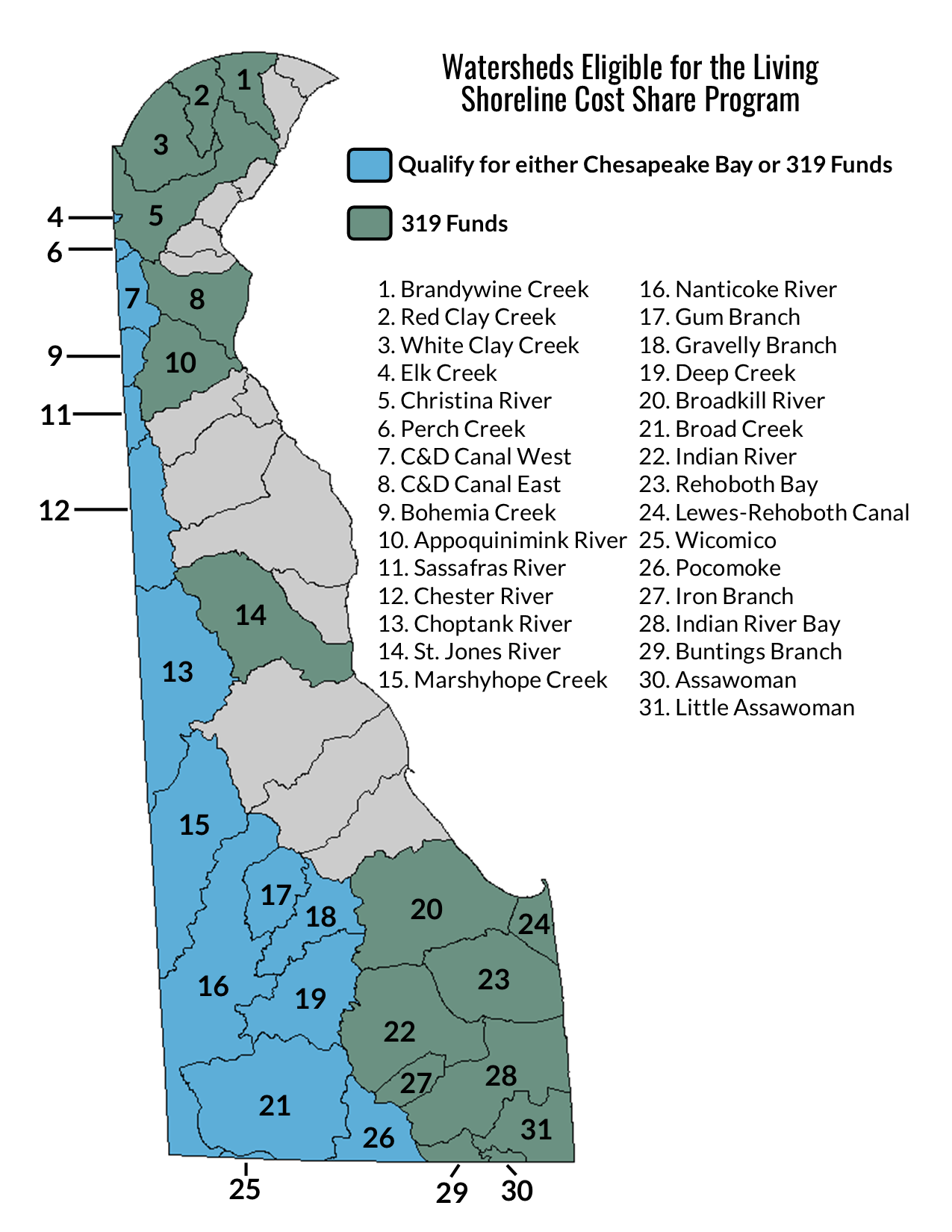
Eligible living shoreline project areas are located within targeted watersheds. Currently, only tidal projects in these watersheds will be considered for cost share assistance. Groups of landowners, HOAs, or community boards are also encouraged to apply for assistance with projects where properties may be adjacent to each other or in shared neighborhood spaces. Learn more at de.gov/livingshoreline.

The webinar also will explain that funding for the Living Shoreline Cost Share Program comes from a collaborative DNREC effort between the Watershed Assessment and Management Section and the Non-Point Source Program for securing funding, specifically the CWA Section 319 Nonpoint Source Pollution Grant and the Chesapeake Bay Implementation Grant III. Information about both also can be found at de.gov/cheswip.

About DNREC
The Delaware Department of Natural Resources and Environmental Control protects and manages the state’s natural resources, protects public health, provides outdoor recreational opportunities and educates Delawareans about the environment. The DNREC Division of Watershed Stewardship develops and implements innovative watershed assessment, monitoring and implementation activities. For more information, visit the website and connect with @DelawareDNREC on Facebook, Instagram, X (formerly known as Twitter) or LinkedIn.

Media Contacts: Joanna Wilson, joanna.wilson@delaware.gov; Michael Globetti, michael.globetti@delaware.gov

###