Open Enrollment on Delaware’s Health Insurance Marketplace Underway

NEW CASTLE – Delaware’s Health Insurance Marketplace’s has entered its 13th year of open enrollment.

Coverage for enrollees who sign up by Dec. 15 and pay their first month’s premium will be effective Jan. 1.

Delawareans can renew existing coverage or sign up for a new plan at HealthCare.gov. The open enrollment period runs through Jan. 15, 2026.

Individuals who don’t act by Jan. 15, 2026, cannot get coverage for 2026 unless they qualify for a Special Enrollment Period based on circumstances such as a loss of qualifying health coverage, change of income, becoming a parent, or other qualifying factors.

“Our priority has always been to expand access to affordable, high-quality health coverage through the Delaware Health Insurance Marketplace” said Insurance Commissioner Trinidad Navarro. “We are proud that residents can continue to access a competitive market, despite federal policy changes that have increased premiums.”

For the 2026 plan year, consumers will choose from 40 plans offered by three carriers.

Plans on the marketplace are spread among metal-level categories – bronze, silver, gold, platinum and catastrophic – and are based on how enrollees choose to split the costs of care with their insurance company. Bronze plans have low monthly premiums but high costs when you need care; gold plans have high premiums but lower costs when you need care. In a silver plan, the insurer pays about 70% of medical costs and the consumer pays about 30%. Consumers who pick silver health care plans might also qualify for additional savings through discounts on deductibles, copayments, and coinsurance.

All plans on the marketplace offer essential health benefits such as coverage of pre-existing conditions, outpatient care, emergency services, hospitalization, prescription drugs, mental health and substance use disorder services, lab services, pediatric services, birth control, and breastfeeding coverage. In addition, coverage cannot be terminated due to a change in health status.

Consumers can go to HealthCare.gov or CuidadodeSalud.gov now to explore their options for 2025 coverage, and they can enroll anytime up until Jan. 15, 2026.

Commissioner Navarro also urged residents to work with the state’s official navigators, or a verified insurance broker to find the best coverage for their needs and budget. “Buying health insurance can already feel overwhelming, especially with the wide range of plans and companies out there. Unfortunately, some companies or agents may use confusing language or deceptive tactics to sell you coverage that’s overpriced, inadequate, or misleading. Our Smart Buyer’s Guide to Individual Health Insurance can help.”

The Department of Insurance has noted a rapid rise in predatory and deceptive activity around Open Enrollment, including scammers signing up residents for coverage without their knowledge in order to obtain commissions, and the use of lead generators to bombard residents researching coverage with efforts to sell non-comprehensive coverage. The guide will assist consumers in verifying if coverage is comprehensive, if contact is from a legitimate, trusted agent, and provides questions to consider during the process.

Delawareans who need help enrolling in coverage will have access to free in-person assistance from federally funded and trained specialists at Westside Family Healthcare locations statewide.

“Every Delawarean deserves access to high quality, affordable health coverage, and no matter what happens in Washington, we will keep working to make that a reality,” Delaware Health and Social Services Secretary Christen Linke Young said. “We encourage individuals and families to visit HealthCare.Gov to review plans and connect with trained navigators if they need help.”

State-licensed insurance agents and brokers are also available to help individuals re-enroll and to help employers update their coverage, at no extra charge.

Delawareans can enroll in marketplace coverage at HealthCare.gov or by calling 1-800-318-2596 (TTY: 1-855-889-4325).

From Ancestry to Artistry: Mezzanine Gallery presents Renita Coursey’s “The Garden”

Coursey’s exhibition brings together beadwork, ribbon skirts, and regalia rooted in Nanticoke culture and contemporary design.


Wilmington, Del. (December 3, 2025)The Delaware Division of the Arts’ Mezzanine Gallery is pleased to present The Garden, a solo exhibition of new work by 2025 Individual Artist Fellow in Folk Arts, Renita Coursey. The exhibition will be on view from December 5–26, 2025, with an opening reception on Friday, December 5, from 5:00–7:00 p.m. in the Mezzanine Gallery, located in the Carvel State Office Building at 820 N. French Street in Wilmington.

The Garden offers an intimate view into Coursey’s evolving artistic practice, weaving together Nanticoke tradition, contemporary design, and a deep sense of cultural stewardship. Through beadwork, ribbon skirts, and mixed-media work, Coursey cultivates a creative space grounded in identity, ancestry, and intergenerational connection. The exhibition reflects her journey to reconnect with her roots and to honor the teachings, practices, and people who guide her work.

A native Delawarean, Coursey grew up on Nanticoke land in Millsboro, surrounded by the cultural life of her tribal community. Although she felt shy as a child during the dances held across from her home near the Nanticoke Indian Tribal Center, those early experiences shaped her understanding of tradition, belonging, and creative lineage. After moving to Virginia at age eleven and later serving four years in the U.S. Navy as a Hospital Corpsman, Coursey remained in Hawaii to complete her Bachelor of Science at the University of Hawaii at Manoa before ultimately returning home to Delaware.

Upon returning, she felt a renewed pull toward ancestral connection and began teaching herself beadwork—often late at night or before dawn while caring for her infant son. That practice grew into a disciplined, intentional art form. She later learned ribbon skirt making from tribal elders in her hometown, deepening her connection to her grandmother, a seamstress she never met but feels close to through her work today. Coursey now blends Native traditional styles with modern streetwear, creating beadwork and garments that honor heritage while pushing creative boundaries.

Her commitment to culture and craft is balanced with her work in emergency veterinary medicine, where she has spent eight years caring for critically ill patients. She is also a mother of two, a throughline she credits as one of her strongest artistic inspirations. Coursey grounds her creative practice in patience, prayer, and purpose, often praying for the wellbeing of the future wearer of each beadwork piece. She cites inspiration from Native artists such as Samantha Whitefeather, Gina Tiger, Skye Paul, and designers behind contemporary Native-owned brands like B Yellowtail and Urban Native Era.

As she continues to grow her artistic voice, Coursey is exploring powwow dancing, regalia making, moccasin construction, and mixed media. Her Fellowship supports this expansion, allowing her to create new regalia, acquire supplies, and continue refining her work for powwows and beyond.

The Garden invites visitors into the emotional, cultural, and spiritual terrain of Coursey’s world – a space where tradition and innovation flourish side by side, rooted in gratitude for the generations before her and hope for those yet to come.

Coursey shares about the exhibit:

A collection of my own beadwork, some traditional regalia & some modern pieces, made using a two needle flat stitch technique. Much like gardening, beadwork asks me for patience. It has shown me the value that small efforts have over time.

The progress is quiet.

A true labor of love.

The Garden…

It’s a place where good stuff grows. Where I’ve learned that mistakes are a doorway. A place that hold emptiness, unwavering, knowing that it will be made full of life again and again. It is where I’ve cried for,

Laughed with,

Craved,

& thanked those who have had an undeniable influence on my life. Both here & passed on.

Each piece is in some way inspired by or dedicated to a soul I dearly love.

The Mezzanine Gallery is open Monday through Friday, 8:00 a.m. to 4:30 p.m. Admission is free.


About the Artist

Renita Coursey, born in Millsboro, Delaware, is a Nanticoke artist, mother, military veteran, and emergency veterinary medicine professional. A 2025 Individual Artist Fellow in Folk Arts, she blends Native American traditional beadwork with modern streetwear, creating ribbon skirts, regalia, and intricately beaded pieces that reflect both her cultural heritage and contemporary influences. After earning her Bachelor of Science from the University of Hawaii at Manoa, Coursey spent eight years working in emergency veterinary medicine while raising her two children. She later returned to Delaware to reconnect with her native roots and deepen her artistic practice, learning beadwork and ribbon skirt making from tribal elders and cultivating a personal style grounded in intention, cultural continuity, and gratitude. Her work has been recognized by institutions including the Winterthur Estate and the Delaware Division of the Arts.

About the Mezzanine Gallery

The Mezzanine Gallery, located on the second floor of the Carvel State Office Building (820 N. French Street, Wilmington, DE), is open to the public Monday through Friday, from 8:00 a.m. to 4:30 p.m. The gallery highlights the work of Delaware’s Individual Artist Fellows, showcasing a diverse range of artistic talent throughout the year. For more information, visit https://arts.delaware.gov/mezzanine-gallery.

Images in the banner:Sunnie Nokomis Harmon” (2025), 100% wool felt, Charlotte true, Miyuki beads, red split hide, red deer hide, 2.5”x2.5”.

###


Contact: Andrew Truscott, Program Officer, Marketing and Communications

302-577-8280, andrew.truscott@delaware.gov

About the Delaware Division of the Arts
The Delaware Division of the Arts is an agency of the State of Delaware. Together with its advisory body, the Delaware State Arts Council, the Division administers grants and programs that support arts programming, educate the public, increase awareness of the arts, and integrate the arts into all facets of Delaware life. Funding for Division programs is provided by annual appropriations from the Delaware General Assembly and grants from the National Endowment for the Arts, a federal agency. For more information about the Delaware Division of the Arts, visit arts.delaware.gov or call 302-577-8278.


2026 Delaware State Parks Passes and Permits Go on Sale Dec. 9

Annual passes provide access to the state’s 17 state parks, including Trap Pond State Park in Laurel and others inland or at the beach. Photo by Delaware State Parks

Delaware State Parks will begin the sale of its 2026 park passes and surf fishing permits on Dec. 9.

Passes and permits can be purchased online at the destateparks.com/buy-a-pass webpage or at park offices. Daily entrance fees in state parks will begin on March 1, 2026 with the start of the annual fee season. The rates include:

Daily entrance fees:
Inland parks: $5 for vehicles registered in Delaware: $10 for out-of-state vehicles
Beach parks: $10 for vehicles registered in Delaware: $20 for out-of-state vehicles

Annual passes:
• $50 for vehicles registered in Delaware; $100 for out-of-state vehicles; 50% discount for seniors and military members

Lifetime Pass:
⦁ $150 for Delaware residents only, ages 65 and older

Surf Fishing Permits:
⦁ No changes to the surf fishing permit program or fees in 2026, but the off-peak surf fishing permit will be discontinued in 2027 now that weekend and holiday reservations were removed from most surf fishing beaches in July 2025.

New fees were adopted for 2026 for the first time in 10 years after extensive public outreach, including three public open houses, communication across multiple channels, endorsement by Park Friends groups and the approval of the state Parks and Recreation Advisory Council. In a survey of more than 1,200 people, 68 percent of respondents said they strongly agree or agree that a fee increase was justified to continue current services.

“Delaware State Parks are now hosting 7.4 million visitors annually, nearly 2 million more people than in 2015, and we are grateful our residents and visitors appreciate the quality of the parks and the programs they provide,” said DNREC Secretary Greg Patterson. “And they appreciate the value; for Delaware residents, a family can spend a day in a state park for less than a single movie ticket, and a pass to get them in any park unlimited times for a whole year is less than a family dinner out.”

Under restrictions on federal funding used to operate parks in Delaware and around the country, charges for out-of-state residents are not allowed to be more than double that for in-state residents.

The DNREC Division of Parks and Recreation will continue to offer free or low-cost options to make Delaware State Parks accessible for all. In partnership with the Delaware Department of Health and Social Services, those who receive assistance from a State Service Center are eligible to purchase an annual pass for $10. A park pass also can be reserved online at no cost using a library card.

For more information on fees, visit the destateparks.com/passes-permits-and-fees webpage.

About DNREC
The Delaware Department of Natural Resources and Environmental Control protects and manages the state’s natural resources, protects public health, provides outdoor recreational opportunities and educates Delawareans about the environment. The DNREC Division of Parks and Recreation oversees more than 26,000 acres in 17 state parks and the Brandywine Zoo and the Indian River Marina.  For more information, visit the website and connect with @DelawareDNREC on YouTube, Facebook, Instagram, X (formerly known as Twitter) or LinkedIn.

Media contact: Beth Kuhles-Heiney, elizabeth.kuhlesheiney@delaware.gov; Michael Globetti, michael.globetti@delaware.gov

###


Take C.H.A.R.G.E. of Lithium-ion Battery Safety

As holiday wish lists fill with the latest tech gadgets, the Delaware State Fire Marshal’s Office joins the Fire Safety Research Institute (FSRI), reminding shoppers of the unique fire risks lithium-ion batteries pose and how to prevent fires through proper storage, charging, and recycling.

Lithium-ion batteries are commonly found in household items like personal shavers, remote control toys, drones, laptops, handheld power tools, e-scooters and lawn equipment. While lithium-ion battery-powered devices have many benefits, such as longer charge time and higher efficiency, they also pose unique fire risks. They store energy more densely than traditional batteries and can become unstable if damaged (punctured, swollen), improperly used (overcharged) or exposed to extreme temperatures. This instability can lead to overheating, sparking, and even explosions.

Fire departments worldwide are experiencing an increase in fire incidents, injuries and deaths involving lithium-ion battery-powered devices. According to data from UL Solutions, since 2022 there have been 188 explosions and more than 3,000 fires caused by consumer products powered by lithium-ion batteries.

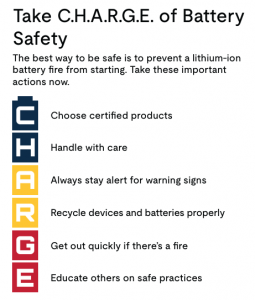
For people giving or receiving tech gifts this holiday season, FSRI’s Take C.H.A.R.G.E. of Battery Safety tips outline how to properly select, care for and dispose of lithium-ion battery-powered devices:

1. Choose Certified Products: Prioritize your safety by selecting lithium-ion
battery-powered devices certified by a nationally recognized testing laboratory to ensure they meet important safety requirements.

2. Handle Lithium-Ion Battery-Powered Devices with Care: Always follow manufacturer guidelines and use the provided charger for lithium-ion battery-powered devices. Avoid modifying batteries or chargers and charge your devices in safe environments away from extreme temperatures, direct sunlight and flammable materials. For larger devices, such as e-bikes, charge in a location that does not block your exit path, separate from sleeping areas and ideally outside your home. Refrain from overnight charging of large devices.

3. Always Stay Alert for Warning Signs: Regularly inspect devices for any signs of damage, such as swelling or punctures. Be aware of unusual sounds like hissing or popping. Watch out for excessive heat or a strange odor. White or gray wispy smoke indicates there is immediate danger of fire. If you notice any of these warning signs, immediately stop using the lithium-ion battery-powered device.

4. Recycle Devices and Batteries Properly: Responsibly dispose of old or damaged batteries and devices by taking them to a designated battery recycling center. Never discard batteries, chargers or battery-powered devices in regular trash bins.

5. Get Out Quickly if There’s a Fire: Know the warning signs to look and listen for and get out if you see or hear them. Follow your home fire escape plan to leave immediately, closing doors behind you as you exit, and call 9-1-1.

6. Educate Others on Safe Practices: Help protect your friends and loved ones by sharing how they can Take C.H.A.R.G.E. of Battery Safety.

To fully Take C.H.A.R.G.E. of Battery Safety, it is crucial to see these guidelines not as individual tips, but as interconnected steps. Each measure supports and reinforces the others. Embracing and adhering to all these guidelines can significantly reduce risk and create a safer home or work environment. For more information, visit batteryfiresafety.org.


CHARGE


DPH Announces Availability of All Routine Vaccinations at DPH Clinics

As flu and respiratory illness season starts, the Division of Public Health (DPH) is announcing that flu, RSV, pneumonia, COVID-19 vaccines, as well as all other routine vaccinations, are available at DPH Clinics for Delawareans six months and older. Routine vaccines on the Centers of Disease Control and Prevention’s (CDC) immunization schedules can be found at https://www.cdc.gov/vaccines/hcp/imz-schedules/index.html. Residents with insurance may be charged a co-pay at the time of services, depending on their coverage.

A list of DPH clinics located within some state service centers— located in all three counties — can be found at https://publichealthalerts.delaware.gov/public-health-clinics/.

“Ensuring that Delawareans have easy access to vaccinations is a critical part of keeping our communities healthy,” said DPH Director Steven Blessing. “By offering vaccinations statewide, we are making it easier for families to stay up to date on their immunizations and protect themselves from serious illnesses.”

Vaccinations at DPH Clinics are available by appointment, and walk-in availability may vary by site. Delawareans are encouraged to contact their preferred location to confirm hours and services. Many vaccinations are also available at doctors’ offices and pharmacies.

DPH encourages uninsured and underinsured residents to take advantage of vaccination options available at DPH Clinics, which serve as community health hubs and provide a range of preventive and wellness services. Many vaccine-preventable diseases — including measles and pertussis — remain active threats, particularly to children, older adults, pregnant individuals, and people with chronic health conditions. Staying current with vaccinations remains one of the most effective ways to protect both individuals and entire communities.