Governor Meyer Signs Legislation to Bring Down Energy Prices, Protect Environmental Resources and Wildlife

WILMINGTON– Today, Governor Matt Meyer signed a sweeping package of energy legislation into law to ensure that energy is accessible, affordable, and reliable to meet the needs of all Delawareans. He will also sign bills that safeguard our state’s air and water quality. Championed by legislators, advocates, and environmental leaders, these new provisions aim to lower utility costs, add more energy to the grid, deliver power to Delaware households more reliably, hold polluters accountable, and protect Delaware’s rich biodiversity.

“Delawareans should be able to keep the lights on and breathe clean air no matter what zip code they live in,” said Governor Matt Meyer. “These laws take on rising energy costs, crack down on polluters, and protect the natural beauty that makes our state special. This is common-sense, people-first governance.”

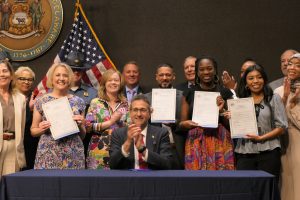
Governor Meyer sits at a table smiling as legislators and advocates stand behind him holding bills just signed.

The eleven bills focus on energy reform and environmental protection. Key provisions range from expanding energy storage and regulating utility rates to strengthening enforcement against environmental violations and honoring Delaware’s unique wildlife.

Senate Bill 59 reforms utility rate-setting to prioritize prudent spending over unchecked cost recovery. Senate Bill 60 prohibits use of customer funds for non-utility activities and limits excessive capital spending. Senate Bill 61 requires transparency in Delaware’s participation in regional energy grid governance. All three of these bills were sponsored by Sen. Stephanie Hansen.

“Sparked by increasingly higher prices for energy, these pieces of legislation represent the spirit of democracy at work,” said Sen. Stephanie Hansen. “In tandem, these bills are a coordinated and comprehensive approach to addressing the skyrocketing cost of energy while making sure that our most vulnerable neighbors aren’t left behind. I want to thank the constituents who raised their voices, the partners and advocates who helped shape this effort, and our Governor for signing the bills into law today.”

Sen. Hansen also sponsored Senate Bill 175, which ensures net-metering customers benefit from excess energy credits, and Senate Joint Resolution 3, directing a cost-benefit analysis and pilot program for energy storage systems in Delaware.

House Joint Resolution 3 calls for a comprehensive analysis of grid-enhancing technologies across all Delaware utilities, sponsored by Rep. Frank Burns.

“Delaware is seeing real challenges with energy reliability and rising costs, and recent spikes in energy bills are hitting consumers hard,” said Rep. Frank Burns. “By studying Grid-Enhancing Technologies and exploring ways to boost grid capacity, we can strengthen our energy supply to better meet demand and ultimately lower costs for Delawareans.”

House Substitute 1 for House Bill 50 establishes the Delaware Energy Fund to provide utility assistance to low- and moderate-income households. And House Substitute 2 for House Bill 116 allows for discounted utility rates for low-income residents. Both of those bills were sponsored by Rep. Debra Heffernan.

“This past winter made it clear just how vulnerable so many households are to rising energy costs. And with PJM, our regional grid operator, warning that rates could jump as much as 30% this summer, the pressure on families is only growing,” said Rep. Debra Heffernan, Chair of the House Natural Resources and Energy Committee. “The bills signed into law today will help make energy more affordable in the long-term and provide the stability and relief our most vulnerable neighbors need in the near future.”

Earlier this year, Governor Meyer also signed House Bill 62, sponsored by Rep. Melanie Ross Levin, which limits utility cutoffs at critical times and during extreme heat or cold weather.

Rep. Larry Lambert sponsored House Bill 210, which raises fines on commercial polluters and allocates more penalty revenue to impacted communities.

Governor Meyer sits at a table signing legislation as legislators and advocates stand behind him.

“Pollution does not impact everyone equally. And as we’ve seen over and over again, it’s often our underserved neighbors and communities of color who face the highest levels of exposure, while having the fewest resources to fight back,” said Rep. Larry Lambert. “HB 210 is the result of years of hard work and conversations with residents. Now, thanks to Governor Meyer’s signature, we will be better able to hold polluters accountable and get money and resources back into the communities that are most impacted.”

These reforms come at a time of rising energy costs and heightened climate urgency, particularly following a winter in which many Delawareans struggled with unusually high heating bills. Governor Meyer emphasized that these bills were developed collaboratively with members of the General Assembly, the Public Service Commission, Delaware Public Advocate, DNREC, Energize Delaware, environmental groups, and community advocates.

House Bill 189, sponsored by Rep. Sophie Phillips, and Senate Bill 148, sponsored by Sen. Stephanie Hansen, call attention to two important animals in Delaware’s ecosystem. The House bill designates the Red Knot as Delaware’s official migratory bird, and the Senate Bill designates the Blue Dasher as the official state dragonfly.

“Red knots are a critical part of Delaware’s ecosystem and are a great example of why we must tread carefully in nature,” said Rep. Sophie Phillips. “By making this incredible species our state migratory bird, we are helping to bring awareness to the importance of protecting our ecosystem and all of the creatures within it.”

For additional questions or to set up an interview with Governor Matt Meyer please email govcomm@delaware.gov.

Governor Matt Meyer Signs Legislation Protecting Vulnerable Communities

WILMINGTON– Today, Governor Matt Meyer signed four bills related to immigration and protecting vulnerable communities: HB 142, HB 152, HB 153, and HB 182. Governor Meyer was joined by Lt. Governor Kyle Evans Gay, Attorney General Kathy Jennings, Speaker Melissa Minor-Brown, Senate President Pro Tempore David Sokola, primary bills sponsors Rep. Mara Gorman, Sen. Marie Pinkney, and Rep. Josue Ortega, as well as Rony Baltazar-Lopez, Vice Chair of the Delaware Hispanic Commission, and many state and local activists and community members.

“Every Delawarean has the fundamental right to live in a secure, respectful, and inclusive community,” said Governor Matt Meyer. “That’s why we’re taking meaningful steps to address outdated laws and private‑enforcement loopholes. These reforms are about recommitting to being a state of neighbors and working toward better, safer communities for Delaware residents.”

Governor Meyer speaks at a podium with law enforcement standing behind him.

“Delaware is privileged to have some of the best law enforcement in the country—as AG, I know that for a fact,” said Attorney General Kathy Jennings. “These bills solidify the sacred bond of protection that law enforcement has with the people it is sworn to serve—ensuring that everyone, no matter where they are born, feels safe calling police, and ensuring that the men and women who dedicate their lives to protecting Delawareans’ safety can do just that.”

“The bills signed today take a critical step forward by recognizing that public safety is best served when arrests are made by trained professionals accountable to the law, not by untrained civilians acting on instinct, emotion, or prejudice,” said Rep. Mara Gorman. “These are measures that will protect our neighbors, community members, and law enforcement officers, and I appreciate my colleagues and Governor Meyer for swiftly passing and signing them.”

“The bills signed by Governor Meyer today mark a significant step forward in making our communities safer,” said Sen. Marie Pinkney. “Just as importantly, they also reaffirm Delaware’s commitment to a justice system rooted in fairness, transparency, and trust.”

House Bill 142, sponsored by Rep. Mara Gorman and Sen. Marie Pinkney, removes the authority for private individuals to execute warrantless arrests in Delaware when the accused is charged with a felony in another state. It also eliminates an obsolete provision allowing officers to command assistance from private persons for out‑of‑state arrests

Governor Meyer sits at a table clapping as legislators stand behind him holding their bills that were just signed.

.

House Bill 152, sponsored by Speaker Melissa Minor-Brown, Rep. Mara Gorman, Sen. Eizabeth “Tizzy” Lockman, Sen. Russ Huxtable, Sen. Gerald Hocker, Sen. Brian Pettyjohn, and Sen. Marie Pinkney, expands the state’s impersonation statute to criminalize impersonating a federal officer. Current law prohibits impersonation of state and local law enforcement, firefighters, and EMTs. The bill clarifies the definition of “law‑enforcement official” to ensure federal agents are covered.

House Bill 153, sponsored by Rep. Mara Gorman and Sen. Marie Pinkney, abolishes the “Citizen’s Arrest,” prohibiting individuals without explicit statutory authority—such as private detectives—from making arrests or detaining others. This effectively bans outdated “citizen’s arrest” provisions and reinforces the exclusive authority of sworn law enforcement.

House Bill 182, sponsored by Reps. Mara Gorman and Josue Ortega, as well as Sens. Marie Pinkney and Tizzy Lockman, bans Delaware law enforcement agencies from entering into 287g or other data-sharing agreements with federal immigration authorities. State and local law enforcement are not trained to enforce federal immigration laws, and entering into such agreements takes resources away from essential public safety duties. Collaborations on other public safety matters remain permitted.

“Over the past several months, I’ve heard from many people in our community who are genuinely afraid for their families, for their safety, and for what comes next,” said Rep. Josue Ortega. “I’m hopeful that the bills signed today bring some peace of mind and show all Delawareans that we’re ready to take action to protect the people we serve.”

“In our current political climate, there are Delawareans in every community who are afraid of racial profiling,” said Sen. Tizzy Lockman. “House Bill 182 is about increasing trust between the public and law enforcement. Our local police departments should be left to focus on community policing and building relationships in the precincts that they serve — not enforcing federal immigration law.”

For additional photos from the signing, click here.

For additional questions or to set up an interview with Governor Matt Meyer please email govcomm@delaware.gov.


Delaware Libraries Launch 2025 Summer Library Reading Program

This year’s theme is “Color Our World.”

Libraries across Delaware are opening their doors to a world of imagination, learning, and creativity with the launch of the 2025 Summer Library Reading Program, themed “Color Our World.” First Lady Dr. Lauren Meyer and State Librarian Dr. Annie Norman encourage readers of all ages to register at their local public library or online at https://guides.lib.de.us/summerreading.

Now in its 46th year, the annual Summer Library Reading Program provides programs for children, teens, and people of all ages to motivate and experience the joy of reading throughout the summer. The 2025 theme, Color Our World, features creativity.

“Reading helps young people see the world in new ways, and through initiatives like the Summer Library Reading Program, we’re making sure all children have the opportunity to grow, explore, and shine,” said Governor Matt Meyer. “This year’s theme of “Color Our World” is a beautiful reminder that every child’s voice and imagination add something unique to our communities.”

The statewide initiative, supported by the Governor, the Delaware Department of Education, and the Delaware Division of Libraries, aims to encourage reading during the summer, helping students stay academically engaged and creatively inspired.

“Books enable children and teens to see themselves and others in vivid, meaningful ways,” said First Lady Dr. Lauren Meyer. “I’m thrilled to be part of this effort as the theme highlights the compassion, inclusion, and the incredible potential of young minds.”

In addition to local library events, special programs sponsored by the Division of Libraries at each library include Science of Color by the Delaware Aerospace Education Foundation and Author Orpheus Collar, a New York Times best-selling graphic novelist.  Visit https://guides.lib.de.us/summerreading for the performance schedules and more.

“The Summer Library Reading Program is one of the most powerful ways we nurture a love of reading in Delaware’s students; helping them read, imagine, and grow all summer long,” said Cindy Marten, Secretary of Education. “A love of reading sparks curiosity, builds strong literacy habits at home, and brings families into the joy of literacy together. This is how we raise lifelong readers: one great book, one bedtime story, one spark at a time. So, let’s grow that love. Get a library card, check out a book, and read with a child. Together, we’ll color our world with words, with wonder, and with the power of every child’s voice.”

“Youth Services Librarians’ creative power is connecting each child with the perfect book to launch a reading passion for a lifetime,” said State Librarian Dr. Annie Norman. “Readers who read for pleasure read frequently, building knowledge and reading stamina, which is essential for success in college, careers, and lifelong learning.”

The Division of Libraries is the backbone for the Delaware Literacy Alliance, where library and literacy professionals are joining forces to support literacy across the lifespan.  All who have an interest in literacy are encouraged to participate. Sign up at https://DelawareLiteracyAlliance.org.

###

The Delaware Division of Libraries, a state agency dedicated to unleashing the potential in all Delawareans in partnership with Delaware Libraries, offers free access to the DLC (online catalog) Wi-Fi; computers/internet; eBooks; programs/workshops; community partnerships; and more. The Division of Libraries is also the backbone for the Delaware Literacy Alliance, where library and literacy professionals join forces to improve literacy across the lifespan for all Delawareans.


Governor Matt Meyer Signs FY2026 Appropriations Bills with Historic Investments, Celebrates Major Legislative Victories

DOVER — Today, July 1, Governor Matt Meyer marked several legislative victories at the end of the 2025 legislative session, delivering on key promises for Delawareans including strengthening public schools, expanding healthcare access, making housing more affordable, and boosting transparency and accountability in government.

Many of those priorities were included in a $6.5 billion operating budget (HB 225) and a $37 million supplemental spending bill (HB 226) for Fiscal Year 2026, signed by Governor Meyer tonight. Governor Meyer applauds the General Assembly’s bipartisan support for a forward-looking, fiscally responsible spending plan. Governor Meyer also signed SB 200, the FY26 Capital Budget, also known as the “Bond Bill,” as well as HB 230, the Grant-in-Aid bill.

The FY2026 appropriations reflect Governor Meyer’s commitment to investing in the foundation of Delaware’s future—education, public health, workforce development, and equity. SB 200 also includes a $90 million investment in the University of Delaware, Delaware State University, and Delaware Technical Community College, including $20 million for Biden Hall, marking the state’s most significant investment ever in higher education.

Following the signing, Governor Meyer released the following statement:

“This budget is a promise to the people of Delaware: we are investing in your future. We’ve paired bold investments with responsible governance. From raising teacher pay and expanding early literacy programs to strengthening our safety net and honoring our commitments to public workers, we are building a state where every child, every family, and every community has a chance to thrive. I’m especially proud of the steps we’ve taken to advance justice, boosting support for victim services and launching new tools like the Office of the Inspector General. This is what government can and should do: reflect our values, strengthen our communities, and prepare us for the future.”

PRIORITY FUNDING ITEMS:

Education

  • $33.1 million to cover projected growth in our schools, including raising teacher pay.
  • $8.4 million to continue increasing mental health support within elementary, middle, and high schools.
  • $8 million to create an Early Literacy Emergency Fund to help support our youngest learners.
  • $3 million to fund teacher-driven projects, allowing teachers to request funding for classroom needs as they see fit.
  • $2 million to assist education agencies with disciplinary needs.
  • $250,000 to continue the voluntary middle and high school cell phone pouch pilot program to reduce classroom learning distractions.

Healthcare

  • $61.2 million toward Other Post-Employment Benefits Investments, ensuring healthcare for state retirees and reducing long-term liability.
  • $28 million to cover the state share of state employee and state retiree health insurance premiums to ensure existing health benefits remain intact.
  • $1.3 million for residential and childhood lead prevention and remediation.
  • $500,000 to eliminate $50 million in medical debt.

Housing

  • $5 million for the Delaware Workforce Housing Program.
  • $19 million for an Affordable Rental Housing Program within the Housing Development Fund.
  • $4 million for the Strong Neighborhood Housing Fund.
  • $10 million for Urban Redevelopment.

KEY BILLS SIGNED SINCE JANUARY 21

  • SB 21: Clarifying key governance structures to reinforce Delaware’s reputation for equitable, predictable, and efficient corporate oversight.
  • HB 140: Legalizing Medical-Aid-in-Dying.
  • HB 110: Amends requirements for fingerprint-based background checks for Delaware’s licensed marijuana businesses, moving the recreational market kick-off forward.
  • HB 62: Limits utility cut offs in extreme temperatures.
  • SB 69: Bans Red Dye 40 in school meals.
  • SB 159: Requires electric substations to be included in heavy industrial zones, clearing the path for offshore wind.
  • SB 180: Allows out-of-state licensees to practice in Delaware in emergencies, as determined by the Board of Pharmacy and the Secretary of State.

BILLS TO BE SIGNED IN THE COMING WEEKS

Education

  • HS 1 for HB 91: $3.2 million for all public schools to offer free breakfast, regardless of a student’s income level.
  • SB 81: Ensures educators with paraprofessional experience receive salary credits regardless of hire date.

Healthcare

  • SB156: Removes medical debt from credit reporting.

Housing

  • SB 150: Creating an Affordable Housing Rental Program within DSHA.
  • SJR 8: Launching a pilot program for DSHA focused on zoning reform.
  • SB 115 w/ SS 2: Shielding eviction records from public view to help former defendants overcome barriers to housing and economic stability.

Transparency and Accountability

  • SB 4: Creating an Office of the Inspector General.
  • HB 1: Creating a cabinet-level position for Veterans Affairs.
  • SB 59, 60, 61: Demanding transparency from utility companies in their decision-making processes to hold them accountable for rising energy rates.

Safety and Criminal Justice Reforms

  • SB 7: Lessening probation and parole restrictions needed to support rehabilitation and protect public safety.
  • SB 32: Keeps DOC correctional, probation, and parole officers’ personal information confidential upon request.
  • SS 1 for SB10 (Richard “Mouse” Smith Compassionate Release Act): Streamlines Delaware’s sentence modification process, allowing for direct applications to the parole board based on serious medical conditions, age, and time served.
  • SS 1 for SB 17: Updating the Victims’ Bill of Rights.

The budget maintains a Rainy Day Fund of $365.4 million and a Budget Stabilization Fund of $469.2 million. Governor Meyer’s FY2026 “Budget Reset” framework—focused on affordability, transparency, and economic opportunity—helped shape the final spending plan.

For additional questions or to schedule an interview with Governor Matt Meyer, please email govcomm@delaware.gov.


Governor Meyer Signs Bill to Improve Prescription Distribution

SB180 will expand the abilities of pharmacies to meet the needs of Delawareans, particularly in response to the closing of 29 Rite Aid locations statewide


DOVER – Today, Governor Matt Meyer signed Senate Bill 180, which gives authority to the Board of Pharmacy to modernize Delaware’s licensure system, including specific provisions to better prepare for and manage emergencies in the State of Delaware. Making it easier for pharmacies to distribute prescriptions efficiently and timely for patients. Provisions of this bill directly address the closures of more than a thousand Rite Aid pharmacies nationwide, including 29 locations in the State of Delaware.

“Delawareans deserve 21st-century healthcare, and that includes fast access to quality pharmaceuticals. By allowing out-of-state licensed pharmacists to practice in Delaware during emergencies, we’re taking proactive steps to ensure our residents have uninterrupted access to essential medications,” said Governor Matt Meyer. “I’m deeply grateful to the General Assembly for their swift action and collaboration. I’d also like to recognize the dedicated work of the Division of Professional Regulation and the Board of Pharmacy in guiding this initiative forward. Together, we will continue to lead the way in healthcare policy, ensuring Delawareans always have reliable, safe, and timely care.”

SB 180 amends Chapter 25, Title 24 of the Delaware Code relating to the Board of Pharmacy. This bill will allow out-of-state licensees to practice in Delaware in emergencies, as determined by the Board of Pharmacy and the Secretary of State. The bill also makes it legal for pharmacies to treat faxed prescription transfers of non-controlled medications the same as written transfers, provided all required information is included in the faxed prescription. Additionally, the Board will update its regulations to enable pharmacy technicians to assist in prescription transfers.

“Senate Bill 180 has been a long time in the making, with the help of significant stakeholder input. But the need to modernize the Board of Pharmacy has been exacerbated by the recent closures of Rite Aid,” said Sen. Nicole Poore. “Rite Aid has 29 stores in Delaware, employing a significant number of pharmacists and techs. Estimates show that Rite Aid pharmacists filled more than 2.5 million prescriptions across Delaware this year — a significant amount of which were for Medicaid prescriptions. We must act quickly to ensure continuity in the operations of our state’s remaining pharmacies.”

“As Delaware communities continue to feel the deep impact of widespread pharmacy closures, we must act quickly. For many families, these pharmacies are more than just a place to fill prescriptions…they are a lifeline,” said Rep. Kam Smith. “With this legislation, we are updating the language of pharmacy law to reflect modern practices, ensuring everyone has access to the essential medications and pharmacy services they need to stay healthy and safe.

“These Rite Aid pharmacy closures will result in thousands of Delawareans transitioning to other pharmacies that will fill their prescriptions and deliver important care,” said Julie Miro Wenger, Executive Director Delaware Association of Chain Drug Stores. “To bolster pharmacies’ capacity to absorb this influx of patients, prescriptions and clinical care. These regulatory and legislative changes offer flexibility that will enhance pharmacy operational efficiencies and enhance their ability to meet increased demand for care in communities throughout the state.”

For questions, please email govcomm@delaware.gov.

###