Delaware wildfire crew on Idaho’s Copper Mountain Fire


Delaware wildfire crew
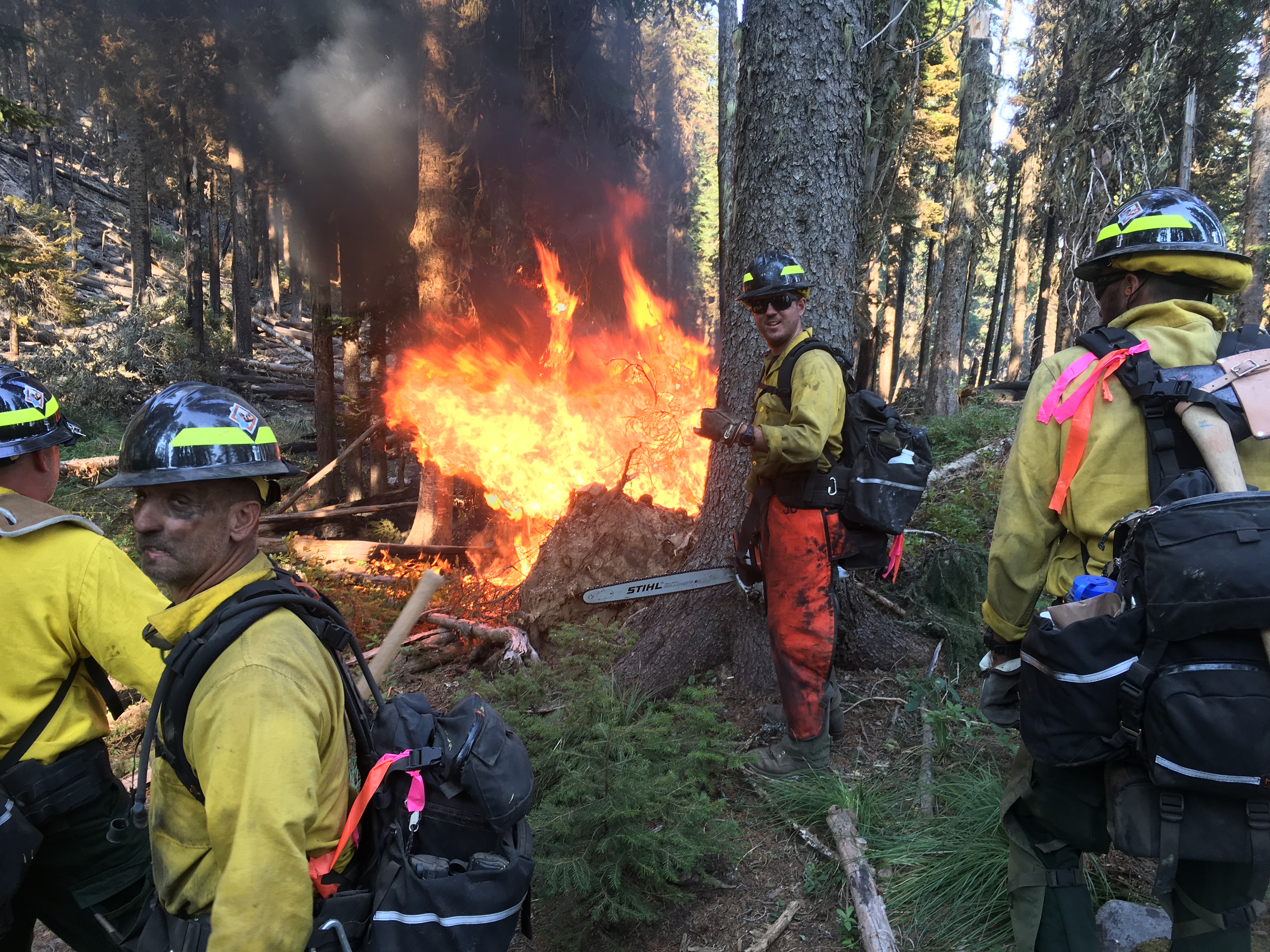
Delaware’s crew tackles a flare-up on Division Tango of the 180-acre Copper Mountain Fire in northern Idaho near the Canadian border.

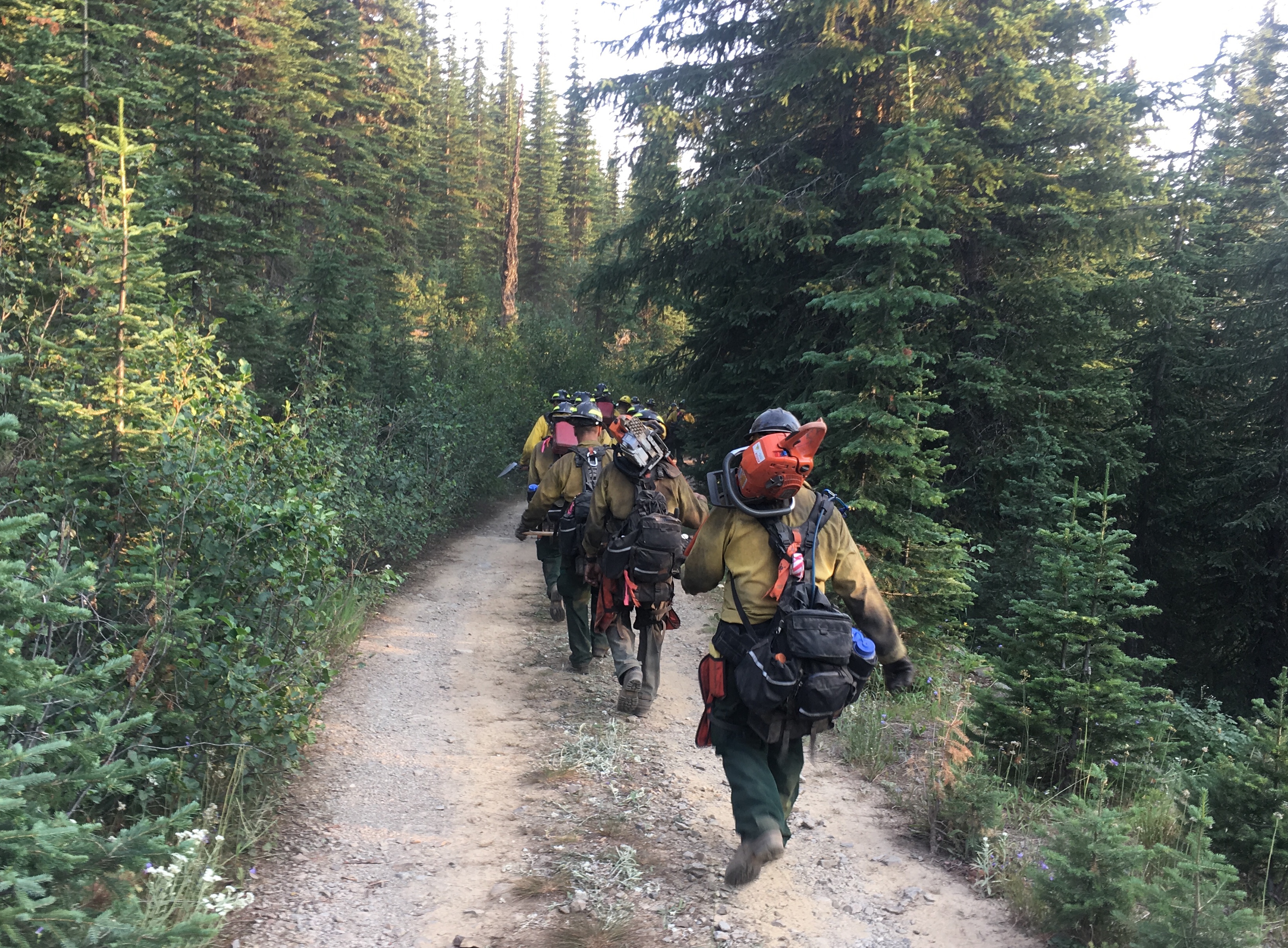
Twenty wildland firefighters from Delaware are part of 137 personnel battling the Copper Mountain Fire, a 180-acre blaze located four miles east of Eastport, Idaho on the Canadian border.  Michael A. Valenti of Dover, Delaware’s state forester and crew boss for the team, reports that “firefighters are working in rough terrain and completing very long hikes to and from the fire each day.” The crew is staying in the relatively primitive conditions of a spike camp near the incident and eating MRE’s (Meals Ready-to-Eat). A “spike camp” is a remote camp near a fireline that lacks the logistical support of a larger fire camp, such as catered meals and hot showers.

Delaware wildfire crew on fire line in Idaho.
Delaware’s crew hikes back to its spike camp after a long day on the line at the Copper Mountain Fire in northern Idaho on the Canadian border. The 180-acre blaze was started by lightning on August 2.

The Copper Mountain Fire is a lightning-caused blaze burning in timber that started on August 2. The fire is only 20% contained as of August 13 and is being managed by a Type 3 incident management team led by Rod Weeks. Firefighters are continuing line construction on both flanks of the fire and attempting to hold existing line. Fire officials are also coordinating with the British Columbia Wildfire Service on suppression efforts.

For more information on the Delaware wildfire crew, contact Kyle Hoyd, kyle.hoyd@delaware.gov, 302-698-4548.


Delaware ranks third nationally in 2016 Election Performance Index, or EPI.

Wilmington – Delaware ranks third nationally in the 2016 Election Performance Index, or EPI.  The State finishes behind Vermont and Minnesota. Delaware ranked from fifth to ninth in previous EPIs.

The EPI evaluates the overall performance in election administration of the 50 states and the District of Columbia. The Pew Center for the States produced the first EPI following the 2008 General Election. Pew published subsequent EPIs following the 2010, 2012 and 2014 General Elections. The EPI uses data from various surveys to determine State scores in the 17 indicators used to rank the States. The Massachusetts Institute of Technology (MIT) took over the EPI starting with the 2016 General Election.  The EPI includes a detailed explanation of the methodology.

Delaware scored higher than the National Average in 13 areas, including:

  • Residual vote rate of 0.32% compared to the National Average of 1.4%. The EPI states that this “…measures the performance of voting [equipment] by calculating the number of under- and over-votes cast in an election, as a percentage of voter turnout.” The EPI explains this topic more fully in the Indicators section.
  • Voting wait time of 4.9 minutes compared to the National Average of 8.24 minutes.
  • Voter registration rate of 86.99% compared to the National Average of 84.18%.
  • Turnout of 64.61% compared to the National Average of 61.64%.

Delaware scored lower that the National Average in the following areas:

  • Disability or illness-related voting problems where Delaware scored 17.22% compared to the National Average of 14.16%.
  • Mail ballots not returned where Delaware scored 11.93% compared to the National Average of 11.11%.
  • Military and overseas ballots rejected where Delaware scored 4% compared to the National Average of 3.55%.
  • Registrations rejected where Delaware scored 7.58% compared to the National Average of 5.65%.  Long-standing procedures resulted in staff coding records coding records as rejected instead of duplicate or test records. The Department corrected this problem. Delaware’s future rejected registration score will be much lower than the National Average.

Delaware uses technology to improve the delivery of election services to the State’s voters.  The state’s iVote voter portal is a “one-stop location” where Delaware voters can register to vote, update their voter registration, find their polling place, view their sample ballot, request an absentee ballot, and much more at their convenience. The iVote system operates 24/7/365 with the exception of brief periods for maintenance.  Additionally, the Delaware’s award-winning e-Signature system, is a model copied by many states including those touting automatic registration.  The e-Signature system offers a convenient method for Delaware’s citizens to register to vote or update their voter registration record while conducting business with the Division of Motor Vehicles, maximizing efficiency and respecting their busy schedules.

State Election Commissioner Elaine Manlove noted: “Delaware’s Elections Team is dedicated to providing the highest quality and most convenient voter registration and voting experience to the State’s voters. Our mission of using technology to improve every facet of elections is reflected in our EPI rating.  We will remain dedicated to continually improving the quality of service provided to Delawareans.”

Contact: Howard Sholl, Department of Elections, New Castle County Office, (302) 577-3464.


Governor Carney and DelDOT Cut Ribbon on New South Frederica Grade Separated Intersection

Delaware Department of Transportation (DelDOT) Secretary Jennifer Cohan and Delaware Governor John Carney were joined by members of the state’s congressional delegation and local leaders as they cut the ribbon on the South Frederica Grade Separated Intersection (GSI) on Friday.

“Investing in infrastructure is a central part of our strategy to make sure that Delaware has a strong, growing, and globally competitive economy that works for all Delawareans,” said Governor John Carney. “Over the next six years, we are investing nearly $700 million to upgrade our roads and bridges in Kent County, and nearly $4 billion statewide. These investments will modernize our transportation system, create jobs, help attract even more businesses to Delaware, and ease congestion across our state.”

The project removed the at-grade intersection at Milford Neck Road and Tub Mill Pond Road and provided access to and from Route 1 via ramps. Frederica Road and Tub Mill Pond Road were realigned to create a new service road on the west side of Route 1.

“The completion of the South Frederica GSI marks another step in our progress toward a safer and more user-friendly Route 1 through Kent County,” said Secretary Cohan. “We continue to complete these GSI projects on Route 1 – at Route 9, North Frederica, Thompsonville, South Frederica and Little Heaven later this year – helping our residents and visitors have safer and easier travels to their destinations.”

“It is important that as Kent and Sussex Counties grow, we are able to keep State Route 1 at capacity and safely flowing. Here, we have a transportation project that has not only eased congestion, but also provided access to this fantastic Sports Complex that sees thousands of cars on the weekends,” said U.S. Senator Tom Carper. “Kent County is poised for growth, and one way to encourage economic development is by offering safe and reliable roads, highways and bridges. This project’s funding is shared by the state and federal government and is a great example of what we can do when we work together to improve our transportation infrastructure.”

“From tourists going to our beautiful beaches in the summertime, to year-round residential traffic, State Route 1 and the South Frederica corridor are critical components to economic development in Kent County and throughout the state,” said Congresswoman Lisa Blunt Rochester. “With the completion of the South Frederica project, the Delaware Department of Transportation is reducing traffic congestion, facilitating commercial growth, and making our roads safer for everyone living and visiting in Delaware. I’m proud to stand with Governor John Carney and Transportation Secretary Jennifer Cohan in cutting the ribbon to open this much anticipated project.”

“While the South Frederica Overpass was not initially planned for the DE Turf Complex it was essential for the project to happen. Without the interchange Delaware would not have realize the significant economic benefit from the DE Turf,” said DE Turf Chairman William Strickland. “To date, over 100,000 visitors from 33 states, Canada and New Zealand have come to the complex and importantly have stayed in our hotels, eaten at our restaurants and shopped in our stores. We are so appreciative of the great partnership that has been forged with DelDOT to see the South Frederica Overpass to completion and most importantly for the highly professional way they have managed safe travel for our guests.”

A-Del Construction served as the lead contractor on the $26.6 million project which broke ground in March 2016, and received $21.7 million in funding from the Federal Highway Administration (FHWA).


Raccoon in Hockessin Tests Positive for Rabies

DOVER — Delaware’s Division of Public Health (DPH) is warning Hockessin residents in the Highland Meadows area (from Brackenville Road to Sharpless Road) of a positive case of rabies in a raccoon that came into contact with two dogs recently. The raccoon was captured and brought to the DPH Lab, where test results on Friday, Aug. 3, 2018, confirmed it had rabies.

The raccoon climbed a resident’s fence and entered the homeowner’s yard, at which point it got into a fight with the homeowner’s two dogs. The homeowner did not make contact with the raccoon; however, one of the dogs licked the homeowner’s face after the altercation with the raccoon. The homeowner has begun treatment for possible rabies exposure, and the dogs, both up to date on rabies vaccines, are currently under quarantine following exposure.

Anyone in this area who thinks they might have been bitten, scratched or come in contact with the rabid raccoon should immediately contact their health care provider or call the DPH Rabies Program at 302-744-4995. An epidemiologist is available 24/7. Anyone who thinks their pet may have been bitten by this raccoon should call their private veterinarian or the Delaware Department of Agriculture (DDA) at 302-698-4630.

Since Jan. 1, 2018, the Division of Public Health (DPH) has performed rabies tests on 80 animals, nine of which were confirmed to be rabid, including three foxes, three raccoons (including this one), one cat, one dog and one horse. Rabies tests performed on two animals (one sheep and one dog) were indeterminate. DPH only announces those rabies cases for which it is possible the animal had unknown contacts with humans and there is a risk of exposure to the community.

Rabies in humans and animals cannot be cured once symptoms appear. If the animal is unavailable to be quarantined or tested, DPH recommends that people receive post-exposure prophylaxis (PEP) treatment, a series of four vaccinations, as a precautionary measure.

Rabies is an infectious disease affecting the nervous system of humans and other mammals. Infection can occur through the bite or scratch of an infected animal or if saliva from such an animal gets into the eyes, nose, mouth or an opening in the skin.

Fortunately, rabies is also almost completely preventable. DPH recommends that members of the public take the necessary steps to stay clear of exposure to rabies. Rabies prevention begins with the animal owner. Vaccination of pets and livestock is a crucial factor in rabies prevention.
•  All dogs, cats, and ferrets 6 months of age and older are required by Delaware law to be vaccinated against rabies by a licensed veterinarian. Consider vaccinating livestock and horses as well. It is recommended to consult with your private veterinarian if you have any questions regarding whether your animal(s) should be vaccinated against rabies.
•  Pet owners can reduce the possibility of pets being exposed to rabies by not letting them roam free.
•  Spaying or neutering your pet may reduce the tendency to roam or fight and, thus, reduce the chance they will be exposed to rabies.
•  Do not keep your pet’s food or water outdoors; bowls can attract wild and stray animals.
•  Keep your garbage securely covered.
•  Do not touch or otherwise handle unfamiliar animals, including cats and dogs, even if they appear friendly.

For more information on the DPH rabies program, visit http://www.dhss.delaware.gov/dhss/dph/dpc/rabies.html or call 1-866-972-9705 or 302-744-4995. For more information on rabies, visit the Centers for Disease Control and Prevention at http://www.cdc.gov/rabies/.

A person who is deaf, hard-of-hearing, deaf-blind or speech-disabled can call the DPH phone number above by using TTY services. Dial 7-1-1 or 800-232-5460 to type your conversation to a relay operator, who reads your conversation to a hearing person at DPH. The relay operator types the hearing person’s spoken words back to the TTY user. To learn more about TTY availability in Delaware, visit http://delawarerelay.com.

Delaware Health and Social Services is committed to improving the quality of the lives of Delaware’s citizens by promoting health and well-being, fostering self-sufficiency, and protecting vulnerable populations. DPH, a division of DHSS, urges Delawareans to make healthier choices with the 5-2-1 Almost None campaign: eat 5 or more fruits and vegetables each day, have no more than 2 hours of recreational screen time each day (includes TV, computer, gaming), get 1 or more hours of physical activity each day, and drink almost no sugary beverages.
Sussex County Man Tests Positive for West Nile Virus

DOVER – The Division of Public Health (DPH) is announcing that a 60-year-old Sussex County man has tested positive for the state’s first human case of West Nile Virus (WNV) in 2018. The man was briefly hospitalized for illness in July and after a preliminary positive test result from the DPH Laboratory in Smyrna, the blood sample was sent to the Centers for Disease Control and Prevention (CDC) for confirmatory testing. WNV, a mosquito-borne illness, can become serious, and DPH reminds people to take precautions to avoid mosquito bites. In 2017, one case of WNV was confirmed in a Kent County woman, the first such case in two years in Delaware.

The Department of Natural Resources and Environmental Control (DNREC) Mosquito Control Section has seen an increase of WNV found in wild birds and sentinel chickens. The first case of WNV in birds this year was detected in late June in a wild crow collected in Sussex County by DNREC’s Mosquito Control section. WNV-positive sentinel chickens have been found at 10 of the 20 Mosquito Control Section sentinel chicken stations around the state, with virus-positive stations now in all three counties, and 13 WNV-positive wild birds have also been collected from all three counties. The increase in WNV detection in birds is occurring at about twice the normal rate, according to DNREC Mosquito Control officials.

“With the appearance of this disease in a person, along with an accompanying increase of West Nile Virus in wild birds, we want to urge everyone to protect yourself and your loved ones from mosquito bites. These bites can cause much more serious health problems than just itching and discomfort,” said DPH Director Dr. Karyl Rattay. “This is an early start to the transmission season for West Nile Virus, and it is concerning that we could see more cases this year in humans than in past years.”

WNV and EEE are transmitted by mosquitoes, generally in summer and fall, with a peak period for disease transmissions from mid-August to mid-October. Although nearly 80 percent of people infected with WNV will not become ill, and only a little less than 20 percent of those infected will develop West Nile fever, with mild symptoms (fever, headache, body aches, a skin rash on the chest or back and swollen lymph glands), one in 150 people infected will develop severe infection (West Nile encephalitis or meningitis).

Symptoms of severe WNV infection include headache, high fever, stiff neck, and/or tremors and muscle weakness. The elderly and those with weakened immune systems are most at risk. Anyone who experiences any of these severe symptoms should seek medical help immediately. Symptoms may progress to stupor, disorientation, coma, convulsions, paralysis, and possibly death.

WNV is primarily transmitted to humans by the common house mosquito, while the Asian tiger mosquito can also carry the disease. Mosquitoes in Delaware can also carry viruses that may result in death, including Eastern equine encephalitis (EEE), which can cause brain inflammation and be fatal to humans and horses, and dengue virus.

Earlier this month, DNREC’s Mosquito Control Section found Delaware’s first EEE-positive sentinel chicken for 2018 in a station in Sussex County. Like WNV, EEE can adversely affect both humans and horses – EEE is more severe than WNV, but fortunately much rarer. Heightened concerns over possible transmission to humans from both viruses, will continue into mid-October, until cooler temperatures start to significantly slow down both mosquito and virus activity.

Other mosquito-borne diseases that could occur in Delaware include chikungunya, which while rarely fatal, may result in severe and debilitating symptoms, including fever and joint pain, and Zika. The most common symptoms of Zika are rash, fever, joint pain, and conjunctivitis (red eyes). The largest health impact of the Zika virus appears to be on infants whose mothers were infected during pregnancy. There have been reports of a serious birth defect of the brain called microcephaly, a condition in which a baby’s head is smaller than expected when compared to babies of the same sex and age, as well as other poor pregnancy outcomes in babies of mothers who were infected with Zika virus while pregnant. To date, no cases of Zika in the state have been linked with local mosquito or human transmission.

DNREC’s Mosquito Control Section dealt with a statewide eruption of adult mosquitoes from late May through the end of June, occurring primarily in inland areas and caused by heavy rainfall. For the past two weeks the agency has faced another onslaught of adult mosquitoes in coastal areas attributable largely to tidal flooding and rains. To help the Section combat swarming numbers of mosquitoes this year, and to reduce mosquito-breeding habitat for mosquitoes that can transmit WNV, DNREC urges homeowners to practice good water sanitation on their property by eliminating standing water, particularly as might be collected in buckets, containers, uncovered trash cans, stagnant bird baths, old tires, and unused swimming pools.

To avoid mosquito bites and reduce the risk of infection, individuals should also:
• When outside, wear shoes, light-colored long-sleeved shirts and pants. Mosquito netting can protect one’s face and neck, and infants in carriages, strollers, and playpens. Mosquitoes are most active at dusk and during the early-morning hours.
• Use Environmental Protection Agency (EPA)-registered insect repellents. Follow the manufacturer’s instructions for reapplication times.
• Do not use insect repellent on babies younger than 2 months of age.
• Dress your child in clothing that covers arms and legs. Do not apply insect repellent onto a child’s hands, eyes, mouth, or on cut or irritated skin. Adults: Spray insect repellent onto your hands and then apply to the child’s face.
• Prevent mosquitoes from entering the house by using screens and keeping windows and doorways tightly sealed.

While there are no vaccines against WNV or EEE for humans, effective EEE and West Nile vaccines are available for horses through veterinarians, according to the Delaware Department of Agriculture’s State Veterinarian’s Office. Both WNV and EEE cause severe, and sometimes fatal, infections in horses. Signs of infection in horses include fever (although not always with WNV), anorexia, head pressing, depression or personality change, wobbling or staggering, weakness, blindness, convulsions, muscle spasms in the head and neck, or hind-limb weakness. If owners notice any of these signs in their horses, they should contact their veterinarian immediately.

To report suspected cases of human WNV, call the DPH Office of Infectious Disease Epidemiology at 888-295-5156.

For more information about:
• Mosquito biology/ecology and control – Contact the Mosquito Control Section’s Dover office at 302-739-9917.
• Reporting WNV-suspect wild birds, or for requests for mosquito relief – For upstate areas from Dover north, contact Mosquito Control’s Glasgow field office at 302-836-2555; for downstate areas south of Dover, contact Mosquito Control’s Milford field office at 302-422-1512.
• WNV or EEE in horses and equine vaccines – Contact the Department of Agriculture’s Poultry and Animal Health Section at 302-698-4500 or 800-282-8685 (Delaware only).
• For more information on West Nile virus or Eastern equine encephalitis – Visit the CDC website, www.cdc.gov/ncidod/dvbid/westnile/index.htm

A person who is deaf, hard-of-hearing, deaf-blind or speech-disabled can call the DPH phone number above by using TTY services. Dial 7-1-1 or 800-232-5460 to type your conversation to a relay operator, who reads your conversation to a hearing person at DPH. The relay operator types the hearing person’s spoken words back to the TTY user. To learn more about TTY availability in Delaware, visit http://delawarerelay.com.

Delaware Health and Social Services is committed to improving the quality of the lives of Delaware’s citizens by promoting health and well-being, fostering self-sufficiency, and protecting vulnerable populations. DPH, a division of DHSS, urges Delawareans to make healthier choices with the 5-2-1 Almost None campaign: eat 5 or more fruits and vegetables each day, have no more than 2 hours of recreational screen time each day (includes TV, computer, gaming), get 1 or more hours of physical activity each day, and drink almost no sugary beverages.