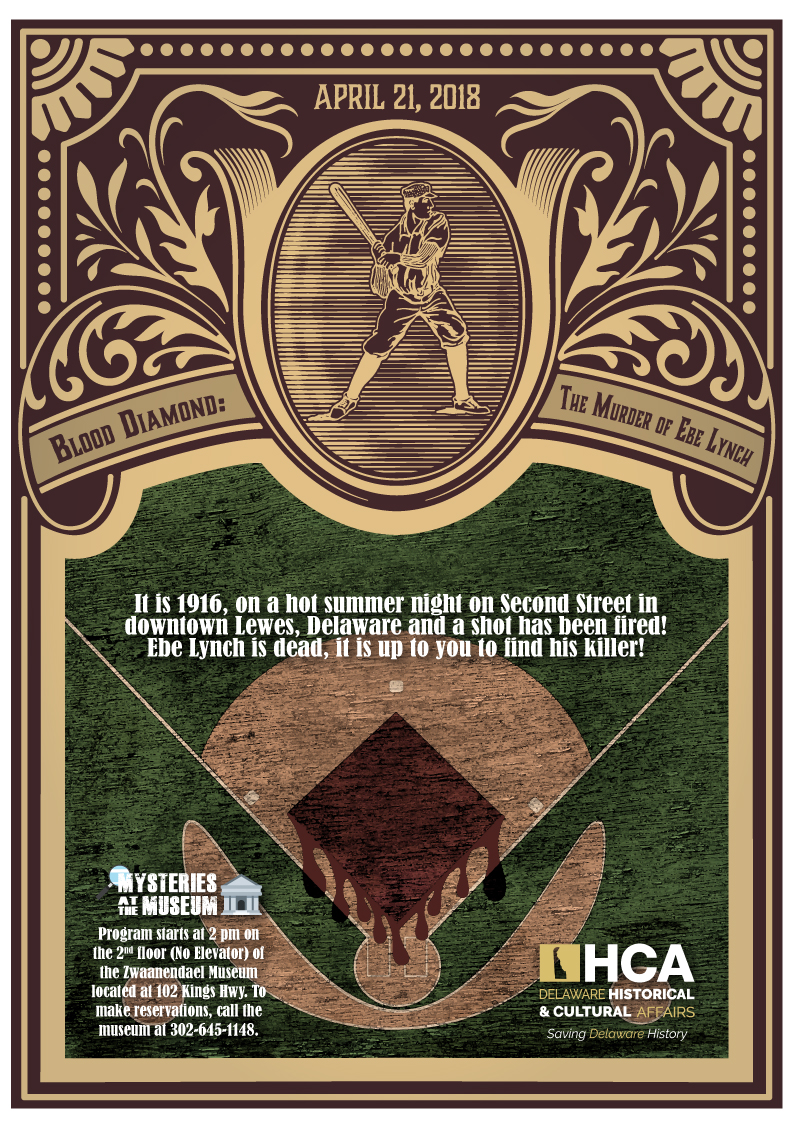
“Blood Diamond: The Murder of Ebe Lynch” at Lewes, Del.’s Zwaanendael Museum on April 21, 2018

(DOVER, Del.—April 12, 2018)—On Saturday, April 21, 2018 at 2 p.m., the Zwaanendael Museum, located at 102 Kings Highway in Lewes, Del., will present “Mysteries at the Museum: ‘Blood Diamond: The Murder of Ebe Lynch.’ ” Created by Zwaanendael Museum staff, this theatrical murder-mystery is based on an actual incident that took place on a hot summer night in 1916 on Second Street in Lewes. During that incident, shots were fired and Ebe Lynch, a prominent local postmaster and president of the Lewes baseball team, was found dead. As part of the play, museum visitors will serve as detectives, meeting suspects and evaluating clues to determine who committed this heinous crime. Guests of all ages will enjoy participating in this historical whodunit.

Poster for "Blood Diamond: The Murder of Ebe Lynch"

“Blood Diamond: The Murder of Ebe Lynch” will be presented on the museum’s 2nd floor (entry via staircase; no elevator). Admission is free but, due to space restrictions, reservations are required by calling 302-645-1148 no later than April 20, 2018.

The Zwaanendael Museum was built in 1931 to commemorate the 300th anniversary of the state’s first European colony, Swanendael, established by the Dutch along Hoorn Kill (present-day Lewes-Rehoboth Canal) in 1631. Designed by E. William Martin (architect of Legislative Hall and the Hall of Records in Dover), the museum is modeled after the town hall in Hoorn, the Netherlands, and features a stepped facade gable with carved stonework and decorated shutters. The museum’s exhibits and presentations provide a showcase for Lewes-area maritime, military and social history.

Zwaanendael Museum
Zwaanendael Museum

The Zwaanendael Museum is administered by the Division of Historical and Cultural Affairs, an agency of the State of Delaware. The division enhances Delaware’s quality of life by preserving the state’s unique historical heritage, fostering community stability and economic vitality and providing educational programs and assistance to the general public on Delaware history and heritage. The division’s diverse array of services includes operation of five museums which are accredited by the American Alliance of Museums, administration of the State Historic Preservation Office, conservation of the state’s archaeological and historic-objects collections, operation of a conference center and management of historic properties across the state. Primary funding for division programs and services is provided by annual appropriations from the Delaware General Assembly and grants from the National Park Service, Department of the Interior, a federal agency. However, the contents and opinions expressed in the division’s programs and services do not necessarily reflect the views and policies of the Department of the Interior.

-End-

Contact:
Jim Yurasek
Delaware Division of Historical and Cultural Affairs
Phone: 302-739-7787
E-mail: Jim.Yurasek@delaware.gov
Web: http://history.delaware.gov


Governor Carney and DelDOT Mark National Work Zone Safety Week

During an event held at the Delaware Turf Sports Complex in Frederica, in observance of National Work Zone Awareness Week, Governor Carney and Transportation Secretary Jennifer Cohan and others educated attendees on the importance of observing extra caution while traveling through work zones. National Work Zone Awareness Week is held the second week of April each year at the traditional start of construction season, when the number of workers on our nation’s roadways increases. The theme of this year’s Delaware awareness campaign is “Work Zone Safety is for Everyone.” This year we raise awareness by featuring DelDOT workers who put their lives on the line daily as they work within active traffic maintaining Delaware roads. They were joined by their family members reminding drivers that like them, they have families and loved ones to return home to.

Proclaiming the month of April in Delaware to be National Work Zone Safety Awareness Month, Governor Carney encouraged all citizens to be aware of the importance of safe driving habits within highway work zones. “Whether filling potholes or building entirely new roadways, men and women work alongside traffic every day to improve our state,” said Governor John Carney. “As Delaware continues to invest nearly $4 billion in infrastructure over the next six years, we need everyone to slow down and pay careful attention to keep work zones safe.”

“The presence of work zones might create temporary hassles, but they are vital to the safety and efficiency of travel through our state,” said DelDOT Secretary Jennifer Cohan. “A work zone is moms and dads and sons and daughters at work. We love them as our fellow Delawareans, and we must do everything within our power, as drivers who pass them every day, to protect them and to ensure that they make it home to see their loved one each day.”

Although highway workers are often among the victims of such crashes, it’s important for drivers to understand that four out of five victims of work zone crashes are actually drivers or their passengers. Generally, crashes occur when drivers speed through a work zone or do not pay attention to the changing road conditions and run into other vehicles, highway equipment or safety barriers, or drive off the roadway completely. In a typical five-day work week, an average of seven motorists and one worker are killed nationwide. The primary causes of work zone crashes are following too closely and inattentive driving.

“The Delaware State Police and the Delaware Department of Transportation are partners working together to ensure safer work zones for both workers and the traveling public,” Sergeant Richard Bratz, Delaware State Police, Director of the Public Information Office informed the gathering. “Everyone should know that speeding through work zones is not tolerated in Delaware. Every time you enter a work zone as a motorist, you are entering a Higher Fine Zone. Any traffic violations within this zone are subject to fines that are doubled in cost. We want to make sure that the traveling public and workers make it home to their families each and every day. We ask that each person drive with greatest amount of care and attention to keep work crews safe while doing their jobs. The Delaware State Police recognizes National Work Zone Safety Awareness Week in Delaware and is very proud to be a part of this annual event.”

“Like most roadway tragedies, work zone crashes are preventable,” says Cathy Rossi, Vice President of Public and Government Affairs for AAA Mid-Atlantic. “With extra precaution, and forethought during construction season, we can travel safely, helping the men and women who work on our road crews return safely to their families every day.”

The National Work Zone Awareness Week began in 1999, when the Federal Highway Administration (FHWA), the American Traffic Safety Services Association (ATSSA), and the American Association of State Highway and Transportation Officials (AASHTO) signed a Memorandum of Agreement pledging to increase public awareness of work zone safety issues through a national media campaign. Since then, awareness has continued to grow, with state agencies and other organizations sponsoring high-visibility education and outreach initiatives.

Some simple tips for improving work zone safety include:

*          When you see the “orange and black,” be extra cautious.

*          Warning signs will let you know what to expect.

*          Barrels or cones will delineate your path of travel.

*          Flag persons will help direct you along the way.

*          Avoid distractions.

*          Don’t tailgate.

*          Don’t change lanes.

*          Slow down and expect the unexpected.

For complete Delaware work zone statistics check out the Delaware Strategic Highway Safety Plan.

The United States Department of Transportation’s Federal Highway Administration has developed a Work Zone Safety webpage highlighting the statistics for the frequency and severity work zone crashes.

For traffic information, visit www.DelDOT.gov; Follow DelDOT on social media at   http://twitter.com/DelawareDOT or  http://www.facebook.com/DelawareDOT or download the free DelDOT App, and listen to WTMC 1380 AM.


Celebrate National Library Week April 8-14

(Dover, DE) – This week, Delaware joins libraries nationwide in celebrating the many ways libraries enrich their communities through the transformative services and expertise they offer.

April 8-14, 2018 is National Library Week, the annual celebration of the life-changing work of libraries, librarians, and library workers. People of all ages can collaborate, try out new technologies, and develop their skills and passions at Delaware libraries throughout the state.

“We are privileged to partner with our libraries to transform lives through the First Chance Delaware initiative,” said Delaware’s First Lady, Tracey Quillen Carney. “Our goal is to ensure that all of Delaware’s children have a ‘first chance’ to succeed. Certainly, promoting early literacy and school readiness is a critical part of that work; and in addition, libraries are playing an increasingly important role as centers of community life. So the library habit is about literacy, and also about parent-child engagement and access to other services that support strong and healthy families. To support our families and a first chance for all our children, I encourage every Delawarean to get and use a Delaware library card.”

“Delaware has made a great investment in upgrading the services offered to residents in our 33 public libraries across the state,” said Secretary of State Jeffrey Bullock. “What’s great about Delaware librarians is their enthusiasm and willingness to adapt to the changing needs of the community,”

Through partnerships, libraries can extend the reach and effectiveness of partner capabilities and resources and foster collaboration. “Libraries level the playing field for people of any age who seek information and access to technologies to improve their quality of life.” said Deputy Secretary of State Courtney Stewart.

Although studies show that in the public’s mind the library brand is “books,” this week showcases libraries’ role to support all topics as a place to “get things done.” As technology evolves, libraries continuously keep pace to ensure individuals and communities excel. Resources like eBooks and technology classes, materials for English-language learners, and programs for job seekers are just a few ways libraries recently — and continuously — transform and lead in their communities.

“Libraries are making experiences come alive, off the page, for our communities,” said Dr. Annie Norman, State Librarian. “Libraries are a linchpin for discovery in all subject areas, and we are working with partners and experts to make available a greater array of experiences for our communities. So Delawareans have the opportunity they might not have otherwise to discover a passion, to develop an expertise, and to make connections to support invention and innovation.”

First sponsored in 1958, National Library Week is a national observance sponsored by the American Library Association (ALA) and libraries across the country each April.

Find more information about your local libraries at https://delawarelibraries.org.

About the Delaware Library Association

The Delaware Library Association is a chapter of the American Library Association, and its mission is to promote the profession of librarianship, to advocate for library services, and to provide information and services for Delawareans. DLA is the only statewide association that represents all types of libraries including academic, public, school, and special libraries.

About the Delaware Division of Libraries

The Delaware Division of Libraries, a state agency dedicated to unleashing the potential in all Delawareans in partnership with Delaware Libraries, offers free access to the online catalog (delawarelibraries.org); Wi-Fi; computers/internet; eBooks, programs/workshops, community partnerships, and more.

#FirstChanceDE, #GetaLibraryCardDE


In Wake of 12 Overdoses in New Jersey, Delaware Health Officials Issue Warning to People in Active Use

NEW CASTLE (April 10, 2018) – In the wake of a dozen overdoses in Camden, N.J., including four that were fatal on Friday, Department of Health and Social Services (DHSS) Secretary Dr. Kara Odom Walker is urging people in active substance use in Delaware to be aware of the increased possibility that heroin could be laced with fatal amounts of fentanyl.

“Because of I-95, we know it’s easy for heroin and other illicit drugs to flow to Delaware from New Jersey, Pennsylvania, Maryland and other states,” said Secretary Walker, a board-certified family physician. “If you are in active use, we urge you to seek treatment immediately. If you continue to use substances, have the overdose-reversing medication naloxone with you because the risk for death is increased. Our first priority is to reduce harm and save lives.”

Camden County (N.J.) Police said at least a dozen people overdosed during a short period Friday from heroin laced with fentanyl, a synthetic painkiller that is up to 50 times more potent than heroin. Four of those people died, police said.

In Delaware, there have been 71 deaths from suspected overdoses through April 9 of this year, including six from Friday, April 6, through Monday, April 9, according to preliminary reports from the Department of Safety and Homeland Security’s Division of Forensic Science. Of the 71 total deaths for 2018, 50 have been in New Castle County, 15 in Sussex County and six in Kent County, The youngest person who died was 19; the oldest 74.

Elizabeth Romero, director of DHSS’ Division of Substance Abuse and Mental Health, encouraged individuals in active substance use in Delaware to see a medical provider immediately or call DHSS’ 24/7 Crisis Services Hotline to be connected to trained crisis professionals who can discuss treatment options. In New Castle County, the number is 1-800-652-2929. In Kent and Sussex counties, the number is 1-800-345-6785. Individuals and families also can visit DHSS’ website, www.HelpIsHereDE.com, for addiction treatment and recovery services in Delaware or nearby states.

If individuals see someone overdosing, they should call 911. Under Delaware’s 911/Good Samaritan Law, people who call 911 to report an overdose and the person in medical distress cannot be arrested for low-level drug crimes.

If a user has ingested fentanyl or a drug laced with fentanyl, time is critical because the powerful opioid quickly affects the central nervous system and the brain. Users often have trouble breathing or can stop breathing as the drug sedates them. If someone is too drowsy to answer questions, is having difficulty breathing, or appears to be so asleep they cannot be awakened, call 911 immediately.

Naloxone, the overdose-reversing medication carried in Delaware by community members, paramedics and some police officers, can be administered in overdoses involving fentanyl. Because fentanyl is more potent than heroin or opioid painkillers, multiple doses of naloxone may be needed to reverse an overdose. In 2017, Delaware paramedics and police officers administered naloxone 2,714 times in suspected overdose situations to a total of 1,906 patients.

Overdose deaths continue to increase in Delaware. In 2017, 345 people died from overdoses, up 12 percent from the 308 people who died in 2016, according to statistics from the Division of Forensic Science.

-30-

The Department of Health and Social Services is committed to improving the quality of life of Delaware’s citizens by promoting health and well-being, fostering self-sufficiency, and protecting vulnerable populations.


First Chance Delaware

First Lady Tracey Quillen Carney’s remarks as prepared for delivery at the announcement of First Chance Delaware — an initiative led by the First Lady to recognize and facilitate effective partnerships, to share research and best practices, and to promote opportunities to collaborate in support of Delaware’s children.

But then Paul DiLorenzo from Casey asked us to think bigger, more in terms of promotion than response; and of course, that instantly made sense.When Jackie Mette first suggested that we apply to Casey Family Programs for a First Spouse Initiative Grant, I knew I wanted it to be about giving kids a chance to succeed, a chance to recognize and work toward their potential. So we started to think about specific programs that would do that in targeted ways – a kind of traditional approach for a first spouse; identify a need, a way to respond, and focus on it for as long as you’re here.

If our goal is, in a foundational way, to give Delaware’s children a chance to succeed, we can’t do that with one program; and we can’t do it by responding just to how kids suffer when they crash into obstacles; we have to deal with the obstacles themselves.

That’s the reality John recognized when, in his one of his first initiatives as Governor, he re-established the Family Services Cabinet Council. When families face foundational challenges, like access to stable housing and nutritious food, each adversity deepens all of the others, in a geometric – and generational – erosion of opportunity. So to be effective – and certainly, to be efficient – the efforts to alleviate those challenges must also be inter-connected and mutually reinforcing.

Our First Chance Initiative, with a founding grant from Casey Family Programs, seeks to encourage a coordinated, intentional, and evolving culture of commitment to Delaware’s children – to make the First State a place where every child has a First Chance to succeed.

The why of the First Chance Initiative is pretty obvious:

  • It’s our shared interest in public health, educational excellence and workforce development; in attracting businesses and talented employees, based on the skills of Delawareans and on the quality of life in our state;
  • it’s our interest in saving on emergency medical costs and other crisis interventions;
  • it’s our interest in parent-employee productivity and retention, and in supporting community safety and sustainability, by building on the fundamental strength of families.
  • And, even more obviously, it’s our moral obligation – to give kids a chance, a First Chance, to succeed.

As for the how of the First Chance Initiative:

First, we want to recognize cross-sector collaborations that are working, to promote awareness of what’s out there – both for families who might benefit and for prospective partners, who share an interest and want to get involved.

Second, we want to take that intentional, coordinated approach to expanding successful programs, especially where parents, children, and teens are engaged in partnerships and settings that they trust – partnerships like our evidence-based home visiting programs for newborns and moms; settings like our Boys & Girls Clubs, community centers, Y’s, libraries, faith-based settings, and public schools where adults invest in building strong relationships with students. While we have kids and families in these trusted programs and settings, how can we better coordinate a mutually reinforcing First Chance web of support and opportunity?

In our year of groundwork for the First Chance Initiative, we’ve focused on partnerships in three areas –
1. Addressing childhood hunger,
2. Promoting early literacy, and
3. Expanding trauma-informed care.

Good things are happening, and again, we want to build on those successes.

Good things like the program to help struggling readers, a program I had a chance to see in action at Manor Elementary School. The program is a partnership among the Reading Assist Institute and its private and public supporters, the Colonial School District, and AmeriCorps. We’re going to celebrate three years of that partnership at an end-of-year bash on April 26th, with food provided by the culinary arts students at William Penn.

Good things are happening.

Good things like Compassionate Connections, a partnership I’ve been privileged to join.

The work started when Compassionate Schools, a national program, joined with Delaware’s Department of Education – with early involvement from the University of Delaware, and, once again, lead funding from Casey Family Programs. The Compassionate Schools work expanded, with deepening commitment from those early partners, and inspired by a grassroots push from members of the Delaware State Education Association. DSEA earned a National Education Association grant to form Compassionate Connections and to launch a three-year pilot program in five schools.

Compassionate Connections, again, involves all of the original Compassionate Schools partners, including Casey – and also:

  • Children and Families First,
  •  the Office of the Child Advocate,
  • the Parents Advisory Council for Education,
  • the Red Clay and Christina School Districts,
  • the Wilmington Advisory Council,
  • the Family Services Cabinet Council’s ACEs Subcommittee,
  • the ACLU,
  • the Rodel Foundation,
  • and the Department of Services for Children, Youth, and their Families – aka, Secretary Manning’s “Kids Department.”

In addition to that collaboration, many schools apply the new Opportunity Grants toward trauma-informed work. A shoutout, too, to Wilmington University, which now offers a certificate in Trauma Informed Approaches, as a complement to degrees in six different majors.

This isn’t touchy-feely stuff; as we now know, this is brain science and biology – with implications for every family, school, work place, and neighborhood.

Good things are happening, like the collaboration I am proud to introduce as our inaugural First Chance Program – our state task force on childhood hunger. I want to thank Charlotte McGarry, from the Food Bank of Delaware; Ray Fitzgerald, Director of Social Services at DHSS; and Aimee Beam, from the Department of Education – as well as the task force’s partners, which include:

  • the Harry K Foundation,
  • Secretary Bunting, superintendents, principals, and members of the Delaware School Nutrition Association,
  • the Department of Agriculture and Delaware farmers,
  • all of our Summer Food Service and after-school partners,
  • and the regional office of the USDA.

If we’re going to give kids a First Chance to succeed, what better place to start, than fighting childhood hunger.

It doesn’t take a lot of data to figure it out – have you ever been at your best when you were hungry? I’ve had the misfortune, on occasion, to be with our Governor when he’s hungry – it’s not something you want to see.

Our task force on childhood hunger has set specific goals to:

  • increase participation in school breakfast,
  • improve our effectiveness in serving summer meals,
  • expand opportunities for after-school meals and snacks,
  • and, with the help of the Harry K Foundation, to make sure that every school with a basic needs closet, also has a food pantry.

The goals of the task force are aggregate; not one for the Food Bank, one for DHSS, and one for DOE, not one for philanthropy and one for reimbursable programs.

We have shared goals – because we have shared goals, and a common interest in achieving them – again, whether you look at it from an economic, quality of life, or moral point of view.

In building a statewide culture of commitment to children – as we review budgets, policies, and programs – let’s ask what each of us can do, what each of our agencies, businesses, and funding sources can do, to break down silos in support of shared goals, to engage in creative, common-sense collaborations, to give kids a First Chance to succeed.

I am privileged to have the opportunity to invest the convening power and platform of the First Lady’s role toward the First Chance Initiative.


Delawareans can learn more about First Lady Tracey Quillen Carney’s “First Chance Delaware” initiative, and sign up to help, at de.gov/firstchance.