State Agencies Preparing for Major Winter Storm

Winter storm to bring 6 to 10 inches or more of snow with hazardous driving conditions

SMYRNA, Del. – The Delaware Department of Transportation (DelDOT), Delaware Emergency Management Agency (DEMA), and other agencies are preparing for a major winter storm that is expected to impact the state starting Sunday night. The National Weather Service has issued a winter storm warning with 6 to 10 inches or more of snow expected by Tuesday morning. Heavier snow could begin Monday around 6 a.m., with snowfall rates of one inch an hour possible. Cold temperatures and gusty winds will make travel difficult, especially during the morning and evening commutes.

Governor John Carney on Sunday activated the Delaware National Guard to support storm response operations. DEMA is also activating its Emergency Operations Center in Smyrna and coordinating with state, county, and local partners to meet ongoing needs for the duration of the event.

Driving restrictions are not issued at this time. However, based on weather and roadway conditions, state officials could issue driving restrictions such as a Level 1 Driving Warning, which cautions motorists of adverse weather conditions and urges them to stay off the road if possible. If driving is necessary, motorists are asked to use caution and common sense. More stringent driving restrictions – such as a Level 2 Restriction or a Level 3 Driving Ban – would only be issued under a declared State of Emergency and are authorized under Delaware Code, Title 20, Chapter 31.
 
NWS Snow Update 1-6-25
 
DelDOT has 300 pieces of snow removal equipment, including snowplows, brining equipment, and salt trucks, and have been brining roads throughout the state today. Crews will begin plowing operations starting around 2 a.m. on Monday and will continue throughout the storm. The focus will be ensuring major routes such as I-95, Route 1, Route 13, and Route 113 remain open and passable. Secondary roads and streets in subdivisions could be slippery and snow-covered: state officials urge everyone to exercise caution when driving.

“DelDOT crews will be working throughout the storm to clear and treat roads across the state, however, cold temperatures and continued snowfall could cause roads and bridges to be hazardous as the day progresses,” said Acting Secretary of Transportation Shanté Hastings. “Please slow down and adapt driving to the conditions if you must be out.”

DelDOT offers many resources for updates on traffic and road conditions, such as the DelDOT mobile app. DelDOT’s Traffic Management Center broadcasts 24 hours a day at 1380 AM and is live-streamed on deldot.gov.

Winter Driving and Safety Tips:

  1. Make sure that your windshield is completely clear of snow and ice and that you also clear snow off the top of your vehicle and the bed of your pickup trucks.
  2. Once on the road, take it slowly. Travel at or below the posted speed limit.
  3. Leave plenty of space between you and the car in front of you. If you’re too close, there will not be enough time to react if that person loses control of his vehicle.
  4. Turn on your headlights so other drivers can see you. Delaware law requires headlights in conditions of poor visibility. Low beams provide better visibility than high beams.
  5. Apply brakes carefully, especially on hills and exit/entrance ramps. Allow for more stopping distance.
  6. Bridges and overpasses freeze faster than other road surfaces. There might be ice you cannot see.
  7. Pay extra attention when approaching intersections. Watch for cars that don’t have the right of way. Even though you are taking precautions, you need reaction time in case other drivers go through a stop sign or stop light.
  8. Wear your seatbelt. If you are involved in a wreck, your seatbelt will help you control the vehicle and improve your chances of escaping serious injury or death by nearly 50%.
  9. If your vehicle starts to skid, don’t panic. Don’t hit the brakes hard. If your car has anti-lock brakes (ABS), apply steady pressure to the brakes, shift the car or truck into neutral and steer in the direction you want your car to go until the skid is over. If you don’t have ABS, apply pressure to the brakes, just short of locking them up, release the pressure, and re-apply at a lower level.

Visit PrepareDE.org for more tips on preparing for winter storms or this year’s Winter Weather Week news release.

Resources:

Social Media:

Delaware Department of Transportation on Facebook and X
Delaware Emergency Management Agency on Facebook and X and Instagram

CONTACT:
C.R. McLeod, DelDOT
C: (302) 388-2303
E: charles.mcleod@delaware.gov

John Petersen, DSHS
C: (302) 233-8180
E: john.petersen@delaware.gov

DelDOT Preparing for First Significant Snow Event of Winter

The National Weather Service has issued a winter storm watch for the entire state that will be in effect from late Sunday night to Monday night.

The department has 300 pieces of snow removal equipment and is responsible for nearly 14,000 lane miles of road in the state and initial efforts will be focused on clearing primary roads such as I-95, Route 1, Route 13, and Route 113. The objective is to keep primary roads passable, and drivers are advised to adapt their driving to the road conditions and avoid driving during the storm if possible. DelDOT cannot provide estimates on when specific roads will be plowed as conditions will dictate plowing operations.

Once primary roads are determined to be in passable condition, plow crews will move to secondary roads such as Route 9, Route 24, and Route 71, and then to local roads. We do not plow subdivisions with privately maintained streets or subdivisions within the Snow Removal Reimbursement Program.

DelDOT will be brining roads in Sussex County beginning Sunday morning. Routes 1 and 13 will be brined in Kent County from the New Castle County line to Dover. New Castle County roads were brined on Friday and no additional brining is necessary. DelDOT staff will be reporting ahead of the storm’s start to make additional preparations for the storm’s arrival.

The department has several resources available to monitor road conditions in real-time. The DelDOT interactive map, available on the deldot.gov website, and the DelDOT app provide resources such as 230 traffic cameras and the snowplow tracker that will be active throughout the storm event.

The “Frequently Asked Questions” webpage also provides additional information related to snow removal operations.

Downed trees and wires can be reported to the Transportation Management Center by calling (302) 659-4600, or #77 on cellphones.

DelDOT will post updates on Facebook, NextDoor, and X social media platforms throughout the storm event and issue news releases should driving restrictions be necessary.


With Delaware Under Severe Heat Watch for the Weekend, DPH Offers Tips to Vulnerable Populations at Risk

DOVER, DEL. (June 21, 2024) – With all of Delaware under a heat advisory or excessive heat watch alert from the National Weather Service, the Delaware Division of Public Health (DPH) offers information on resources and tips to help everyone stay safe this weekend and throughout the summer.

While conditions such as those expected across the state in the next few days pose a risk for individuals of all ages and health status, certain populations are at greater risk for heat-related illnesses and heat impact. DPH offers the following information, education, and resources to assist Delawareans during the current heat wave and those expected to come this summer.

Populations at greater risk of heat-related illnesses and heat impact:

  • Infants and children: One of our most vulnerable populations, infants and children, rely on others to care for them and address their needs. They are unable to fully communicate when they are overheated or thirsty/dehydrated and require additional attention during extreme heat.
  • Older adults: Those 65+ often cannot adjust to sudden temperature changes as well as younger individuals, and in some cases, this is due to their medications or current health conditions. Extra precautions should be taken and assistance from family members is even more important during extreme heat.
  • Pregnant individuals: Pregnancy can make you more likely to get sick from the heat because the body has to work harder to cool down both you and the baby. Additionally, hydration is especially important for pregnant individuals as you are more likely to become dehydrated more quickly.
  • Pets: Fully dependent on their human best friends for their care, pets are just as vulnerable to extreme heat. Animals at the greatest risk of stress from the heat include pregnant or lactating animals, very young and older animals, animals with darker coats, obese pets, short-nosed dog breeds and animals with chronic health conditions. It is best to bring pets indoors and provide plenty of water.

Additionally, those who work outside, individuals with chronic health conditions, and anyone unable to obtain shelter in a cool, well-ventilated place are at greater risk of heat-related illnesses. If you know someone in any of these vulnerable populations, be sure to check on them frequently and offer assistance where possible.

General tips to prevent heat-related illness:

Stay as cool as possible.

  • Try to find an air-conditioned place, if possible, to help keep your body temperature at the right level. If you do not have an air-conditioned residence, locate a local cooling station or visit a public place such as a mall or library.
  • Wear the appropriate clothing. Choose lightweight, light-colored, loose-fitting clothing.
  • Use your stove or oven less to keep your home temperature down and avoid hot and heavy meals which add heat to your body.

Avoid outdoor activities or plan accordingly.

  • If you have the option to avoid outdoor activity or limit it, do so.
  • If you must be outside for work or other activities, try to limit time outdoors to the coolest parts of the day. Pace yourself and protect your body from the sun by wearing a wide-brimmed hat, sunglasses, and sunscreen of SPF 30 or higher applied 30 minutes prior to going out and reapplied as appropriate.
  • Practice caution when walking dogs. If you must walk them, the best time of day in the summer months is in the early morning or late evening when the sun’s heat is not as intense. A simple touch of your hand to any surface where a walk is planned will tell if it’s too hot for a dog. If it’s too hot for a human hand, it’s too hot for a dog’s paws.

Drink plenty of fluids

  • Stay hydrated with water and avoid sugary and alcoholic beverages.
  • Drink more than you typically would, regardless of how active you are, and do not wait until you are thirsty to drink.
  • Avoid drinking very cold liquids which could cause stomach cramps.
  • If your doctor limits how much fluids you drink or you are on medications where fluids are restricted, contact the doctor to determine what is best for you during extreme heat.

Do not leave children, pets, or anyone else in a parked car.

  • Even if the windows are cracked, the temperature in a car can rise to a dangerous level very quickly.
  • When exiting a vehicle, double check the back seat to ensure that no sleeping child or pet is left behind.

The CDC offers a heat and health tracker to determine the conditions for your specific area and the National Weather Service has a new website to identify the potential heat risk for your area over a seven-day period.

The three Delaware county administrations, the City of Wilmington, and certain non-profits operate cooling stations during these heat advisories or alerts.  For information on these locations and more heat-related resources, contact Delaware 211, which will have extended hours this Saturday, June 22 and Sunday, June 23 from 9:00 a.m. to 12:00 p.m. and is available weekdays from 8:00 a.m. to 9:00 p.m. You can also text your ZIP code to 898-211 to obtain more information.


DelDOT, DEMA Issue Travel Advisory for Snow and Ice

Heavier snow to cause poor visibility this afternoon with roads expected to freeze tonight

SMYRNA, Del. — The Delaware Department of Transportation and Delaware Emergency Management Agency (DEMA)  are issuing a travel advisory for this afternoon and evening due to poor visibility from heavier snowfall and freezing on road surfaces tonight as temperatures drop. The advisory is not an official Level 1 Driving Warning, but is meant to caution motorists of adverse weather conditions and to stay off roads if possible. If driving is necessary, motorists are urged to use caution and common sense.

“DelDOT crews have been working throughout the storm to clear and treat roads across the state, however, falling temperatures and continued snowfall will cause roads and bridges to be icy as the day progresses,” said Secretary of Transportation Nicole Majeski. “Please slow down and adapt your driving to the conditions if you must be out.”

The National Weather Service is forecasting snowfall rates that cause reduced visibility for motorists and temperatures to drop below freezing tonight. This will create hazardous driving condition across the area. DelDOT crews are working to clear the roadways, but many secondary routes will remain slippery and snow-covered.

Winter Driving and Safety Tips:

  1. Make sure that your windshield is completely clear of snow and ice and that you also clear snow off the top of your vehicle and the bed of your pickup trucks.
  2. Once on the road, take it slowly. Travel at or below the posted speed limit.
  3. Leave plenty of space between you and the car in front of you. If you’re too close, there will not be enough time to react if that person loses control of his vehicle.
  4. Turn on headlights so other drivers can see you. It’s Delaware law to use headlights in conditions of poor visibility. Low beams provide better visibility than using high beams.
  5. Apply brakes carefully, especially on hills and exit/entrance ramps. Allow for more stopping distance.
  6. Bridges and overpasses freeze faster than other road surfaces. There might be ice you cannot see.
  7. Pay extra attention when approaching intersections. Watch for cars that don’t have the right of way. Even though you are taking precautions, you need reaction time in case other drivers go through a stop sign or stop light.
  8. Wear your seatbelt. If you are involved in a wreck your seatbelt will help you keep control of the vehicle and improve your chances of escaping serious injury or death by nearly 50%.
  9. If your vehicle starts to skid, don’t panic. Don’t hit the brakes hard. If your car has anti-lock brakes (ABS), apply steady pressure to the brakes, shift the car or truck into neutral and steer in the direction you want your car to go until the skid is over. If you don’t have ABS, apply pressure to the brakes, just short of locking them up, release the pressure, and then re-apply at a lower level.

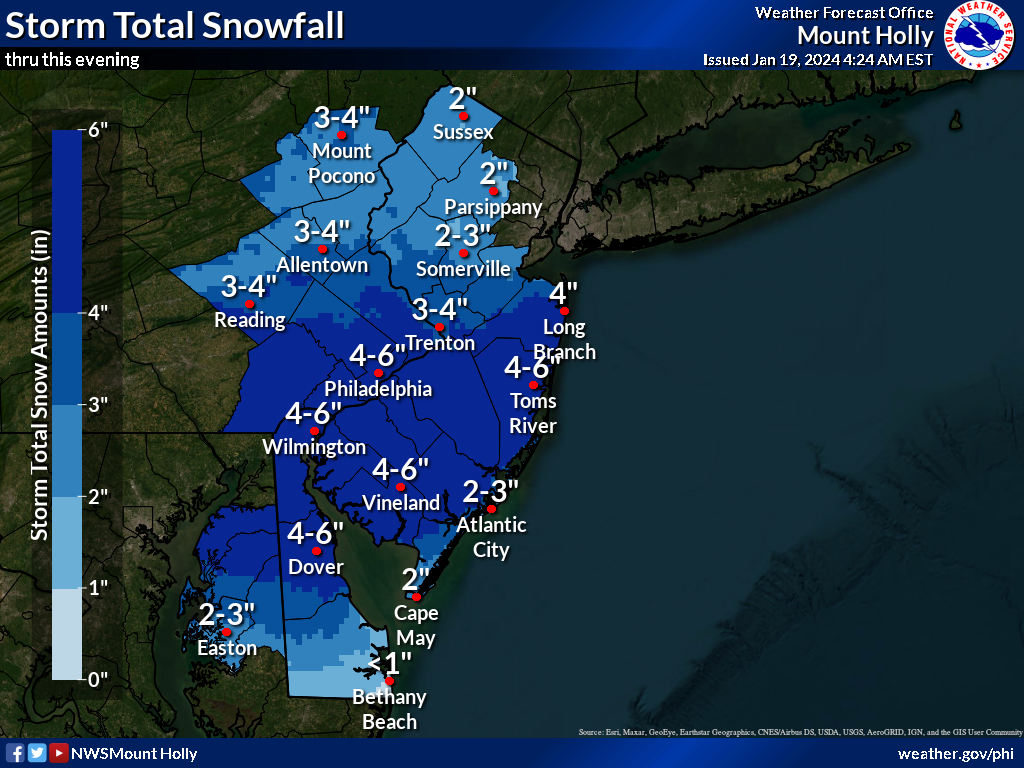
    Snowfall

###

Delaware Emergency Management Agency (DEMA) is the lead state agency for coordination of comprehensive emergency preparedness, training, response, recovery, and mitigation services to save lives, protect Delaware’s economic base and reduce the impact of emergencies. DEMA is a division within the Department of Safety and Homeland Security (DSHS) and authorized by Delaware Code, Title 20,Chapter 31 §3101-3130.

Social Media:

Delaware Department of Transportation on Facebook and X
Delaware Emergency Management Agency on Facebook and X and Instagram


State of DE offices in Kent & NCC Counties are closed on Friday, January 19, 2024

Severe Weather Conditions & Emergencies Alert

State of Delaware offices in Kent and New Castle Counties are closed on Friday, January 19, 2024, during regular business hours 8 a.m. to 4:30 p.m. Non-essential employees who live or work in Kent and New Castle Counties are not to report to work for this period. Essential employees designated for severe weather are to report as scheduled.