Delaware test scores show pockets of progress, but literacy emergency remains

New teaching strategies are driving gains in some Delaware schools, particularly in literacy instruction. Yet the latest student assessment performance test results show that there is still much work to do across reading, writing, and mathematics.

Across all three counties, English proficiency in grades 3-8 rose to 41% (up 1 point from 2024), and math to 34% (up 1 point). SAT reading proficiency among 11th graders climbed to 47% (up 2 points), while math held at 18%. Notable bright spots include New Castle Elementary in Colonial School District and the Cape Henlopen School District, where investments in high-quality instructional materials, LETRS training, and strong professional learning communities have fueled steady gains. Multilingual learners in Cape scored 21% proficient in ELA (state average: 15%), and low-income students scored 26% proficient in math (state average: 17%).

“No one should be satisfied with these scores,” said Secretary of Education Cindy Marten. “But where educators have the right tools and training, students are making real progress. We will keep scaling those strategies statewide until every child can read, write, and calculate at grade level.”

Since taking office in January 2025, the Meyer Administration and the Department of Education have prioritized a series of significant reforms in response to the literacy emergency. Targeted investments to support instruction are central to the effort. This includes developing professional learning communities for educators, year-long educator residencies, new professional development opportunities, strategic staffing models, early talent development initiatives, and improved recruitment efforts.

“These scores must improve,” said Governor Matt Meyer. “As our administration’s investments begin to reach classrooms this school year, every student must receive a world-class education, and every educator must have the tools to deliver the educational outcomes every Delaware family deserves.”

This school year, the state will be providing teachers with the opportunity to select literacy supports for their students and will be launching Bridge to Practice Grants, which further support district/charter efforts to build systems for literacy as well as strategic staffing models that create opportunities for increased collaboration and student achievement. This is along with an $8 million direct investment in expanding early literacy supports contained within the FY2026 state budget.

The complete 2024-2025 standardized testing results are available on the Delaware Open Data Portal.


2024 State Assessment Results Show Pandemic Recovery Continuing

New statewide student assessment results reinforce students’ continued need for help to recover from pandemic school building closures.

In English language arts (ELA), 40 percent of students in grades 3-8 scored at or above their grade’s proficiency level this year, the same as in 2023. In mathematics, 33 percent of students in grades 3-8 scored at or above their grade’s proficiency level, up 1 percentage point from last year. Overall, proficiency remains below the pre-pandemic levels in 2019 (53 percent in ELA and 44 percent in mathematics).

For high school statewide assessment, Delaware uses the SAT. This year 45 percent of students scored proficient or higher on the reading test, up 1 percentage point from last year while 18 percent scored proficient or higher in mathematics, down 5 percentage points from last year. On the essay test, 37 percent were proficient, down 5 percentage points from last year. In 2019, 48 percent scored proficient or higher on the reading test with 28 percent doing so in math and 42 percent on the essay.

“These results spotlight how great our students’ needs remain,” Secretary of Education Mark Holodick said. “Schools across the state have been investing in extended learning time, tutoring, high quality instructional materials, social emotional learning efforts and more. We must continue to evaluate student needs and provide appropriate supports.

“Just looking at the statewide data doesn’t tell the full story. To really understand what’s working and what needs adjustment, we must disaggregate the results to dig into the district, charter and school building data including grade level and demographic results,” Holodick said. “That’s how we can determine which interventions are having impact and affecting outcomes.”

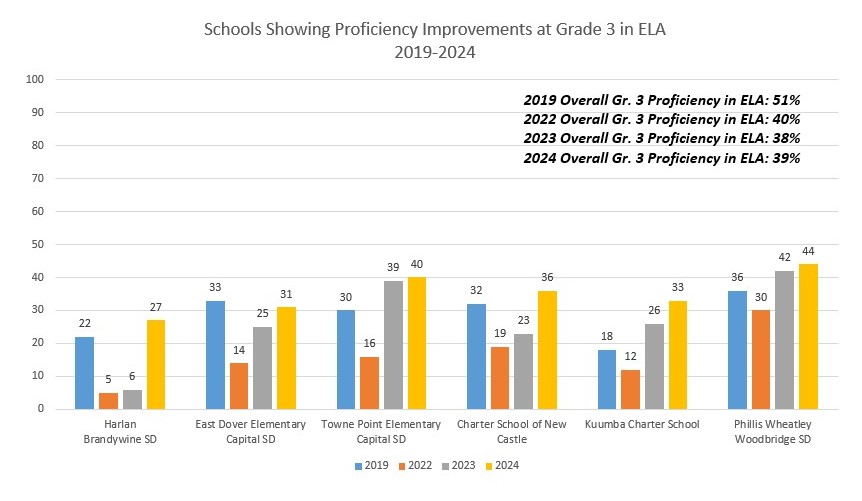
Much of the state’s focus of the past year has been on early literacy with the results showing some highlights in grade 3 ELA proficiency. For example, at Brandywine School District’s Harlan Elementary School, 27 percent of students were proficient in ELA this year, up from 6 percent in 2023. The 2024 scores surpass Harlan’s pre-pandemic scores (22 percent). Capital School District’s East Dover Elementary and Towne Point Elementary also saw gains as did Charter School of New Castle, Kuumba Academy Charter School and Woodbridge School District’s Phillis Wheatley Elementary School.


Graph showing proficiency improvements at grade 3 in ELA from 2019-2024.


Harlan, East Dover, Towne Point and Kuumba all have partnered with DDOE to participate in targeted support for early literacy through the Accelerate Grant. Through this partnership they implemented high dosage tutoring while engaging in professional learning and coaching support for their leaders and literacy educators. East Dover and Towne Point also have been highly engaged in the Early Literacy Leadership Academy (ELLA) work bringing district and building leadership to the table for sessions. They have participated in the coaching sessions and were also part of a webinar sharing their work. They have also participated in  DDOE’s Reimagining Professional Learning grants, and they have worked to connect their efforts across every initiative in early literacy. Phillis Wheatley has remained focused on supporting educators to use the curricula they have adopted.

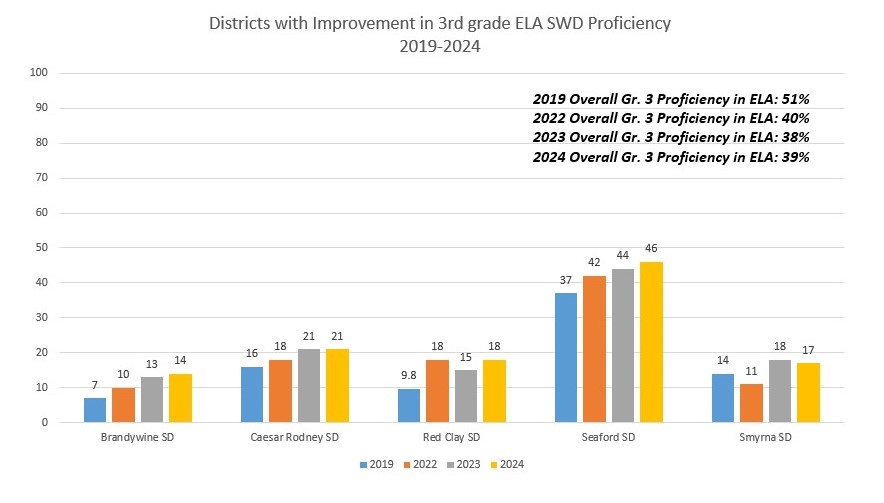
Another good story is being told in the Seaford School District, where third grade students with disabilities have been out-performing third-graders statewide for several years. For 2024, 46 percent of Seaford third-graders with disabilities scored proficient or above. That compares to 39 percent of third-graders statewide.


Graph showing districts with improvements in grade 3 ELA SWD from 2019-2024.


Seaford has remained consistent with its High Quality Instructional Material (HQIM) Tier 1 resources prior to, during and post-pandemic. The district also is diligent in its implementation of Seaford’s professional learning plan to increase the knowledge of current staff and onboard new staff. Seaford staff use Interim Assessment Block (IAB) data to look at trends in the data and pinpoints upcoming intersections of its curricula that they could be more intentional about during instruction.

“When DDOE staff visited classrooms over the past year, it was evident that Seaford continues to prioritize and streamline its literacy efforts. All students were receiving access to grade level instruction, and it wasn’t possible to tell the difference between general education students and students with disabilities,” Holodick said.

Seaford leaders pointed to several important factors to their students’ success as well:

  1. Students have access to high quality Tier 1 instruction with appropriate accommodations.
  2. Students receive these accommodations all year during instruction to help them meet grade level standards.
  3. Students are placed with staff they feel comfortable with on testing days.  “You can’t underestimate the power of a positive relationship,” Seaford Director of Instruction Kirsten Jennette said.
  4. IABs are used for practice throughout the year.
  5. Educators constantly review all of a student’s data to determine what the student needs to be successful.

“We look at each student individually and not just at the label attached to the child,” Jennette said.


Download full results on the Delaware Open Data Portal.


The state also administers science and social studies assessments in some grades, an alternate assessment for students with significant cognitive disabilities and the ACCESS test for multi-language learner students. Those results will be published in the coming weeks.


2022 State Test Results Provide Baseline for Pandemic Recovery

Statewide assessment results for the 2021-22 school year reinforce the continuing need to provide additional supports and learning time to students in response to COVID-19 school building closures.

For English language arts, 42 percent of students in grades 3-8 scored at or above their grade’s proficiency level. In mathematics, 30 percent of students in grades 3-8 scored at or above their grade’s proficiency level. Although the percentage of students who scored proficient is higher than in 2020-21, making a direct comparison is not appropriate because of lower participation rates in 2020-21 due to COVID-19.

“Providing educational opportunities this summer has been a priority because we know students are continuing to recover from pandemic-related unfinished learning,” Secretary of Education Mark Holodick said. “Recovery doesn’t happen overnight, and our educators are committed to continuing to meet students where they are to provide them the supports and learning time they need to succeed.  Federal Elementary and Secondary Emergency Relief funds (ESSER II and ESSER III) will allow for our schools and districts to use targeted interventions and institute system changes that address the needs of all students, especially those kids who need it most.”

For high school statewide assessment, Delaware uses the SAT, administered during the school day, generally in students’ 11th grade year. In 2022, Delaware moved from a paper and pencil exam to an online assessment (grade 3-8 assessments previously were online). Statewide, 47 percent of students scored proficient or higher in the reading test, 24 percent in math and 38 percent on the essay portion.

In science, Delaware tests in grades 5, 8 and high school biology. The 2021-22 scores show 21 percent of fifth graders, 17 percent of eighth graders and 26 percent of high school biology students scoring proficient or higher.

Social studies is assessed in grades 4, 7 and 11. Statewide for 2021-22, 32 percent of fourth graders, 29 percent of seventh graders and 24 percent of 11th graders scored at or above the proficient level.

Delaware administers an alternative assessment for students with significant cognitive disabilities. The state moved to a new assessment model in 2022. Find more information on this assessment as well as the ACCESS English language proficiency assessment here.

Families received their student reports in the mail last month, providing valuable information on their children’s learning progress. Educators received the results a few weeks after the students tested.

 “These assessment results help everyone from the classroom educator to policymakers better understand student learning and needs, and they will provide important guidance to us as we plan how to best support our students in the new school year,” Holodick said.

Find full results, including demographic and district/charter information, here.


2021 State Assessment Results Released

The Delaware Department of Education today released statewide assessment results for the 2020-21 school year, cautioning that due to low participation rates the results do not allow for comparison to previous test administrations.


“The 2020-21 school year was different from any other since many of our students were learning remotely for part or all of the academic year. Although assessment opportunities were available to all students, we saw significantly fewer students take the assessment,” Secretary of Education Susan Bunting said. “While direct comparisons with assessment data from previous years may not be appropriate because of this, the data provides an important temperature check that allows our schools to better track and address both short- and long-term learning needs.”


Although the U.S. Department of Education waived student assessment requirements in the 2019-2020 academic year due to COVID-19 school building closures that spring, Delaware was required to administer all tests for the 2020-21 academic year.


Statewide, participation was at 60 percent for the state’s English language arts and mathematics assessments for grades 3-8 while about 71 percent of eligible students took the SAT, the state’s high school federal accountability test. For the state’s social studies and science exams, 49 percent of eligible students participated. The state also administers an alternative assessment for students with significant cognitive disabilities. The overall participation was 58 percent on the alt assessment.


For those students who did participate, 41 percent scored at the proficiency level on the 3-8 ELA test while 26 percent did so in mathematics. On the SAT, 49 percent scored at proficient on evidenced-based reading and writing with 28 percent doing so on the math portion of the test and 44 percent on the essay section. Proficiency on the science assessment was 24 percent and 30 percent on the social studies assessment. For the alt assessment, the proficiency rates were 26 percent for ELA, 21 percent for math and 13 percent for science.


Families received their student reports in the mail last month, providing valuable information on their children’s learning progress. Educators received the results a few weeks after the students tested.


“Educators and school-based staff have faced and risen to meet unprecedented challenges in the past year. The assessment results will be used to help all of us educators better understand the needs of our students so we can more effectively support them,” Bunting said.


Find full results, including demographic and district/charter information, here.


Media contact: Alison May, alison.may@doe.k12.de.us, 302-735-4006

2019 state assessment results released

The Delaware Department of Education on Thursday released the 2019 statewide student assessment results.


Statewide, 53 percent of students in grades 3 to 8 scored at the proficient level or higher this year in the Smarter English language arts (ELA) assessment, compared to 54 percent in 2018. For mathematics, 44 percent of students in grades 3 to 8 scored at the proficient level or higher, no change from the 2018 results. At the high school level, students took the SAT with the results relatively unchanged.


Because Delaware transitioned this year to new science and social studies assessments, state officials will spend the fall setting cut scores to determine which scores are proficient on the new tests. Results will be released this winter. Results for the state’s alternate assessment, administered to those students with significant cognitive disabilities, were released today as well. Those results also were relatively unchanged.


Educators already received their students’ scores — Smarter results, for example, are available to teachers three weeks after their students complete the test. Families will receive score reports with their children’s results via U.S. mail beginning next week. Family guides and other resources also are available online.


For more information on state assessment results, visit the Delaware Report Card site and see the 2019 assessment presentation.


Smarter Assessment (ELA/mathematics)


Nationwide, states administering the Smarter assessment have seen similar trends to Delaware – slow growth at the state level with larger gains at some school levels.

Delaware did see slight gains in some subgroups statewide between 2018 and 2019, with English learners and students with disabilities averages increasing by one percentage point each in ELA and one percentage point in math for both students with disabilities and Hispanic students.

Secretary of Education Susan Bunting thanked students and educators for their hard work. She also committed to continue to provide supports from the state.

“We must focus our time and resources on promoting early diagnosis and intervention, using a range of assessments throughout the year and training educators on how to use the data available to them to effect change in curriculum and instruction,” she said. “We also must provide technical assistance and other support to our schools and districts  as they select local curricula so all children have access to high quality materials and assessments.”

Bunting also pointed to bright spots across the state, such as in Seaford School District, which has seen steady growth in both ELA and mathematics scores since 2015, the first year the state administered the Smarter assessment. For ELA, 56 percent of students scored at the proficient level or higher, above the state average and up 2 percentage points from last year. In 2015, only 38 percent of Seaford students were proficient. Math scores also are continuing to climb: This year 48 percent of students scored at proficient or higher, above the state average and 2 percentage points higher than in 2018. It is a 20-point gain from 2015.


Seaford’s Frederick Douglass Elementary particularly has shown strong growth. For ELA, 42 percent of students were proficient in 2015. The number has consistently improved since then, reaching 67 percent of students this year. In 2015, only 7 percent of the school’s English learners were proficient in ELA; 60 percent were this year. Other subgroups also showed strong ELA growth: the percent proficient went from 39 percent to 64 percent for low-income students, and 7 percent to 47 percent for students with disabilities.


Douglass’ math scores also have increased steadily, moving from 35 percent to 69 percent for all students between 2015 and 2019. English learner scores went from 7 percent to 70 percent proficient, students with disabilities went from 14 percent to 41 percent, low-income went from 30 percent to 66 percent, and Hispanic students went from 37 to 76 percent.


“When asked to explain our success we are able to point to simple addition,” Seaford Superintendent David Perrington said. “The district has worked hard at bringing together a number of dynamics that are essential for student achievement.  These include a supportive school board, a vision-driven district office staff, a strong building leadership, a committed teaching staff, an engaged student body, and a caring school community.

“At the beginning of the school year we discussed the concept ‘Push Don’t Pity.’  This model is grounded in the belief of high expectations for all students,” he said. “It requires us as educators to accept the responsibility of each student’s learning experience and each student to believe they have the capacity to succeed.  When added successfully together we have a sum of increasing student achievement.”

Lake Forest also saw some strong gains, particularly among subgroups in mathematics in several of its elementary schools. Lake Forest East, for example, saw gains between 2018 and 2019 of 39 percentage points for Hispanic students, 39 percentage points for English learners, 20 percentage points for low-income students and 14 percentage points for African American students. The gain was 12 percentage points for all students.


At Lake Forest North, the 2018 to 2019 scores show gains of 23 percentage points for low-income students, 17 percentage points for English learners, 8 percentage points for African American students, 7 percentage points for Hispanic students and 4 percentage points for all students.


“The Lake Forest School District attributes our success to using the standards to refine curriculum and lesson plans, analyzing formative and summative data during professional learning communities and staff development days and providing time for teacher collaboration throughout the year,” Superintendent Brenda Wynder said. “We are proud of our teachers’ willingness to strive for student achievement and continuous improvement in our data. It has taken our entire ‘village’ to achieve this success.”

Bunting also spotlighted several other schools that have shown strong growth for subgroups and students overall.

  • Caesar Rodney School District’s Allen Frear Elementary saw ELA proficiency for all students go from 69 percent to 83 percent between 2015 and 2019 with African American student proficiency improving from 46 percent to 72 percent. Math proficiency for all students moved from 60 percent to 72 percent with African American proficiency up from 34 percent to 57 percent in the same time period.
  • Christina School District’s Etta Wilson Elementary also has seen consistent growth for multiple subgroups and students overall in both ELA and math. For ELA, all student proficiency this year is 72 percent, up from 49 percent in 2015. English learner proficiency improved from 13 percent to 66 percent, low-income from 35 percent to 61 percent, students with disabilities from 17 percent to 39 percent and Hispanic students from 34 percent to 67 in the same period. In math, 73 percent of students scored at the proficient level or higher this year, compared to 52 percent in 2015. These subgroups also saw growth throughout the years: African American (40 percent to 59 percent), English learner (19 percent to 63 percent), low-income (35 percent to 63 percent), students with disabilities (19 percent to 43 percent) and Hispanic (40 percent to 69 percent).
  • Indian River School District’s Georgetown Middle School also has seen consistent success improving the scores of its students in ELA and math. For ELA, 64 percent of students overall passed the test in 2019, compared to 49 percent in 2015. Improvement among African American (40 percent to 60 percent), low-income (41 percent to 59 percent) and Hispanic students (44 percent to 62 percent) were included in the gains. For math, the growth from 2015 to 2019 overall was 34 percent to 55 percent with increases almost every year overall and among subgroups with an 11-percentage point gain just this year for English learner students. The overall growth for EL was 6 percent proficient in 2015 to 19 percent in 2019. Low-income students grew from 28 percent in 2015 to 50 percent this year with Hispanic student proficiency up to 52 percent in 2019, compared to 33 percent in 2015.


SAT


Delaware’s high school federal accountability test is the SAT, typically taken in 11th grade. Statewide 48 percent of students scored at the proficient level or higher in 2019 on the evidence-based reading and writing (ERW) portion, down 2 percentage points from 2018. In math, 28 percent of students did so, the same percentage as in 2018. For the essay portion of the exam, 42 percent of students scored at proficient or higher, down from 44 percent in 2018.


For math, Indian River School District saw gains. Indian River High School had 35 percent of students scoring at the proficient level or higher in 2019, up from 29 percent in 2018 and 32 percent in 2017. Sussex Central High School had 22 percent in 2019, up from 19 percent in 2018 and 21 percent in 2017.  Colonial School District’s William Penn High School also has seen steady growth: 15 percent in 2019, up from 13 percent in 2018 and 10 percent in 2017.


Alternate assessment


This is the second year of administration for Delaware’s alternate assessment. The percentage of students scoring proficient is down in all three subject areas (ELA, math and science) from last year’s initial administration. The 2019 state average for ELA was 28 percent proficient, down from 32 percent in 2018; math was 15 percent in 2019, down from 17 percent in 2018; and science was 17 percent in 2019, down from 19 percent in 2018.


Media Contact: Alison May, alison.may@doe.k12.de.us, 302-735-4006