Department of Insurance Issues First-Ever GLP-1 Report

While utilization rises, rebates mean that insurers and employers break-even

Use of GLP-1s – the popular medications to treat Type 2 Diabetes and obesity – nearly doubled among Delaware’s fully-insured commercial members from 2020 to 2023, according to a new first-in-the-nation analysis from the Department of Insurance’s Office of Value-Based Health Care Delivery. Data shows the expense of the medications was nearly fully balanced by manufacturer rebates.“It’s long been suggested that the cost of GLP-1s have been a primary contributor to rising health insurance costs, but this data shows that simply is not the case. Considering the rebates from drug manufacturers and other entities, even with increased utilization, they are not a substantive cost driver,” said Insurance Commissioner Trinidad Navarro. “While we can’t necessarily quantify the other savings they produce, for example by managing chronic conditions, preventing emergency care, and reductions in other medications, GLP-1 medications are proving to be an important cost-effective tool in managing obesity and diabetes.”
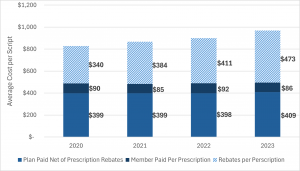
A simplified version of a chart from the report showing average cost of prescription, broken into insurer payment, insured payment, and rebates

Prices for the medications were relatively flat, after subtracting rebates, the analysis of data provided to the OVBHCD by Delaware’s three largest pharmacy benefit managers found. Rebates are payments typically made by a pharmaceutical manufacturer to a pharmacy benefit manager, who then shares all or some of rebate with the health insurer or employer.

Driven by the increase in use, total spending on GLP-1 medications more than doubled over the reviewed period. GLP-1 medications accounted for about 6 percent of all pharmacy spending for the Delaware commercial fully insured market. The trends in Delaware mirror those nationally.

In the coming months, the OVBHCD will expand its analysis of pharmacy spending to include all medications, offering further context to pharmacy spending among the commercial, fully insured population.

This report does not provide State of Delaware Group Health Insurance Plan GLP-1 data. Such data is not available in a manner that is inclusive of rebates, and solely reporting on spending can be inherently misleading due to the significant value of rebates received and fully retained by the State. In future contracts, the State’s PBM will be required to submit OVBHCD pharmacy data templates so information can be similarly analyzed by this expert team.

The Department of Insurance remains committed to supporting evidence-based care, improving access to effective treatments, and promoting transparency in the health care market. The Office’s findings will inform ongoing conversations about how to balance innovation with affordability in Delaware’s health care system.

Access the Report: Utilization Not Cost of GLP-1 Medications Drives Increased Spending

Office of Value-Based Health Care Delivery Website


Marketplace Health Insurance Rates Return to Trump-Era Highs

Federal budget, CMS rules, and expiration of subsidies to raise consumer costs

Carriers on the Delaware Health Insurance Marketplace have filed higher rates for the coming year. These actuarially justified increases are a result of federal budget activities, changes made to federal Marketplace rules, and the expiration of enhanced Advanced Premium Tax Credits. They do not apply to Medicare, Medicaid, or those with group or individual policies purchased outside Healthcare.gov.

“Enrollment in the Delaware Health Insurance Marketplace has more than doubled since we first saw rates decline in 2020. In that time, we’ve been able to enhance competition, invest in primary care, and improve the coverage and benefits offered by these plans. But, because of significant federal turmoil, premiums will rise in the coming year, and enrollment is likely to decline.” said Insurance Commissioner Trinidad Navarro.

As of February 2025, Delaware’s Marketplace enrollment was at an all-time high of 50,133. Advance Premium Tax Credits supported 45,885, or 92%, of policyholders, bringing premiums down $538 a month on average. In 2021, the credits were expanded to address the sharp subsidy cliff for those above 400% of the federal poverty level, which improved access and affordability. The expansion is set to expire at the end of the year.

“We continue to encourage Congress to protect health insurance affordability by extending or making permanent the credits Delaware consumers rely on to save more than $6,400 on premiums each year,” said Commissioner Navarro. “While carriers’ proposed rates reflect costs if expanded credits do not continue, we will make every effort to ensure insurers can lower rates if Congress does act.”

Trump Administration changes include cutting 90% of funding for Marketplace navigators and new rules to make enrollment markedly more cumbersome and costly, as well as restrictions on access to $0 premiums and increases to consumer cost-sharing. In Delaware, Special Enrollments grew the participant based by 5,562 throughout 2024, but provisions that eliminate the monthly Special Enrollment Period for income-based need will be effective soon. The rule also attempts to exclude gender-related care from essential health benefits. Along with 20 other states, the Commissioner worked with Attorney General Kathy Jennings to sue the administration over the rule changes.

State-originated causes for rate rise also exist, including continuing to have some of the highest health system prices in the country, with the creation of a regulatory entity to address this under litigation.

Open enrollment for the Marketplace takes place between November 1 and January 15. Residents may qualify to enroll or change plans based on special circumstances, such as a loss of qualifying health coverage, becoming a parent, and several other qualifying factors. Find out if you qualify for special enrollment.

Individual Affordable Care Act (ACA) Marketplace Rates Announced
Following in-depth reviews by the Commissioner, staff, independent actuaries, and the Office of Value-Based Health Care Delivery, rates for 40 regulated 2026 Marketplace plans have been finalized.

AmeriHealth Caritas’ request to increase rates 46.2% was decreased to a final average increase of 34.98% after actuarial discussion with the Department. Their 8 plans are promoted as not requiring referrals.

Celtic Ambetter Health of Delaware demanded a rate change of 31.8%, threatening to exit the state’s Marketplace and leave their policyholders scrambling for new coverage. Their request was approved despite best efforts to negotiate a smaller, but still actuarially appropriate increase, on behalf of Delaware consumers. Their 17 plans include marketed offerings with connected health savings accounts (HSAs), vision, and dental.

Highmark requested a rate increase of 30.3% and an average increase of 25% was approved. They will market 14 comprehensive plans and one catastrophic plan which includes three primary care visits. Offerings include HSA accounts, as well as connected vision and adult dental coverage.

All ACA-compliant health plans offer essential health benefits, including coverage of pre-existing conditions, prescriptions, emergency services and hospitalization, mental and behavioral health coverage, outpatient care, telehealth, lab services, and more. Plans on the Marketplace are spread among metal-level categories – bronze, silver, gold, platinum and catastrophic – and are based on how enrollees choose to split the costs of care with their insurer.

Other ACA and ACA-Compliant Rates

Off-market individual offerings include two plans from AmeriHealth Caritas and two from Highmark, both receiving increases that align with their on-Marketplace rates.

Delta Dental will increase rates by an average of 4.3% for two Marketplace family plans. Dominion Dental will increase their ACA premiums an average 4.8% on their 10 plans, including pediatric plans.

Off-market small group plan options for the coming plan year will finalize in October. Rate submissions show 32 plan options offered by Highmark at a requested a 22.73% increase, and United HealthCare has filed 33 plan options with an increase request of 30.33%.

More information on the rate review process

Be aware of non-compliant alternative health plans


CONSUMER ALERT: Patient And Pharmacy Protections During Rite Aid Closures

Navarro issues bulletin regarding consumer access, coverage, other insurer and PBM requirements

Rite Aid has commenced Chapter 11 bankruptcy proceedings, resulting in pharmacy closures in Delaware. These closures may disrupt patient access to medications, making prescription transfers and pharmacy accommodations an urgent priority. Insurance Commissioner Trinidad Navarro issued Bulletin No. 153 in response, building upon actions of the General Assembly, Meyer Administration, and Board of Pharmacy.

“Minimizing disruptions in pharmacy services is vital to ensuring the health and safety of Delawareans. Insurers and PBMs should ensure access to and coverage for emergency prescription refills, streamline the prior authorization and prescription transfer process, ensure fair reimbursement rates for pharmacies absorbing displaced patients, maintain adequate pharmacy networks, and communicate with affected policyholders,” said Insurance Commissioner Trinidad Navarro

“While this bulletin sets forth requirements for insurers and PBMs, I also want to encourage each and every resident and provider to take steps to ensure continued access to necessary medications. Providers and health systems: please contact your patients and encourage them to change their pharmacy selections in your portals or via direct contact to the provider. Patients currently served by Rite Aid: find a local pharmacy to transfer your medications to, and contact your providers or use their portals to make the switch.”

The Bulletin informs all health insurance carriers and pharmacy benefits managers (PBMs) of their obligations and the Department’s expectations as they relate to pharmacy closures and the Board of Pharmacy Emergency Order. The Department anticipates a significant increase in prescription transfer requests as displaced patients seek new pharmacies.

To maintain continuity of care and prevent disruptions, the Board of Pharmacy authorized one-time emergency prescription refills, which Commissioner Navarro requires to be covered by insurers. Coverage should extend to alternative verification methods such as prescription records, or pharmacy databases when prescriber authorization is unavailable due to pharmacy closures.

Carriers must streamline the prescription transfer process for patients moving from closed Rite Aid locations to new pharmacies. Carriers should notify affected policyholders about pharmacy closures and provide clear instructions on transferring prescriptions. Carriers and PBMs should provide dedicated support methods such as hotlines or web portals to assist individuals navigating prescription transfers.

Prior authorizations tied to a specific pharmacy should be automatically transferred to the patient’s new pharmacy without requiring reauthorization. Specialty medications and controlled substances requiring prior authorization should be expedited to avoid treatment delays. Any documentation requirements should not create undue hardship for pharmacies processing high patient volumes.

PBMs should ensure fair reimbursement rates for pharmacies absorbing displaced patients, preventing financial strain on independent and community pharmacies. Adequate pharmacy networks must be maintained to prevent pharmacy deserts, particularly in rural and underserved areas. Restrictive policies that steer patients toward specific pharmacies or mail-order services are prohibited under Delaware’s Pharmacy Access Act.

Measures specific to the Board of Pharmacy Emergency Order will remain in effect for 120 days from the issuance date unless extended or terminated by the Board with the concurrence of the Secretary of State. The Department will monitor compliance with the Bulletin’s provisions and issue further guidance if needed.

Bulletin No. 153

Board of Pharmacy Emergency Order

Governor Meyer’s Senate Bill 180 Press Release


Prominent Results in Increasing Fund Allocations to New Castle County Fire Companies

The Delaware Department of Insurance reported this month on the initial impact of HB 371, legislation sponsored by Representative Kim Williams and Senator Jack Walsh in the 152nd General Assembly. HB 371 was filed in order to solve an issue brought forth by the Delaware Volunteer Fire Company (DFVA) and the Department of Insurance (DOI) relating to Fire Tax.

Insurance companies pay taxes on the total premiums reported during the previous calendar year. These taxes are collected by the DOI and distributed by the Treasurer to specific entities as directed by law, with the remainder deposited to the State of Delaware’s General Fund. Fire Tax represents a percentage of premium taxes that is to be disbursed via geographic allocation to volunteer fire companies throughout the State and to the City of Wilmington Fire Pension.

The DOI and fire companies noticed in recent years a discrepancy surrounding the Fire Tax, caused by insurers reporting geographic location via Wilmington addresses that are not actually within the city’s jurisdiction. This reduced the accuracy of the funds sent to New Castle County fire companies.

HB 371, signed into law in October 2024, permanently corrected that problem by creating a zip-code based system simplifying geographic designation, ensuring that allocations are determined in a clear and consistent manner from year to year between the City of Wilmington and New Castle County. The solution was tested by the DOI for a year prior to codification to ensure the outcome appropriately solved fire company concerns.

“Every year the General Assembly passes hundreds of bills, so it’s important that we follow up and ensure those laws are working as intended and truly serving Delawareans,” said Rep. Kim Williams.

“Thanks to data from the Department of Insurance, we know that HB 371 is doing exactly that and providing our brave firefighters with more resources to keep our communities safe. This has been a decades-long issue and I’m glad that we were able to come together with the Delaware Volunteer Fire Association, the Department of Insurance, the Treasurer, and the Controller General’s Office to address the problem.”

On May 15th, the Department of Insurance reported that since reform went into effect, each New Castle County fire company received about $381,000 more in funding, inclusive of an $174,000 year-over-year increase following enactment.

Over this period, there has been a roughly $8 million increase in allocated fire taxes across the county. The decrease in Wilmington’s pension allocations has only been approximately $1 million, which speaks to the growth of funds via non-Wilmington new developments, premium changes, and other factors. The Pension had been receiving higher-than-appropriate allocations for several years.

“Throughout the implementation of this reform, each of New Castle County’s volunteer fire companies are receiving more accurate funds for their services protecting residents and insured properties. This year, their total disbursement from this portion of premium tax will be more than $1.25 million each. We are grateful that Rep. Williams, Senator Walsh, and the General Assembly took action to make permanent the improved method of calculating these funds,” said Insurance Commissioner Trinidad Navarro.

“These dollars serve those that save lives, and I couldn’t be more proud to play a part in that process, which this year alone will provide more than $57 million dollars to companies up and down the state, and to the City of Wilmington Fire Pension.”

In addition to employing a zip-code based system, HB 371 also reduced the number of payments per year from two to one, and gave the Insurance Commissioner more time to ensure the accuracy of insurer-reported geographic data.

“Our first responders put their lives on the line every day to keep our communities safe. As legislators, it’s our duty to ensure they have the resources they need to do their life-saving work as safely as possible,” said Sen. Jack Walsh.  “I am glad to see that House Bill 371 is working as we had hoped.”


Liberty Mutual Pays $300,000 Penalty For Misleading Consumers

Additional penalties possible if company compliance does not improve

After months of investigation, the Delaware Department of Insurance announced that Liberty Mutual has paid a penalty of $300,000 across three member companies, with an express stipulation that an additional $200,000 must be paid if conduct is not immediately remedied. The primary activities under review were the companies’ advertisement of potential premium discounts to automobile and homeowners’ insurance consumers despite not offering such discounts in Delaware. It is not the first time the company has been investigated for this issue.

“When shopping for insurance coverage, Delawareans already have so much to think about, especially in this economy. Our team is dedicated to uncovering misleading advertising and other misrepresentations that could lead to consumers choosing the wrong coverage for their needs, or their wallets,” said Insurance Commissioner Trinidad Navarro. “We have seen this problem before, and we are committed to ensuring it is corrected.”

39,806 instances of false information and advertising were uncovered during the examination of the companies. In 31,696 instances, the company listed a “claims free” discount on homeowners insurance declaration pages, when no such discount was offered in Delaware. In 8,110 cases Liberty companies indicated auto insurance consumers could access safety discounts if the consumers’ vehicle uses adaptive cruise control, lane departure warning, or collision preparation systems – but they offered no such discounts on Delaware policies.

The companies, Liberty Insurance Corporation, Liberty Mutual Personal Insurance Company, and LM Insurance Corporation write more than $59.7 Million in premium in Delaware. The examination reviewed relevant data from January 1, 2021 to July 31, 2023.

In the past, investigations of LM General Insurance Company and Liberty Mutual Fire Insurance Company from January 1, 2018 through March 31, 2021 encountered nearly 35,000 instances of false information and advertising, as well as additional violations of the Insurance Code. The companies each paid $150,000 in penalty, but their noncompliance with orders to correct the issue resulted in an additional examination.

Penalties are paid to the State’s General Fund.