Governor Matt Meyer Lays Out Delaware-First Agenda in State of the State Address

Governor focuses on collaboration in putting families first

DOVER— Governor Matt Meyer delivered his State of the State address to the Delaware General Assembly today, outlining a bold, people-first agenda focused on lowering costs for working families, strengthening public education, expanding access to affordable housing, and improving healthcare across the First State.

“Despite unprecedented uncertainty and challenges beyond our control, the State of our State is strong,” Governor Meyer said. “Now is not the time to shy away from difficulty. Because challenge creates opportunity — and opportunity, when met with purpose, makes us stronger.”

The Governor also awarded the State’s highest honor, the Order of the First State, posthumously to Corporal Matthew “Ty” Snook. He also recognized Trooper First Class Scott Smith with the Governor’s Award for Heroism and Bravery.

Affordability
Governor Meyer emphasized that rising costs, particularly energy bills, are straining Delaware families.

“Hard-working Delawareans are getting squeezed simply by turning on their lights,” Governor Meyer said. “Rate increases far beyond inflation are unacceptable.”

The Governor called on the Public Service Commission to halt approval of additional utility rate hikes and outlined efforts to increase in-state energy generation to stabilize costs.

Education
Education remained a central focus, with the Governor reaffirming his administration’s commitment to literacy, equity, and accountability.

“A year ago, we declared a Literacy Emergency, and we meant it,” Governor Meyer said. “If a child cannot read, they cannot succeed.”

Governor Meyer highlighted direct classroom investments supporting more than 4,000 classrooms and reiterated his call to modernize Delaware’s school funding system.

Housing
Governor Meyer described housing as one of Delaware’s greatest challenges, citing a shortage of nearly 20,000 affordable units.

“One-third of housing costs today have nothing to do with construction and everything to do with red tape,” Governor Meyer said.

He announced continued efforts to streamline permitting and accelerate affordable housing construction while protecting farmland and open space, along with plans to expand the HOPE Center model into Kent and Sussex Counties.

Healthcare
The Governor outlined a healthcare agenda centered on access, workforce growth, and innovation.

“No one would design an American healthcare system the way it exists today,” Governor Meyer said.

He highlighted Delaware’s success in securing hundreds of millions of dollars in federal rural health transformation funding to support initiatives, including the state’s first medical school, expanded healthcare training programs, mobile health units, and telehealth services.

Governor Meyer closed by reaffirming his commitment to responsible budgeting, transparency, and collaboration with the General Assembly to deliver results for Delaware families.

To read the Governor’s full State of the State address, CLICK HERE.

For any questions, please email govcomm@delaware.gov.


Governor Matt Meyer Issues Statement on Retirement of Senate President Pro Tempore Dave Sokola

DOVER— Governor Matt Meyer today released the following statement in response to Senate President Pro Tempore Dave Sokola’s announcement that he will not seek reelection:

“Senator Dave Sokola is a leader whose steady presence and thoughtful approach have helped shape public service in our state for a generation. He leads with heart as much as with principle, and I never doubt his sincerity, his respect for this institution, or his deep care for the people we both serve. He brings a quiet strength to his work that steadies the room, and a conviction that reminds all of us why we chose to serve.

“As he prepares to close this chapter, Dave leaves more than a record of legislation — he leaves an enduring example of what it means to lead with integrity, humility, and grace.

“I look forward to a productive session ahead and to working with Dave for one more year to bring a new, fair public education funding formula across the finish line for the students and families of Delaware. Our state is stronger because of his voice, his judgment, and his spirit.”

For any questions, please email govcomm@delaware.gov.


Delaware Publishes Updated Plan to Combat Climate Change and Protect Communities

2025 Plan Addresses Rising Heat, Flooding, and Health Risks

DOVER— Today, the State of Delaware has released the 2025 Climate Action Plan, a practical guide to reduce emissions, strengthen resilience, and secure a safer future for the First State.

“Climate change is already reshaping life here in the First State, from extreme rainfall overwhelming our stormwater systems, to heat islands driving up temperatures in our cities, and coastal roads flooding regularly,” Governor Matt Meyer said. “Our Climate Action Plan puts people first by protecting clean air and water for every Delawarean, creating good-paying clean energy jobs, and making our communities safer and more equitable. We’ve seen real progress towards ambitious targets to cut pollution and strengthen resilience, but now we accelerate — because protecting our environment means protecting our families, our economy, and our future.”

Visit de.gov/climateplan to explore the full plan and data. The 2025 Climate Action Plan is also available in Spanish.

The 2025 plan is the first since Delaware enacted the Climate Change Solutions Act in 2023, which set a target of cutting greenhouse gas emissions by 50% by 2030 and reaching net-zero by 2050. The first Climate Action Plan was issued in November 2021.

In addition to identifying near-term actions and long-term strategies for emission reduction and resilience, the 2025 Plan outlines climate risks and future scenarios, highlights recent progress, discusses workforce needs, and directs an all-of-government approach to responding to climate change. It also includes a chapter dedicated to the important intersection between responding to climate change and land use.

Development of the plan included extensive public engagement over an 18-month period. The DNREC Division of Climate, Coastal and Energy hosted public workshops in all three counties, held dozens of community briefings, and gathered input from more than 2,300 Delawareans through events, surveys, and feedback sessions. Outreach to under-resourced communities ensured equity, and lived experiences helped shape the final plan.

Delawareans are living with climate change now and will experience increased impacts as humans release planet-warming pollution into the atmosphere. Sea levels have risen more than a foot along the coast in the past 100 years and are expected to rise another 1.2 to 1.5 feet by 2050. Average temperatures in the state are 3 degrees warmer since records began in 1895 and are projected to increase and addition 3-4 degrees by mid-century.

Delaware’s precipitation patterns are also changing. Already, we are experiencing extreme rainfall more often, and average annual precipitation is forecast to increase, leading to more flooding in cities and towns.

Greg Patterson, Secretary for the Delaware Department of Natural Resources and Environmental Control, said the plan is flexible.

“Actions may change over time based on increased understanding of climate impacts, technology advancements, and stakeholder input,” he said. “While DNREC plays a leading role in implementing the Plan, no single policy or agency can solve this issue alone. It will take all of us working together.”

The 2025 Climate Action Plan outlines a path to near net-zero emissions by 2050 and steps to improve community resilience. It supports transparency, accountability and a collaborative approach to climate planning, with regular updates due in 2027 and 2029. The next Climate Action Plan will be published in 2030.

Governor Meyer and DNREC Secretary Patterson underscored the importance of the plan in guiding statewide efforts but emphasized that climate change is a shared challenge that affects the health, safety, economy, infrastructure, and quality of life across every community and sector in Delaware.

Leaders across Delaware echoed that message, underscoring the urgency, relevance, and shared responsibility of the state’s Climate Action Plan:

“Portions of Delaware’s infrastructure are especially vulnerable to the impacts of climate change, and our team has worked closely with DNREC on this plan,” Secretary of Transportation Shanté Hastings said. “Together, we are identifying areas of need and steps we can take to mitigate the effects and create resiliency in the years ahead.”

“Climate change is not just a risk for the future, but is already being felt in Delaware today,” Delaware Public Advocate Jameson Tweedie said. “Rising temperatures mean hotter summers and higher costs for air conditioning. More extreme weather brings year-round storm risks: spiking costs, strained systems, and power outages. All of these can mean higher utility costs, less reliability in our power systems, and serious health and safety risks if those systems fail. These compound the impacts of already rapidly rising utility costs on Delawareans, but solutions exist that can both help Delaware achieve its climate goals and help control utility costs. Energy efficiency can both lower energy use and lower energy bills, and incentives are available to help with upfront costs. Solar energy is now one of the lowest-cost sources of electricity and is widely available through rooftop solar and community solar to help Delawareans take control of their energy costs. We must continue working together to find creative solutions to help Delaware address climate change and control utility costs.”

“Climate change is not only an environmental challenge — it is a public health emergency,” Mid Atlantic Alliance on Climate and Health Vice President Shweta Arya said. “Intensifying heat waves and flooding put Delawareans at risk, especially our most vulnerable residents: children, older adults, outdoor and agricultural workers, and people with chronic health conditions. The 2025 Delaware Climate Action Plan builds on the foundation of the 2021 plan and advances the goals of the Climate Change Solutions Act by investing in strategies that prevent heat-related illness, safeguard clean air and water, and strengthen community preparedness. By taking these steps, Delaware is protecting lives today and laying the foundation for a healthier, more resilient future for generations to come.”

“Delaware cannot adapt to a changing climate or sea level rise without cutting greenhouse gas emissions, conserving energy and improving efficiency, adopting clean renewable energy technologies, or protecting the lands and waters that store carbon and enhance coastal resiliency,” Delaware Nature Society Executive Director Jen Adkins said. “The updated Climate Action Plan addresses all of these issues and more by including proven strategies and actions, especially for preserving wetlands and woodlands, which are the most effective carbon storage systems we have, and for enhancing the resilience of natural landscapes and agricultural lands that keep all Delawareans safe and healthy.”

“At Sussex Health & Environmental Network, we hear from families in Sussex County who are paying too much for energy while also living with flooding, extreme heat, and sea-level rise that threatens their homes,” Sussex Health and Environmental Network Executive Director Maria Payan said. “Energy justice means those same families are first in line for relief — lower bills, safer homes, and cleaner air. Delaware’s 2025 Climate Action Plan moves us in that direction by putting more investment into the communities hit hardest by pollution and climate change, so children can breathe easier, stay safe during dangerous heat and floods, and afford to stay in the places they call home.”

For any questions, please email govcomm@delaware.gov.

Governor Meyer Issues Statement on Retirement of Supreme Court Justice Karen Valihura

WILMINGTON—Today, Governor Matt Meyer issued the following statement regarding Supreme Court Justice Karen Valihura’s announcement that she will retire at the end of her term in July.

“Justice Karen Valihura has dedicated her career to upholding the rule of law and strengthening Delaware’s judiciary, and our state is better because of her service.

“For more than a decade on the Delaware Supreme Court, Justice Valihura has brought thoughtful leadership and sound judgment to our state’s highest court. As the second woman to serve on the Delaware Supreme Court, she helped break barriers and set a powerful example of what leadership, excellence, and public service can look like for generations to come.

“As Justice Valihura prepares to step down at the conclusion of her term this July, I want to thank her for her years of distinguished public service and her lasting contributions to Delaware’s courts. Delawareans are better served because of her work, and I wish her continued purpose and success in the next chapter of her public service.”

For any questions or to schedule a one-on-one interview with Governor Meyer, please email govcomm@delaware.gov.


Governor Meyer Announces First Round of Medical Debt Relief, Nearly $19 Million Eliminated for more than 18,000

A FY2026 budget investment of $500,000 will help eliminate up to $50 million total in medical debt for Delaware families

WILMINGTON— Governor Matt Meyer today announced significant progress in Delaware’s medical debt elimination initiative, with nearly $19 million in medical debt abolished for more than 18,000 Delawareans so far. The effort is supported by a $500,000 investment included in the FY2026 budget to partner with Undue Medical Debt, a national nonprofit organization, to eliminate up to $50 million in qualifying medical debt for hardworking Delawareans. Undue Medical Debt acquires the most burdensome medical debts in bulk for a fraction of their face value, meaning one dollar can erase $100 of medical debt on average.

“Medical debt can follow Americans for years, limiting opportunity and creating a burden that no one deserves to carry,” Governor Matt Meyer said. “With this first $19 million in debt wiped away, we’re showing what’s possible when states invest in practical solutions to deliver real relief. We’re already helping over 18,000 Delawareans sleep easier this holiday season, and we look forward to more good news in 2026.”

To date, Undue Medical Debt has abolished $18.8 million in medical debt for 18,145 individuals across Delaware. Those receiving relief span all ages, including more than 2,300 young adults aged 18–30, nearly 7,000 residents aged 31–45, more than 4,300 aged 46–60, and over 3,000 Delawareans aged 61 and older. The administration will continue working with Undue Medical Debt to complete additional debt purchases in the months ahead, with the goal of reaching up to $50 million in total medical debt relief for Delawareans.

“We are all just one injury, diagnosis, or accident away from having our lives turned completely upside down,” House Speaker Melissa Minor-Brown said. “For thousands of Delawareans, this initiative is lifting the heavy burden of medical debt and providing real, life-changing relief. I’m proud that the General Assembly was able to help make this possible, and I hope even more residents across our state are able to benefit from this effort.”

“Medical debt is a burden for thousands of Delawareans, negatively impacting one’s quality of life and financial stability. Our collective efforts to provide relief to residents is a welcome surprise for many this holiday season,” Sen. Spiros Mantzavinos said. “By wiping out medical debt, we help families regain financial security and reduce stress so individuals can focus on their health and future rather than past medical emergencies. These efforts have already delivered extraordinary relief throughout Delaware, offering people a second chance when confronted with hurdles they neither anticipated nor deserved.”

“Medical debt is something that is often completely out of people’s control, but it can have real impacts on their lives and even cause them to delay or skip treatment for serious medical issues,” Rep. Kim Williams said. “I’m glad we were able to help and support Delawareans with this initiative, and together with my and Senator Mantzavinos’ bill to remove medical debt from credit reports, even more people will have the opportunity to move forward without this financial burden holding them back.”

“I’m incredibly grateful to Governor Meyer and the state of Delaware for this investment in medical debt relief that’s bringing much-needed good news to over 18,000 Delawareans just in time for the holidays,” Undue Medical Debt CEO and president Allison Sesso said. “Medical debt is both a financial and emotional burden; no one chooses to get sick, be in an accident, or have a chronic condition. This partnership will provide welcome relief to families facing financial hardship simply from seeking necessary care, and we look forward to continuing our work with Delaware leaders to help even more residents in the new year.”

HOW MEDICAL DEBT ELIMINATION WORKS:

  • Undue Medical Debt purchases bundled medical debt portfolios from hospitals and commercial debt buyers for pennies on the dollar and then abolishes that debt entirely.
  • There is no application process.
  • Eligibility is based on financial need. Delaware residents qualify if their household income is at or below 400 percent of the federal poverty level — roughly $100,000 for a family of three — or if their medical debt equals five percent or more of their annual household income.
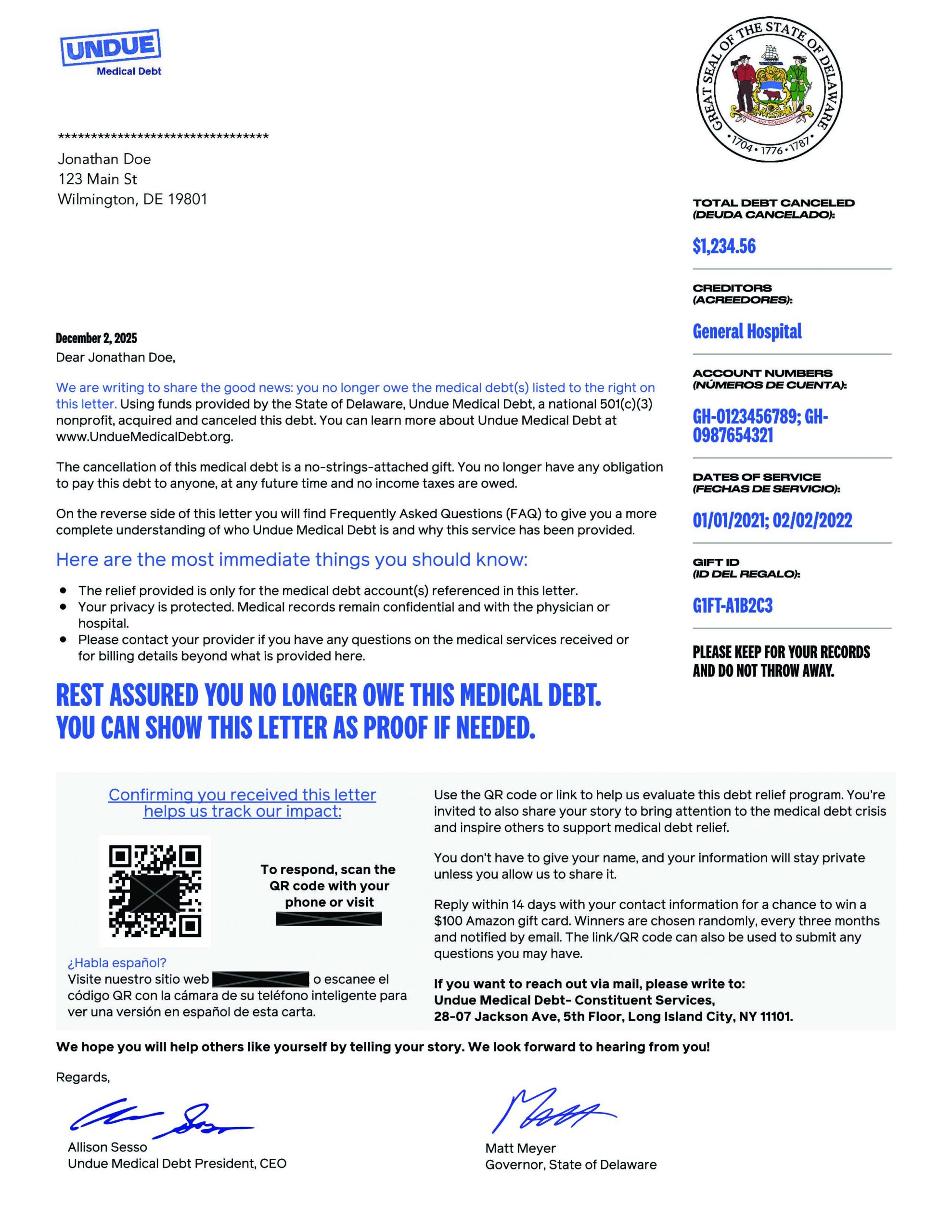
  • Qualifying residents will receive a letter directly from Undue Medical Debt confirming that their medical debt has been eliminated, with letters for the first round of relief set to hit mailboxes between December 19 and December 23, 2025. 23, 2025. No action is required from recipients. The letter functions as a receipt of debt relief. Learn more: https://unduemedicaldebt.org/faq/.

Links to the sample letter, demographics report, and FAQ can be found HERE.

ABOUT UNDUE MEDICAL DEBT:
Undue Medical Debt is a national 501(c)(3) nonprofit founded in 2014 by former debt collectors. To date, Undue has acquired — and abolished — over $23.3 billion of burdensome medical debt, helping over 15 million families and addressing a major social determinant of health. Undue purchases debts for a fraction of their face value in bundled portfolios and partners with individuals, faith-based organizations, local and state governments, foundations, and corporations to empower donors by converting every dollar contributed into $100 of medical debt relief on average.

Undue partners with hospitals, health systems, and physician groups to acquire medical debt for abolishment. Undue rose to national prominence on an episode of HBO’s “Last Week Tonight” with John Oliver, in which Undue facilitated the abolishment of $15M in medical debt. To learn more, visit UndueMedicalDebt.org.


Sample Letter:

A sample letter from Undue Medical Debt informing recipients that their medical debt has been wiped.

For any questions, please email govcomm@delaware.gov.