Family Emergency Preparedness Day on September 14 for National Preparedness Month

Free, family event features information, demonstrations, and activities for all ages.

To celebrate September as National Preparedness Month, more than 45 public safety agencies, nonprofits, and utilities will join together for the 18th Annual Family Emergency Preparedness Day on Saturday, September 14, from 10 a.m. to 2 p.m. at Brecknock County Park, 80 Old Camden Road, Camden, Delaware. There is no cost to attend and free parking is available onsite. There is no rain date.

The event offers attendees a chance to meet first responders and public safety experts in a fun, friendly environment where families can find a wealth of information and resources to promote emergency preparedness and help them “make a plan, build a kit, and stay informed” by visiting PrepareDE.org. The first 500 people to complete an activity challenge can earn a free treat from Kona Ice.

Family Emergency Preparedness Day is sponsored by the Delaware Emergency Management Agency (DEMA), Kent County Parks and Recreation, Kent County Department of Public Safety, Delaware State Fire School, and the Delaware Division of Public Health’s Office of Preparedness.

Previous event photos are available at the DEMA FEP Day Photo Album on Flickr.
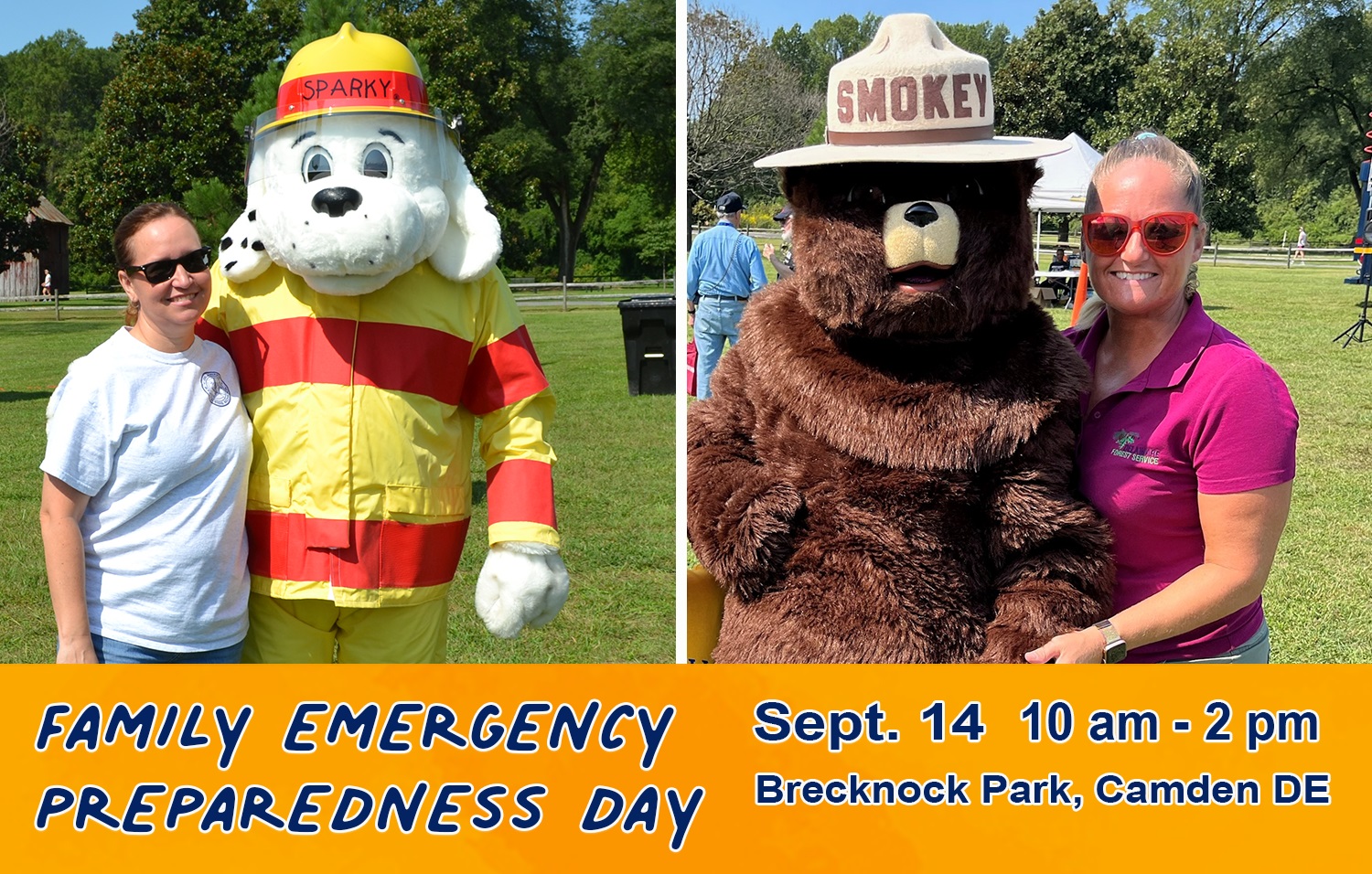
Sparky and Smokey FEP Day
Kids of all ages can meet Sparky the Fire Dog and Smokey Bear at the 18th Annual Family Emergency Preparedness Day.


Kids of all ages can meet Smokey Bear (Delaware Forest Service) and Sparky the Fire Dog (Delaware State Fire School) or take a ride on the Jump on Over Mini-Train. The Camden-Wyoming Fire Company will demonstrate a live vehicle extrication to show how first responders can free occupants trapped in a car. Bayhealth Healthcare will conduct sessions on how to “Stop the Bleed” and Kent County EMS will provide “Hands Only CPR” training. The Delaware State Police will showcase its maritime scuba trailer, mounted patrol, and K-9 unit. Chesapeake Utilities and Delmarva Power trailers will demonstrate gas and electrical safety while the Division of Alcohol and Tobacco Enforcement invites the public to try its Impaired/Distracted Driver Simulator. The public can also explore heavy equipment and emergency apparatus from numerous local fire companies and EMS agencies, including ladder trucks, engines, ambulances, and the Christiana Care Life Net helicopter.
Numerous public agencies and nonprofits will be on hand to inform the public about their many services and resources, including Dover Air Force Base, Delaware 2-1-1, DNREC (hazardous materials), DelDOT (drones), Delaware Office of Highway Safety, DPH Office of Animal Welfare, Delaware Animal Response, Dover/Kent MPO, Delaware Department of Corrections, Kent County Amateur Radio Emergency Services, St. Francis Hospital, YWCA, and many more (see list below).

National Preparedness Month

Launched in 2004, National Preparedness Month (NPM) is FEMA’s national annual preparedness outreach as part of FEMA’s Ready Campaign. In conjunction with the Ad Council, NPM aims to educate and empower Americans to prepare for and respond to all types of emergencies, including natural disasters and potential terrorist attacks. National Preparedness Month culminates on September 30 with National Preparedness Day. The 2024 theme is “Start a Conversation.

The importance of being prepared for emergencies is underscored by the FEMA National Household Survey, an annual snapshot of how well families are prepared for disasters and emergencies. The 2023 responses indicated 51 percent of adults believe they were prepared for a disaster and 57 percent had taken three or more preparedness actions in the last year. The results offered both encouragement and a need to take more action: there was a large increase in the percentage of people who assembled or updated supplies, but also a large decrease in the percentage of people who signed up for alerts and warnings. Only 50 percent of respondents believed that preparing can help in a disaster and were confident in their ability to prepare.
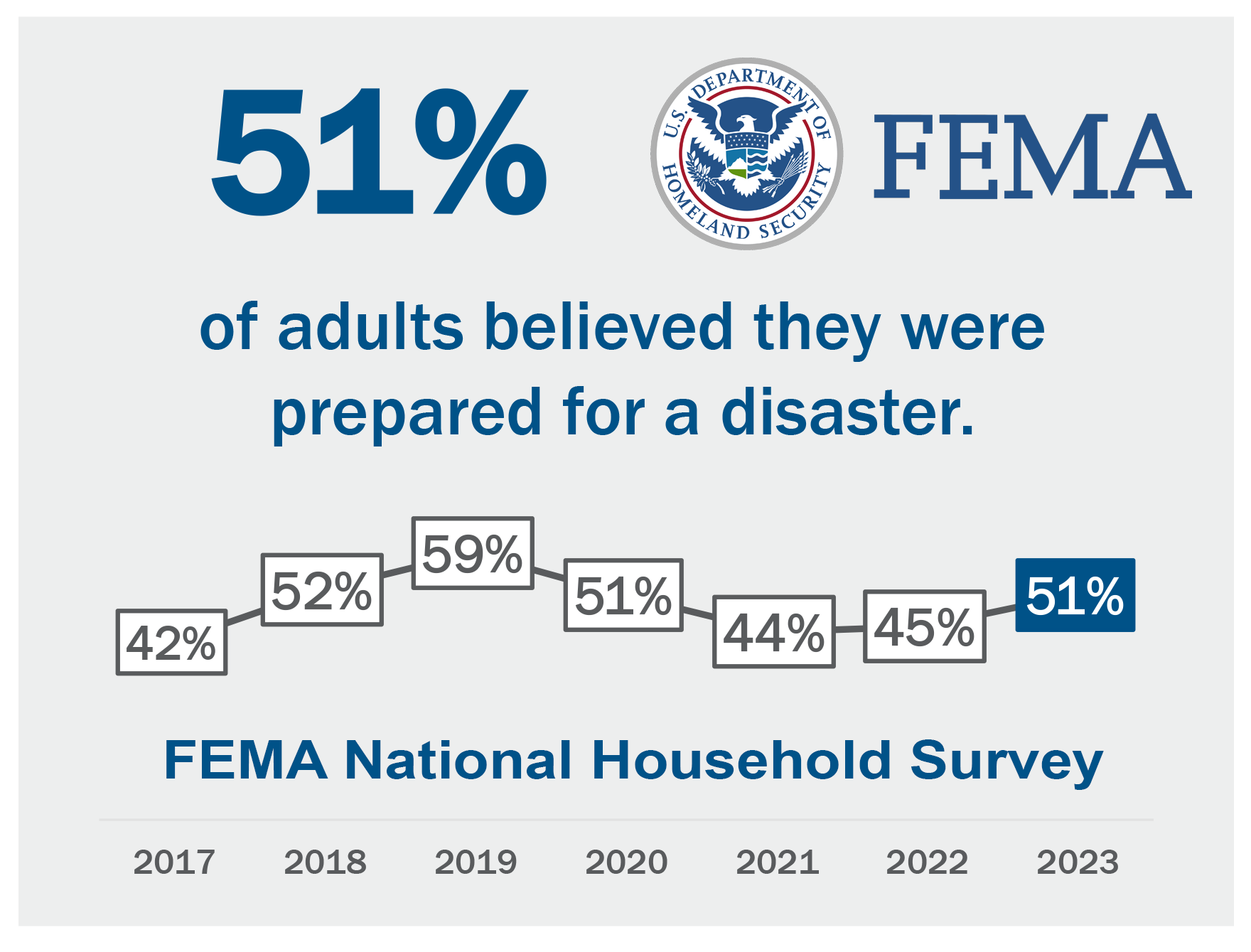
FEMA Household Survey 2023 results

FEP Day 2024 Scheduled Exhibitors:

  • AT&T FirstNet
  • Bayhealth – Injury Prevention
  • Bayhealth Healthcare – Stop the Bleed
  • Camden-Wyoming Fire Company – Fire Trucks and Vehicle Extraction
  • Chesapeake Utilities – Safety Trailer
  • Christiana Care Life Net Helicopter
  • Contact Lifeline, Inc. 2-1-1 Delaware
  • DE BEST (Behavioral and Emotional Support Team)
  • Delaware Insurance Office
  • Delaware Office of Highway Safety
  • Delaware Crime Stoppers
  • Delaware Forest Service – Smokey the Bear
  • Delaware State Fire School
  • DelDOT – Drones
  • Delmarva Power – Electrical Safety Trailer
  • Delaware Emergency Management Agency
  • Delaware Department of Corrections
  • DHSS Office of Infectious Disease
  • DHSS – Office of Animal Welfare/Delaware Animal Response
  • DHSS Office of Preparedness – Access and Functional Needs
  • DHSS/DPH Bureau of Health Equity, Rape Prevention Program
  • DNREC – Hazardous Chemical Safety
  • Dover Air Force Base – Safety Trailer
  • Dover/Kent Metropolitan Planning Organization (MPO)
  • DPH – Office of Preparedness – Make a Kit
  • Division of Alcohol & Tobacco Enforcement – Impaired/Distracted Driver Simulator
  • Delaware State Police (DSP) – Canine Handlers
  • DSP Community Engagement
  • DSP DIAC 1-800-FORCE-12 Terrorism Tip Line
  • DSP DIAC – Maritime Scuba Trailer
  • DSP Mounted Patrol Unit
  • Harrington Fire Department – Static Ambulance
  • Kent County Amateur Radio Emergency Services (ARES)
  • Kent County EMS -– Hands Only CPR
  • Kent County Public Safety – Mobile Unit
  • Little Creek Fire Department – Ladder Truck w/ Flag
  • Magnolia Fire Department -– Tanker – Spray for kids
  • Mini Train – Jump on Over
  • Poison Control Center at Children’s Hospital of Philadelphia (Delaware Center)
  • Respond DE Medical Reserve Corps
  • St. Francis Hospital – Bike and Helmet Safety with Ambulance
  • Sussex County AUXCOMM / CERT Trailer
  • University of Delaware – Center for Disabilities Studies
  • YWCA – SARC – Domestic Violence

Food Vendors:

  • Kona Ice – Desert Truck
  • Steel Bowl – Food Truck

Social Media: Delaware Emergency Management Agency on Facebook and X and Instagram


Carney Administration Prioritizes Farmland Preservation, Preserving Highest Number of Farms

DOVER, Del. (August 13, 2024)—The Delaware Department of Agriculture announced the 28th round of easement selections by the Delaware Agricultural Lands Preservation, preserving 40 farms and 2,262 acres of farmland. With this announcement, the Carney administration has preserved 403 farms, the highest number in the program’s history.

“Investing in Delaware’s AgLands program allows us to protect Delaware’s agriculture heritage and the future of our number one industry while benefiting the greater environment,” said Governor Carney. “I want to thank the Aglands team at the Department of Agriculture, the members of the General Assembly, and all who work to preserve this important part of Delaware’s history and economy. It’s been an honor to support this program and our family farms over the years.”

In 1991, the General Assembly passed legislation, signed into law by Gov. Michael N. Castle, to create the framework for the Agricultural Lands Preservation Foundation, which oversees the preservation program with staffing support from Department of Agriculture employees. The first funding was allocated in 1995 under Gov. Carper, who preserved 273 Delaware farms; Gov. Minner, with 288 farms; and Gov. Markell, with 292 farms.

After over 10 years of not being funded, Governor Carney reinstated the Forestland Preservation Program funding in 2019. Entirely forested properties in managed timber production can enroll in the Forestland Preservation Program, which purchases Forestland Preservation Easements similar to Aglands Preservation. Through Governor Carney’s support in maintaining a sustainable forest system that benefits wildlife habitat, the forest industry, and all Delawareans, the state’s Forestland Preservation Program saw a significant increase in participation. Since then, the program has purchased 12 forestland easements on more than 866 acres, with another 1,617 acres temporarily preserved on 21 forestland areas, similar to how agricultural districts operate for farmland preservation. An additional 40,600 acres of forest have been purchased under Aglands Preservation.

“Trees are extremely important for our environment, but they are also extremely important for the revenue they can produce for our landowners, which is why the Forestland Preservation Program is key to our timber industry in Delaware,” said Secretary of Agriculture Michael T. Scuse. “Because of the importance the Governor placed on planting trees to improve the environment, the Delaware Forest Service made a major effort to plant 1,013,149 trees from 2020 to 2024 before the Governor left office, contributing to his legacy of protecting Delaware’s land and improving the overall environment through increasing forested areas across the state.”

The Delaware Agricultural Lands Preservation Foundation Easements are available for viewing through an online dashboard at https://de.gov/agdashboard.

The Delaware Agricultural Lands Preservation Foundation selects farms approved for easement purchase using an impartial discounted ranking system that maximizes taxpayer benefits. The Foundation does not own the land but purchases landowners’ development rights and places a permanent agricultural conservation easement on the property. Landowners must first voluntarily enroll their farm into a 10-year preservation district and are eligible for permanent preservation the year after they apply.

In addition to more than 155,486 acres in permanent easements, Delaware’s Aglands and Forestland Preservation Programs have more than 47,300 acres of land enrolled in 10-year preservation districts.

County governments can partner with the state program and add county funds to select properties in their areas, leveraging state resources for the greatest impact. In today’s announcement, the county governments provided over $715,000 to help purchase 18 easements in this round.

“Agriculture is the lifeblood of Sussex County. It drives our economy, and it’s driven our communities for centuries. Sussex County is agriculture through and through, right down to our roots,” County Council President Michael H. Vincent said. “The County Council is honored to be part of this continuing effort through the Delaware Aglands program to preserve what is an integral way of life, one that we hope will continue to be for generations to come.”

Delaware’s statewide program made its first round of easement purchases in 1996 and has since preserved 22.7% of New Castle County farmland, 42.8% of Kent County farmland, and 22.5% of Sussex County farmland.

Levy Court President Terry L. Pepper said, “Kent County is committed to balancing growth with conservation. This program not only helps preserve valuable farmland, but also supports local agriculture, ensuring a sustainable and thriving environment for generations to come.”

Delaware farmers interested in preserving their farms should be sure they meet the following eligibility requirements:
• Property must be zoned for agriculture and not subject to any major subdivision plan.
• The property meets the minimum Land Evaluation and Site Assessment (LESA) score of 170. LESA is a process that attempts to estimate the farm’s long-term viability based on the farm’s soil productivity, land use, and agriculture infrastructure on and around the farm. Scores range from 0-300. Aglands program staff calculate the LESA score when applications are received.
•The property must be working farmland with at least $1,000 in agricultural sales annually and generally have at least 10 acres of cropland.
• Farms of 200 acres or more constitute an agricultural district.
• Farms under 200 acres can enter the program if it is within 3 miles of an existing agricultural district.

With 1,273 farms already preserved, rarely does a farm under 200 acres not meet these criteria.

For more information or to obtain applications related to the Delaware Aglands Preservation Program, interested landowners can visit https://de.gov/aglands or call (302) 698-4530.

The Delaware Agricultural Lands Preservation Foundation’s Board of Trustees includes representatives from agriculture and state agencies. Trustees are Mark Collins, chairman; James G. Vanderwende, vice-chairman; Janice Truitt, treasurer; William H. “Chip” Narvel Jr., secretary; Secretary of Agriculture Michael T. Scuse; State Treasurer Colleen C. Davis; Secretary of Natural Resources and Environmental Control Shawn Garvin; Dorothy Abbott; Robert Walls, Sr.; Robert Emerson; and H. Grier Stayton.

###


Box Tree Moth Found at Private Residence in Kent County, Delaware

DOVER, Del. (July 15, 2024) — The United States Department of Agriculture’s Animal and Plant Health Inspection Service (USDA-APHIS) has confirmed a find of box tree moth (BTM; Cydalima perspectalis) at a private residence in Kent County, Delaware.

The box tree moth is a federally regulated pest that primarily feeds on boxwood species (Buxus spp.). If left unchecked, it causes significant damage and can potentially kill the plants. Boxwoods are a popular ornamental evergreen shrub common to many landscape environments in the United States.

“Box tree moth is an unexpected find in Delaware due to the distance from the only known U.S. detections in New York, Michigan, Ohio, and Massachusetts, with the original introduction in New York in 2021. We are working closely with USDA and University of Delaware Extension to map out the infestations. Still, at this time, only one property in Kent County has a confirmed population and control measures have been implemented,” said Jessica Munski, Delaware Department of Agriculture’s Plant Industries Administrator. “This invasive pest is a good flyer, spreading naturally three to six miles a year, but it is suspected that they can fly up to 20 miles. The aggressive, destructive nature of the caterpillar life stage makes it essential to take quick action as soon as damage is detected because defoliation can occur within ten days.”

The caterpillars, which can grow to 1.5 inches, will start out as lime-green, with black stripes, white spots, hair, and a shiny black head. They then create a large amount of webbing on the plant. The caterpillars are ravenous feeders and, in heavy infestations, can completely defoliate host plants. After the leaves are gone, they feed on the bark, eventually killing the plant.

The adult box tree moth generally has white wings with a thick brown border. It can be hard to find as it is most active at night. The BTM can sometimes be confused with the melonworm moth.

What You Can Do
Delawareans can help prevent this invasive pest from spreading throughout the state’s landscape, by monitoring, reporting, and controlling infestations.

  • If you have boxwoods in your landscape, monitor your shrubs for brown or skeletonized leaves, defoliation, and webbing with caterpillars.
  • Contact Delaware Cooperative Extension Master Gardeners at the Garden Helpline to report a suspected find and learn what pest management tools are available:
    • New Castle County: 302-831-8862
    • Kent County: 302-730-4000
    • Sussex County: 302-831-3389
  • Allow Delaware or Federal agricultural officials to inspect your boxwood plants and place detection traps.
  • Remove infested boxwood plant branches. For heavy infestations, cut the boxwood from its base. Your plant should grow back from its roots. All boxwood debris should be double-bagged in plastic and placed in the trash. Homeowners should follow the Delaware Cooperative Extension’s pesticide recommendations.
  • Nursery owners should monitor their boxwoods and implement safeguards to limit pest risk. All nursery businesses should report box tree moth detections to the Delaware Department of Agriculture at DDA_PlantPests@delaware.gov.

Learn more about the box tree moth at https://www.aphis.usda.gov/plant-pests-diseases/box-tree-moth.

###


DPH Partners with Delta Sigma Theta Sorority to Provide Free Health Screenings, Cancer Prevention Education to Kent Co.

By aligning outreach efforts at the Positively Dover African American Festival, DPH and DST aim to improve health outcomes statewide.

DOVER, DEL. (June 20, 2024) – The Delaware Division of Public Health (DPH) Cancer Prevention and Control (CPC) Bureau and the Community Health Mobile Unit are partnering with the Dover Alumnae Chapter of Delta Sigma Theta Sorority (DST), Inc. to inform the community on all aspects of cancer prevention at the Positively Dover African American Festival on June 22, 2024. This event is sponsored by the Inner-City Cultural League, Inc. to celebrate and honor African American culture and heritage.

The partnership aims to educate the public on cancer risk factors, screenings, treatment, and survivorship through culturally inclusive and equitable approaches to access and care on the four most common cancers worldwide: breast, colorectal, lung, and prostate cancer. DPH’s Community Mobile Health Unit will also be onsite to offer a variety of health screenings.

“We are thrilled to collaborate with DST at the Positively Dover African American Festival,” said DPH Director Steven Blessing. “This partnership gives an opportunity to reach a diverse audience and provide them with valuable information and resources to improve their overall health. By offering free health screenings and education, we hope to empower individuals to take control of their health and make informed choices.”

In Delaware, DPH has made considerable progress since 2001 to shrink the racial disparity in colorectal cancer. The Delaware Cancer Registry for 2016-2020 indicates non-Hispanic Black Delawareans have a slightly higher mortality rate for colorectal cancer compared to non-Hispanic White Delawareans (14.9 vs. 12.8 per 100,000 population). Although non-Hispanic White Delawareans have a higher mortality rate for lung cancer compared to non-Hispanic Black Delawareans (40.5 vs. 37.1 per 100,000 population), 48% of distant stage lung cancer cases were diagnosed in non-Hispanic Black Delawareans compared to 41% in non-Hispanic White Delawareans. Distant stage cancer cases are more severe, decrease survival, and are harder to treat compared to cases diagnosed in earlier stages.

Non-Hispanic Black Delawareans are also more affected by breast and prostate cancers compared to non-Hispanic White Delawareans. According to the Delaware Cancer Registry for 2016-2020, non-Hispanic Black women have a higher mortality rate from breast cancer compared to non-Hispanic White women in Delaware (26.8 vs. 20.3 per 100,000 population). Similarly, non-Hispanic Black men die from prostate cancer at double the rate compared to non-Hispanic White men in Delaware (32.6 vs. 15.7 per 100,000 population). These trends in breast and prostate are not unique to Delaware and are consistent with national trend in cancer. For more information, visit https://dhss.delaware.gov/dhss/dph/dpc/cancer.html.

“The Dover Alumnae Chapter of Delta Sigma Theta Sorority, Inc. has a long-standing tradition of service and advocacy,” said DST President Wanda Davis. “Our partnership with the DPH allows us to expand our reach and effectiveness in promoting health and the overall well-being of Kent County community residents.”

For more information on the Positively Dover African American Festival, visit their website at  https://www.icclarts.org/aaf.  To learn more about the Dover Alumnae Chapter of Delta Sigma Theta Sorority, Incorporated, visit their website at https://www.doverdeltas.org/. For more information on preventing, detecting, and treating cancer, visit https://www.healthydelaware.org/Individuals#cancer.


DNREC’s Mosquito Control Section Set to Spray Woodland Pools

The DNREC Mosquito Control section’s woodland pools spray campaign targets larval (immature) mosquitoes before they can emerge as biting insects that torment Delawareans and visitors alike later in spring and summer. /DNREC photo


Spring Campaign to Reduce Numbers of Year’s First Biting Mosquitoes

The Delaware Department of Natural Resources and Environmental Control will begin its annual spraying of spring woodland pools to control aquatic immature (larval) mosquitoes as early as Friday, March 15, weather permitting. The spring spray campaign by DNREC’s Mosquito Control section will begin in southern Sussex County, then expand into Kent and New Castle counties over the next several weeks. Controlling early-season woodland pool larval mosquitoes limits the emergence of biting adult mosquitoes later in the spring.

Up to 10,000 acres of wet woodlands near select populated areas will be treated with a helicopter applying the bacteria-derived insecticide Bti. As with all insecticides used by the Mosquito Control section within the DNREC Division of Fish and Wildlife, Bti has been determined by the U.S. Environmental Protection Agency to pose no unreasonable risks to human health, wildlife or the environment when applied in accordance with product label instructions as required by federal law.

The spring woodland mosquito larvae spraying campaign marks the beginning of Delaware’s mosquito control season – which in most years continues until late October or early November. Starting in April, Mosquito Control section activities will expand to larval and adult saltmarsh mosquitoes, other freshwater mosquitoes, and urban and suburban container-breeding mosquitoes to manage mosquito populations for improving the state’s quality of life and to protect public health.

Locations and times for scheduled mosquito spraying activity in the state can be obtained by calling toll-free 800-338-8181. Mosquito spraying announcements can also be received by email, text or voicemail by subscribing to Mosquito Control’s Spray Zone Notification System at de.gov/mosquitospray.

To request local mosquito control service, call a Mosquito Control section field office:

  • Glasgow Office, 302-836-2555, serving New Castle County and the northern half of Kent County, including Dover.
  • Milford Office, 302-422-1512, serving the southern half of Kent County south of Dover and all of Sussex County.

For more information on DNREC’s mosquito control efforts in Delaware, visit de.gov/mosquito.

About DNREC
The Delaware Department of Natural Resources and Environmental Control protects and manages the state’s natural resources, protects public health, provides outdoor recreational opportunities and educates Delawareans about the environment. The DNREC Division of Fish and Wildlife conserves and manages Delaware’s fish and wildlife and their habitats, and provides fishing, hunting, wildlife viewing and boating access on nearly 68,000 acres of public land owned or managed by the Division of Fish and Wildlife. For more information, visit the website and connect with @DelawareDNREC on Facebook, Instagram, X (formerly known as Twitter) or LinkedIn.

Media contacts: Michael Globetti, michael.globetti@delaware.gov; Nikki Lavoie, nikki.lavoie@delaware.gov

###