Delaware Recognized for 25th Consecutive Year of Excellence in Financial Reporting


The Government Finance Officers Association of the United States and Canada (GFOA) has awarded Delaware its Certificate of Achievement for Excellence in Financial Reporting for the State’s fiscal year 2019 comprehensive annual financial report (CAFR). This is the 25th consecutive year the State has received this award, which is the highest form of recognition in the area of governmental accounting and financial reporting. Its attainment represents a significant accomplishment by a government and its management.

“To have earned this award for 25 consecutive years is both a remarkable accomplishment and a testament to the professionalism of financial personnel throughout State agencies,” said Governor John Carney. “I am proud that our Administration has continued to build upon and strengthen Delaware’s commitment to meeting the highest standards for fiscal disclosure and transparency.”

“The Department of Finance is committed to providing Delaware’s citizens, taxpayers and investors concise and accurate information about our state’s financial health,” said Secretary of Finance Rick Geisenberger. “Being recognized for a clear and thorough presentation of the state’s financial condition is the culmination of hard work throughout the year by hundreds of state financial staff and officers responsible for handling taxpayer funds with diligence and integrity.”

“The Division of Accounting’s Financial Accounting and Reporting Section (FARS), along with fiscal employees throughout State agencies and school districts have proven their dedication to releasing timely and accurate reporting, as well as their commitment to continuous accountability and transparency in our state government,” said Division of Accounting Director Jane Cole.

The FY2019 CAFR was judged by an impartial panel to meet the high standards of the program, including demonstrating a constructive “spirit of full disclosure” to clearly communicate its financial story and motivate potential users and user groups to read the CAFR. The GFOA is a nonprofit professional association serving approximately 17,500 government finance professionals with offices in Chicago, IL, and Washington, D.C. Visit http://www.gfoa.org/ for more information.

The CAFR is available to the public at https://accountingfiles.delaware.gov/docs/2019cafr.pdf.


State Treasurer’s Office Brings Tableau Day to Delaware

Event encourages innovation in government

State Treasurer Colleen C. Davis, along with the University of Delaware and Tableau Software, a leading visual analytics platform, hosted an event for state government and university participants today. The event promoted data gathering and governance, while sharing interactive tools and visualization opportunities through engaging use case presentations from Delaware partners and hands-on trainings for beginner and intermediate users.

“Tableau Day is a great step in making data work for the residents of our state. Walking away from this event, participants can better gather and govern data, and they can take those rows of numbers and translate data into something easy for the public to understand, and use,” said Treasurer Davis.

The event was attended more than 75 participants across more than a dozen agencies of state government and the University of Delaware participants. Tableau Day featured presentations from the Department of Services for Children, Youth and their Families (DSCYF), the University of Delaware, and the Office of the State Treasurer. Tableau led trainings for participants, and Navigator Management Software shared advice and examples of visual analytics use within public entities while promoting data governance.

In April, the Office of the State Treasurer released their interactive Available Income Calculator, created by staff using Tableau. The tool is hosted on Tableau Public, allowing other jurisdictions to use the framework and insert their own consumer data and tax information to make the tool specific to their residents. Since its release, the tool has been used more than 8,000 times.

“The success of the Available Income Calculator is a testament to the State of Delaware’s strong commitment to extending data transparency to their residents,” said Steve Spano, Regional Vice President, Public Sector at Tableau. “We’re delighted to team up with the Treasurer’s office to help other organizations around the state see and understand their data, and use visual data stories to communicate more effectively with their residents.”

Visual analytics products aim to make data useful, internally helping with measurement and decision-making, and externally providing a medium through which the complex can be made simple and readily available for residents. The University of Delaware presented on their efforts to create internal dashboards, while the DSCYF discussed the dashboards they created and have shared with the public to track and visualize data and performance of various programs overtime.

“With respect to technology, government is often viewed as being behind the private sector,” said Susan Steward, Office of the State Treasurer and a Tableau user. “But today we’ve proven that government is moving to the forefront of innovation in order to empower residents to interact with the state.”


Department of Education sets public hearings on school-level financial reporting

The Delaware Department of Education is soliciting public input on the development of standardized school-level financial reporting.

Both the federal Every Student Succeeds Act (ESSA) and Senate Bill 172, passed by the 149th General Assembly earlier this year, require the development of a statewide approach to define and report school-level expenditures so school leaders and the public can better compare per-pupil spending across Delaware. The Department of Education (DOE) will begin reporting school-level per-pupil expenditures in December 2019.

The Department of Education will develop a standardized approach with input from district/charter leaders and other community members. To that end, three public meetings are scheduled for this fall so DOE can share its vision and hear from members of the public. See information below. Public comment will be limited to five minutes per person; DOE will accept written comments at any of the meetings or via email by Friday, October 12th to jennifer.roussell@doe.k12.de.us with SB 172 Public Comment in the subject line.

Once developed, DOE also will host annual optional training sessions for school boards/citizen budget oversight committees, district/charter leaders and the general public on how to understand and use the data to make decisions in the best interest of our students.

Kent County
5 to 7 p.m., Monday, October 1
2nd floor Cabinet Room, Townsend Building
401 Federal Street, Dover

New Castle County
6 to 8 p.m., Wednesday, October 3
Route 9 Library & Innovation Center
3022 New Castle Avenue, New Castle

Sussex County
5 to 7 p.m., Thursday, October 11
Lewes Public Library
111 Adams Avenue, Lewes

Media Contact: Alison May, alison.may@doe.k12.de.us, 302-735-4006


Governor Carney Expands Open Data Council

Executive Order 18 expands the Council to include all Executive Branch agencies

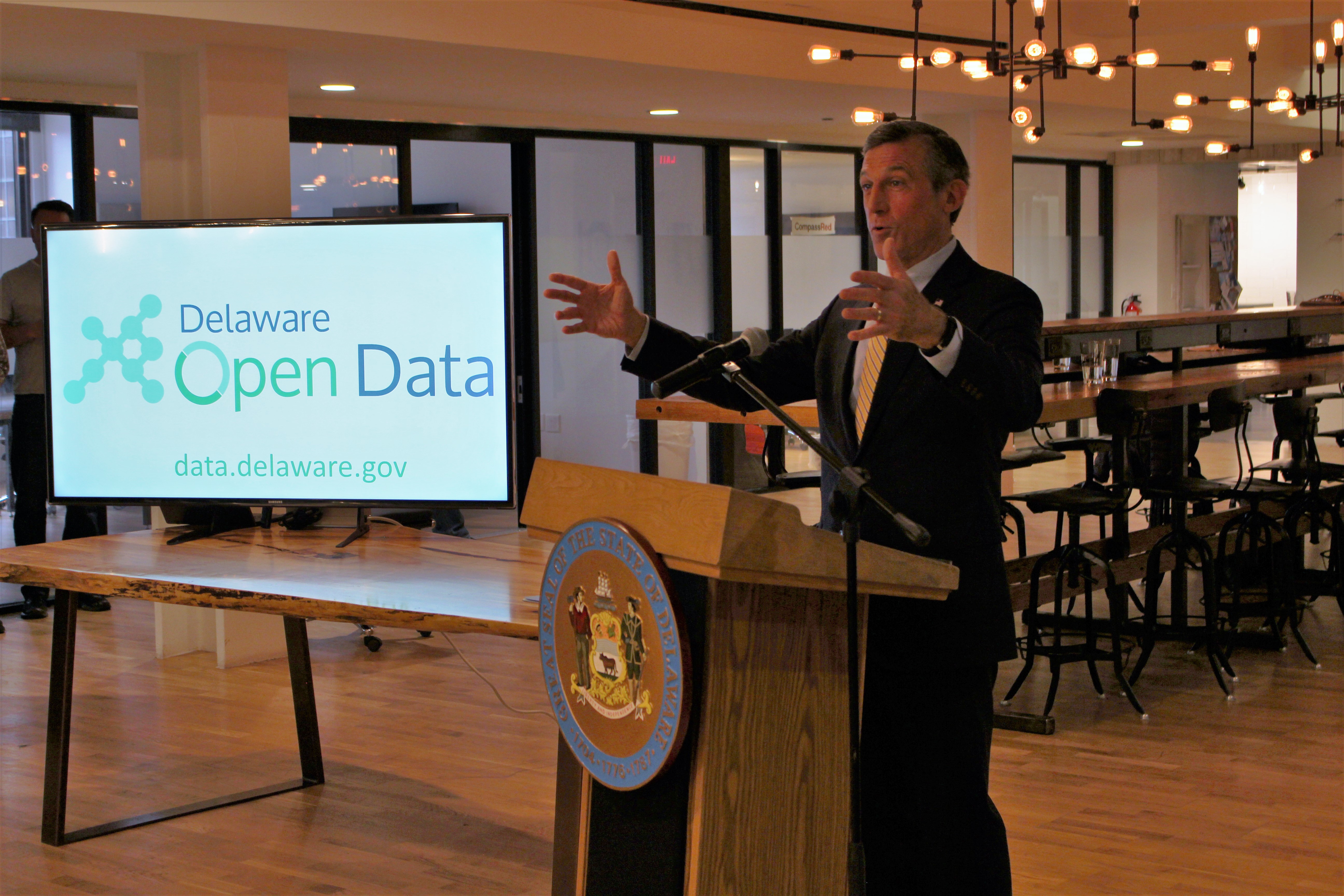
Governor Carney signs Executive Order 18, expanding the Open Data Council


WILMINGTON, Del. – Governor John Carney on Monday signed Executive Order 18, expanding the Delaware Open Data Council to include members from all Executive Branch agencies to promote data sharing. The Governor was joined by members of his Cabinet, technology entrepreneurs and Open Data advocates at The Mill in Wilmington for the Executive Order signing.

The Council brings together a team from state government focused specifically on making more data available to members of the public via the state’s Open Data Portal which streamlines access to public information and enhances government transparency. Established by Executive Order 57 in October 2016, the Open Data Portal is a centralized website that connects the public with non-identifiable public data across state agencies and provides interactive features that allow users to browse and sort information. The public can utilize more than 200 data items through maps, charts, and graphs to visualize it in new and innovative ways. Since its launch, the Open Data Portal has had more than 3.5 million page views. Eleven new data sets were added last year, including Delaware business licenses and air quality monitoring, among others.

“Open Data and data sharing are an integral part of government transparency, efficiency and accountability,” said Governor Carney. “Expanding the Open Data Council to include members from all Executive Branch agencies will help facilitate the work we’ve begun through the Family Services Cabinet Council, and allow us to share and analyze data to effectively deliver services and allocate resources for Delawareans.”

The Delaware Open Data Council, which will now include members from 18 state agencies and offices, is charged with making data available to the public, establishing a statewide data strategy, and recommending standards and policies governing the posting of public data and data sharing among state agencies.

Governor Carney

“Our state agencies have a vast treasure trove of data and we can tap into that potential to help solve real-world problems, improve the delivery of government services and enrich the quality of life for Delaware’s citizens,” said Chief Information Officer James Collins. “Great ideas can come from anyone, anywhere. By making this information available to everyone we create even more opportunities for innovative solutions.”

“Open data is all about building partnerships and using the power of information to fill the gaps between state agencies, community groups, businesses and the average Delawarean,” said Secretary of State Jeff Bullock. “The best ideas require collaboration to come to fruition, and I’m proud that the Department of State is a part of the next wave of new thinking in Delaware.”

“Over the past two years, Open Data Delaware has been excited to see the State’s commitment to open data grow,” said Ryan Harrington of Open Data Delaware. “In those two years, we have seen Delaware transition to a system that makes it easier than ever for anyone to access critical information about the state, giving advocates the opportunity to improve their communities and entrepreneurs more resources to grow companies. The inclusion of every Executive Branch agency into Delaware’s Open Data Portal furthers the ability for people to gain the information that they need to build upon this work.”

“Tech Impact is proud to support Governor Carney and his administration in expanding the Open Data Council,” said Tech Impact Executive Director Patrick Callihan. “Delaware has taken a leadership role in exposing data sets and enabling a transparent government. Some of that data has already been used to create public and social benefit for the state and this greater commitment will surely increase the opportunities to develop solutions to some of our most difficult social issues.”

Members of the public are invited to recommend additional datasets for inclusion in the Open Data Portal by visiting data.delaware.gov/nominate.

###


DNREC to hold public workshops, Wednesday, Nov. 29 and Thursday, Nov. 30, seeking input on Coastal Zone Conversion Permit Act regulatory process

DOVER – Delaware’s Department of Natural Resources and Environmental Control will hold two public workshops this week seeking input as DNREC begins the regulatory process for developing regulations for the Coastal Zone Conversion Permit Act, which Governor John Carney signed into law in August. The act requires the Department to develop and promulgate regulations for the redevelopment of 14 heavy-industrial use sites in Delaware’s Coastal Zone by Oct. 1, 2019. The Nov. 29 and 30 workshops will provide the public an opportunity to comment on the process the Department will use to develop regulations for the conversion permits DNREC will issue for sites to be redeveloped.

The two workshops will be held:
• Wednesday, Nov. 29, at the Kingswood Community Center, 2300 Bowers Street, Wilmington, DE 19802, and
• Thursday, Nov. 30, at Delaware City Fire Hall, 815 5th Street, Delaware City, DE 19706.
Both workshops will begin at 6 p.m.

“The workshops provide an open forum for everyone wanting to express their thoughts and concerns about the Coastal Zone Conversion Permit Act regulatory process,” said DNREC Secretary Shawn M. Garvin. “The Coastal Zone is an important part of Delaware and our environment. The State is committed to having an open and inclusive process, which starts with defining what the process will look like. The workshops are the Department’s first opportunity to listen to input from our citizens about the best way to implement the revisions to the Coastal Zone Act.

Information gathered at the workshops will be compiled by the Consensus Building Institute (CBI), a non-profit organization collaborating with DNREC and the State of Delaware to ensure that regulations are developed by the Department with transparency and openness during the regulatory process. CBI was chosen by the State because it played a similar role in Coastal Zone Act regulations developed in the late 1990s. The information gathered at the workshops will be used by DNREC to help the Department establish a Regulatory Advisory Committee (RAC), which will help guide development of Coastal Zone Conversion Permit regulations.

Both workshops will follow the same agenda. The first part will include informative presentations about legislative changes to the Coastal Zone Act (which originated as House Bill 190 before it was signed into law as the Coastal Zone Conversion Permit Act by the Governor) followed by an opportunity for public comment. During the second half of each workshop, all who attend will be asked to participate in breakout groups focused on establishing the RAC and the role that committee will have in formulating regulations.

The information gathered by CBI in stakeholder interviews and comments made at the public workshops will not be used in drafting conversion permit regulations, but are intended to gather input on the strategy DNREC might use in developing regulations in an open and transparent manner. Information gathered during the workshops and from CBI’s stakeholder interviews will be compiled in a report for DNREC and made available for public review when complete.

For more information on the Coastal Zone Conversion Permit Act, please visit de.gov/conversionpermits. To stay updated on the regulatory process for developing the conversion permit, you can also subscribe to the Coastal Zone Act email listserv by sending a blank email tomailto:join-dnrec_coastal_zone@lists.state.de.us.

Media contact: Michael Globetti, DNREC Public Affairs, 302-739-9902

Vol. 47, No. 251

-30-