Commissioner Stewart Provides Storm Preparedness Tips

Paths of Hurricanes are Hard to Predict: Prepare Now for Severe Weather

Dover, DE – Insurance Commissioner Karen Weldin Stewart is encouraging Delaware residents to take action now to prepare for potential damages and interruptions from Hurricane Matthew. Although it is too early to predict the long-term track of the storm, residents are encouraged to review or develop an emergency plan, create or update a home inventory, and take action to make their homes as safe as possible to prevent any damage from occurring. The Atlantic Hurricane season officially ends on November 30. Even if this current storm bypasses our region there’s still plenty of time for other strong storms to form which could eventually threaten Delaware.

The Department of Insurance has a Storm Preparedness webpage filled with resources and information about what to do before, during and after a major storm.  There’s an abundance of information about protecting your home or business from damage, and tips for preparing for meeting with an adjuster if your property sustains damages. Visit the Storm Preparedness webpage here: http://delawareinsurance.gov/departments/consumer/StormPrepare.shtml

Now is an ideal time to update your personal property inventory for your home, or create one if you’ve never done it before. With today’s technology this process is easier than ever with the help of the free app for your smartphone called MyHome Scr.APP.book, created by the National Association of Insurance Commissioners. The Department of Insurance also has a home inventory PDF that can be printed. For links to all of these resources visit the Storm Preparedness webpage. Having an up-to-date home inventory will help make the insurance claims process much easier should your home be damaged by a natural disaster.

Below is a brief list of items the Delaware Department of Insurance suggests that you review now, before a disaster strikes. For a complete list of items, visit the Storm Preparedness webpage, mentioned above in this article.

  • Make sure that you understand the deductible provision of your policy.
  • Keep all of your insurance policies in an easily accessible location.
  • If forced to evacuate, keep your insurance records with you at all times, including the name and telephone number of your insurer or insurance agent.
  • Be certain you understand the claim procedures of your insurance company.
  • Make sure you have insurance up to at least 80% of the value on your home to avoid penalties under any co-insurance provision of your policy.
  • Keep all necessary information regarding your health coverage, including prescription information, with your insurance records in the event of an evacuation.

For the best protection take pictures of your important documents with your smartphone, or scan these important documents and save them in your personal e-mail or online storage account. That way, if documents are lost in a disaster you can still access them from anywhere. Be prepared, you’ll thank yourself later!

The Delaware Department of Insurance also recommends that residents have evacuation plans and prepare an emergency supply kit. It is recommended that a supply kit should contain: plenty of bottled water, a first aid kit, flashlights, a battery-powered radio, non-perishable food items, blankets, clothing, prescription drugs, eyeglasses, personal hygiene supplies, and cash or traveler’s checks. Additionally, if you need to evacuate your home, turn off all utilities to reduce the chance of additional damage and electrical shock when utilities are restored. For more information on building an emergency kit and preparing an evacuation plan, visit www.ready.gov. You can also learn more about preparing for hurricanes, specifically, at https://www.ready.gov/hurricanes.

The Department of Insurance encourages residents to monitor the storm in the coming days. If the storm tracks toward Delaware, consider taking the following precautions at your home:

  • Clear your gutters of leaves and trim branches that are hanging over your roof.
  • Close and lock all doors and windows to prevent them from blowing open and allowing rain in.
  • Move any items from your yard that could become projectiles and cause damage such as potted plants, grills, toys, garbage cans, lawn furniture, etc.

A note about flood insurance: Your traditional homeowners insurance will not cover your losses due to flooding and storm surges. Only flood insurance will protect your home and property from damage due to flood waters. There is typically a 30-day waiting period from the time your purchase the policy until it goes in to effect. To learn about your home’s specific risk for flooding as determined by FEMA flood maps visit https://msc.fema.gov/portal.

                                                                               ###


Delaware Awarded Record $282,636 to Support Local Export Activities

State receives new trade and export promotion grant for 2016-17

Wilmington, DE – The Small Business Administration (SBA) has granted Global Delaware, the international development initiative of Delaware’s Department of State, an FY 2016 State Trade and Export Promotion (STEP) Program award totaling $282,636 to support the state’s efforts to help Delaware companies enter and develop markets overseas. This year’s grant is the largest STEP award the state has ever received.

global-delaware-logo-headThe SBA’s STEP Program gives states matching-fund awards to assist small businesses looking to enter and succeed in the international marketplace. The program’s objective is to increase the number of U.S. small businesses that export and to increase the value of these exports.
As with previous STEP grants, a significant portion of the grant will be used to directly reimburse small- and medium-sized companies for money spent on eligible, pre-approved export expenses such as international travel, trade show activities, international marketing materials and overseas interpreters.

“This grant award will give a helping hand to small businesses and entrepreneurs looking to expand into foreign markets,” said U.S. Sen. Tom Carper. “One way to create a nurturing environment for small businesses to grow and succeed is to assist them as they explore new markets overseas, and this grant will help them in the crucial first stages.”

“Small businesses in Delaware need to use their limited resources wisely, and for many of them, a business development trip out of the county is rarely an option—even though that trip might significantly help their international business prospects,” said U.S. Sen. Chris Coons. “STEP grants do just that; help companies travel to a foreign market and meet with potential or existing customers. I was glad that the Congress preserved funding for STEP grants, and I have seen the good work they have done for a number of Delaware small business.”

“The vast majority of consumers live outside of the U.S. With the STEP program, Delaware’s small businesses have more access to these markets, and are in a better position to compete, grow their customer base, and create jobs,” said Congressman John Carney. “I’d like to thank the SBA, and congratulate the team at Global Delaware for bringing these resources to our state. This is the type of investment that will continue to move our economy forward.”

“Delaware companies were able to successfully leverage STEP grants to grow their export strategies last year, and we hope to see even more activity this year,” said Secretary of State Jeffrey Bullock, noting that Delaware companies are anticipating over $10 million in sales as a result of last year’s export program. “What we need to see now are more companies—new companies—coming forward to take advantage of this resource to grow their businesses and contribute to job creation here in Delaware.”

The STEP award will also be used to finance export-related marketing activities, such as organizing trade missions to connect Delaware businesses with buyers and distributors abroad. Global Delaware organized trade missions to Mexico, Canada, South Korea and Germany this year. STEP grant funds are used to set up one-on-one business meetings with potential distributors and customers in the target markets, hire interpreters, and cover other costs associated with the missions, such as translating marketing presentations and paying for in-country transportation.

Delaware companies can learn more about attending a mission or applying for an export grant at global.delaware.gov/expand or by emailing global@delaware.gov


Delaware Wins Federal Funding to Assist Dislocated Workers

New online tool will support all Delawareans seeking new employment, fits into state effort to help ex-DuPont employees

Wilmington, DE – The United States Department of Labor has announced that it has awarded the Delaware Department of Labor a $693,357 grant to support dislocated workers through the development of a new web-based application that will be integrated into the state’s existing JobLink infrastructure.

The application is being developed as a way to help citizens respond to changes in their own employment and to apply to new opportunities. The impetus for the exploration of this new solution was the downsizing at DuPont earlier this year, though it is expected to be able to be applied for a wide range of uses once developed.

“This new system will be more user friendly and will help individuals think about new ways that they can apply skills they have developed in a previous job,” said Secretary of Labor Patrice Gilliam. “Our rapid response teams at the Department of Labor provide significant support and resources to impacted workers, but we can always do more. It’s particularly important that our online portals are as effective as possible in reaching these individuals and we are excited about taking this next step.”

The state began to explore new ways to enhance these efforts this spring, and the development of a new application that streamlined the process for identifying an employee’s skills and packaging them into a marketable profile that can be targeted towards specific firms quickly became a top priority, leading the state to seek additional funding.

The grant will be used to fund the initial development costs related to the building, testing, and maintenance of the application.

ABOUT THE DELAWARE DEPARTMENT OF LABOR

The Delaware Department of Labor connects people to jobs, resources, monetary benefits, workplace protections and labor market information to promote financial independence, workplace justice and a strong economy. The department is made up of five divisions:

Division of Employment & Training

Division of Unemployment Insurance

Division of Industrial Affairs

Division of Vocational Rehabilitation

Office of Occupational and Labor Market Information

The combined efforts of these divisions and offices support the employment-related needs of nearly 400,000 Delaware workers and more than 20,000 businesses throughout the state.


U.S. Labor Secretary, Sen. Coons Join Secretary Gilliam-Johnson to Tour Wilmington Apprenticeship Program

Roundtables to discuss Delaware’s progress coincide with announcement of funding won by Markell Administration

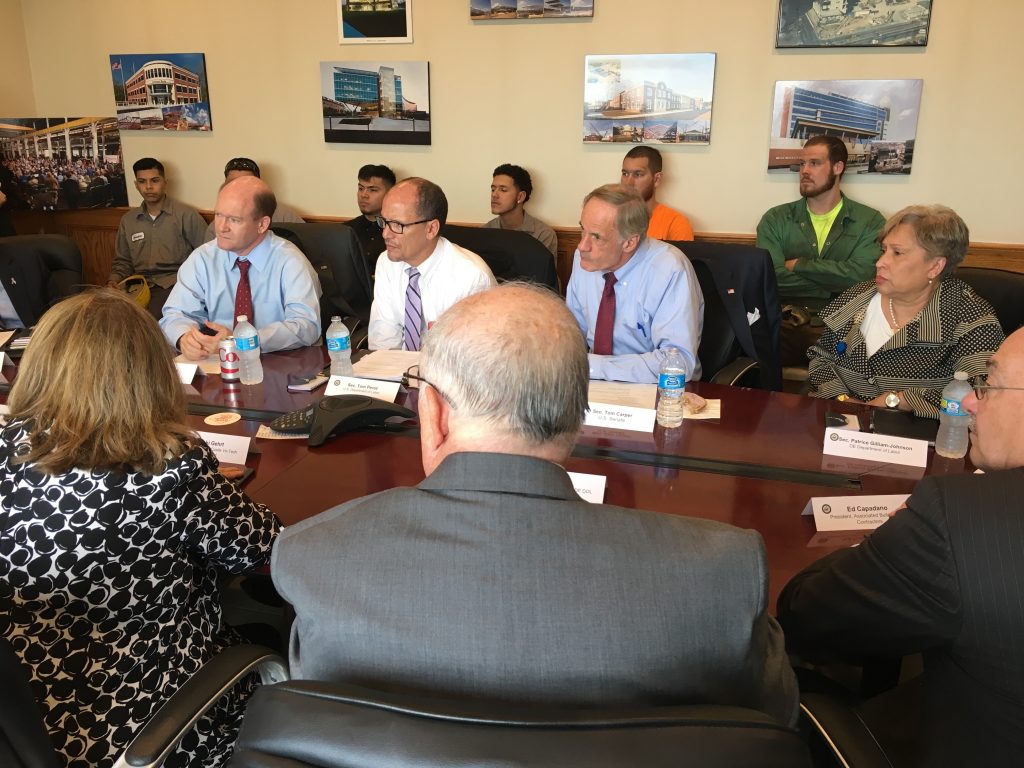
Wilmington, DE – U.S. Department of Labor Secretary Thomas E. Perez, U.S. Sen Tom Carper, U.S. Sen. Chris Coons and Delaware DOL Secretary Patrice Gilliam-Johnson met in Wilmington on Oct. 3 to tour local Apprenticeship and Training operations and participate in two roundtables to discuss the program’s progress.

The visit coincides with a recent announcement by the U.S. Department of Labor that Delaware has received a $200,000 federal grant to expand its Apprenticeship and Training operation by integrating the program into local education and workforce systems, engaging industry and other partners to expand apprenticeship to new sectors and new populations and expanding outreach with employers to offer new apprenticeship opportunities.

This work builds on efforts spearheaded by Governor Markell’s Administration that provide better pipelines to good jobs, including the TechHire initiative that has more than doubled participants incomes by giving them IT training, as well as the Pathways to Prosperity program, through which 6,000 high school students are on track to graduate with college credit and workplace experience in high-demand fields.

“We’re really excited about the strides we continue to make with our apprenticeship and training program in Delaware,” said Secretary Gilliam-Johnson. “We have seen the value of investments in high-quality workforce training through the success of Delawareans who have participated. And thanks to this grant and the support we’ve received from Senator Coons, Senator Carper, Congressman Carney and U.S. Labor Secretary Perez, we’re able to do even more to create employment opportunities for hard-working Delawareans.”

According to USDOL statistics, 87 percent of apprentices are employed after completing their programs, with an average starting wage above $50,000 per year. The return on investment for employers is substantial, as studies indicate that for every dollar spent on apprenticeship, employers receive an average of $1.47 return in increased productivity, reduced waste and greater front-line innovation.

In Delaware the program has produced graduates since the mid 1970’s and currently has nearly 1,100 active registered apprentices in 23 different occupations. There are some 300 active sponsors or employers for these, with the largest numbers stemming from the electrician, plumbing and HVAC trades.

“Enhancing our apprenticeship offerings is one of the best ways to strengthen the quality of our workforce over the long term,” said Governor Markell. “This effort, combined with others like Pathways to Prosperity and TechHire, are helping to ensure Delaware remains competitive in the new economy and that we build on the progress that has led to the best job growth in the region. I welcome Secretary Perez to Delaware today and thank him and our congressional delegation for their support for these programs.”

The majority of apprenticeships are four years in length, with the participants receiving 8,000 hours of paid on-the-job training. For each year of training, a minimum of 144 hours of related instruction is required. Upon completion of the required on-the-job training and related instruction, the apprentice is eligible for “journey papers.” A journeyperson is nationally recognized as having a well-rounded ability in all phases of his or her trade.

Schedule of events

Apprenticeship Tour and Roundtable

What: Secretary Perez, will participate in an apprenticeship roundtable with Senator Carper, Senator Coons, Delaware Secretary of Labor Gilliam-Johnson, elected officials, community leaders and Apprenticeship program participants.

When: 10–11:30 am

Where: RC Fabrication, 824 Locust Street, Wilmington, DE 19801

***

Tech Hire Tour

What: Secretary Perez, Sen. Coons, Delaware Secretary of Labor Gilliam-Johnson, and business and community leaders will participate in a tour of Zip Code. They also will take part in a coding competition where they are put different teams of students competing against each other’s coding abilities.

When:  11:45am – 12:00pm

WhereZip Code, 1105 N. Market Street, 3rd Floor, Wilmington, DE 19801


APPRENTICESHIP AND TRAINING WEEK

President Barack Obama proclaimed the week of November 2, 2015, as the first Annual National Apprenticeship Week. This year, the second Annual National Apprenticeship Week will take place November 14-20, 2016 NAW offers Registered Apprenticeship Sponsors the opportunity to showcase their programs, facilities, and apprentices, and gives Employers, Education, Industry Associations, Labor, Elected officials and other critical partners the opportunity to highlight how Registered Apprenticeship meets their needs for a skilled workforce.


Here’s video of Senator Coons highlighting Delaware Apprenticeship programs to mark National Apprenticeship Week:

https://youtu.be/xDtau3ZlqD0


ABOUT THE DELAWARE DEPARTMENT OF LABOR

The Delaware Department of Labor connects people to jobs, resources, monetary benefits, workplace protections and labor market information to promote financial independence, workplace justice and a strong economy. The department is made up of five divisions:

Division of Employment & Training

Division of Unemployment Insurance

Division of Industrial Affairs

Division of Vocational Rehabilitation

Office of Occupational and Labor Market Information

The combined efforts of these divisions and offices support the employment-related needs of nearly 400,000 Delaware workers and more than 20,000 businesses throughout the state.


Delaware Makes Historic Investment In Community-Based Prisoner Re-Entry Programs

18 Community Organizations Will Use Funds To Assist Adults and Juveniles Exiting from Correctional Facilities

Eighteen non-profit organizations will receive a total of $2 million to help juvenile and adult Delawareans successfully re-enter the community after completing prison sentences. The $2-million investment, using funds from settlements with national banks for misconduct on financial markets, is the largest state investment in community-based re-entry programs in at least a decade.

The program was designed by the Delaware Department of Justice and the Delaware Criminal Justice Council. The $2-million in funds are part of a $36-million settlement that the Department of Justice reached with national banks relating to bank misconduct in the financial markets. The funds were awarded to non-profit organizations by the Criminal Justice Council through a competitive grant process, and the CJC will monitor the eighteen organizations to ensure that the grant funds are spent appropriately.

“Currently, about two-thirds of our inmates who exit the adult correction system are back in again within three years,” said Attorney General Matt Denn. “The numbers are even worse for juveniles. We know, from experience around the country and right here in Delaware, that good re-entry programs can reduce those numbers, and improve public safety. But good programs cost money, and the state has never adequately invested in re-entry programs. This investment in community-based re-entry programs will allow these diverse programs to show what they can do, help many Delawareans avoid going back to prison, and give policymakers a basis for funding the programs over the long term.”

The grants are divided between larger grants of up to $150,000, targeted at more established non-profit organizations, and smaller grants targeted at new or small non-profits. Each of the grants contains performance measures by which the grant’s success can be objectively measured.

“The Criminal Justice Council is proud to partner with Attorney General Denn and the Department of Justice to implement this unprecedented investment in re-entry services in our state,” CJC Executive Director Chris Kervick said. “These funds, totaling almost $2 million dollars, represent the largest sub-grant awards in recent history and will go a long way to support programs that assist people as they come home to their communities.”

Some examples of successful grant recipients include:

• A grant to Brandywine Counseling and Community Services will allow the organization to provide services to fifty juveniles per year who are preparing for release from juvenile detention facilities, and are judged to be at high risk to re-offend. Under the program, a case worker from Brandywine Counseling will begin working with targeted juveniles thirty days before they are released from juvenile detention facilities, and continue working with the juveniles after release to ensure that they are re-enrolled in school, receive job training and opportunities, and appropriate health care. Brandywine Counseling’s grant of $150,000 will pay for the costs of the program for two years.

“BCCS is well-equipped to reshape how we prepare to assist adjudicated youth,” said Brandywine Counseling and Community Services’ (BCCS) CEO, Dr. Lynn Fahey. “This grant will allow us to implement best practices, but also develop a new approach to integrating juveniles back into society. Our goal is help these youth focus on personal responsibility and growth. Everyone at BCCS believes in second chances and this grant provides us with the opportunity to prove it.”

• In Her Shoes, Inc., a non-profit organization formed in 2010 by a former correctional system employee that has operated to date with no paid staff, provides a variety of re-entry services to adult women released from the Baylor Women’s Correctional Institution. A one-year grant of $25,000 to In Her Shoes will allow the organization to sustain and expand its services to women released from Baylor by hiring its first part-time staff person.

“I was thrilled to learn ‘In Her Shoes, Inc.’ was recognized by for its efforts to help female ex-offenders make a productive return to the community after incarceration,” said Founder and Executive Director Lenora Webb. “It’s an honor to know the Criminal Justice Council recognizes our work, and its generous award will allow us to continue our consistency in how we strive to overcome barriers to transition for these women.”

• A grant to Interfaith Community Housing of Delaware will allow it to implement its new Homeworks Construction and Education Program. Under this program, Interfaith Community Housing will collaborate with construction companies working on its Wilmington housing renovation projects to provide on-the-job, paid training to persons recently released from Delaware prisons. Interfaith Community Housing will collaborate with the Wilmington HOPE Commission’s Achievement Center and the United States Probation Office for the District of Delaware, providing workforce training to former inmates who are receiving other services from one of those two organizations. The grant of $100,000 received by Interfaith Community Housing will supplement a grant already received from the Delaware Department of Labor, and fund the program for its first two years.

“Interfaith Community Housing of Delaware couldn’t be more proud of providing this workforce development program for Wilmington’s most marginalized populations. We recognize that employment and training is critical for the long-term success of any truly transformative community revitalization efforts,” said Interfaith executive director Gary Pollio. “Working with our phenomenal partners – the Department of Labor, U.S. Probation, and the Achievement Center of Wilmington’s HOPE Commission – ensures Interfaith that our HomeWorks Construction and Employment and Training program will have significant impacts on the overall health, economic growth, and long-term stabilization of the communities served.”

Click here to see the full list of grant recipients and descriptions of their programs.