After arriving in Delaware in 2017, spotted lanternfly now confirmed in Sussex County

DOVER, Del. (July 12, 2022) — Five years after the first confirmed spotted lanternfly was found in New Castle County in 2017, the spotted lanternfly has made its way to Sussex County, creating a statewide quarantine for this invasive pest.

The spotted lanternfly is a destructive invasive planthopper that attacks many hosts, including trees, shrubs, orchards, grapes, and hops. The insect is detrimental to Delaware’s agricultural industry, forests, and residential areas.

Effective July 12, the Delaware Department of Agriculture (DDA) will expand the quarantine to include Sussex County due to established populations of spotted lanternfly found in Georgetown, Milford, Seaford, Ocean View, and Rehoboth. Quarantine means that residents, businesses, or municipalities cannot move any material or object that could harbor the pest without taking precautions to prevent the spread. Adults can fly, hop, or drop onto a vehicle – meaning that this pest can be easily transported to new areas where it can create another infestation.

“It is practically impossible to eradicate the spotted lanternfly because of its status as a hitchhiker bug,” said Deputy Secretary of Agriculture Nikko Brady. “For a small state, our Spotted Lanternfly Program has done an excellent job in fending off the spread of this invasive insect for five years and are just now finding it in Sussex County.”

Since the initial population of spotted lanternfly was found in 2018, DDA has partnered with USDA to conduct surveys and assessments. Overall, the Spotted Lanternfly Program has treated 23,721 acres with insecticides or herbicides to reduce Delaware’s spotted lanternfly population. Once the females began laying egg masses this past fall, the team scraped 90,147 egg masses with 30-50 eggs in each, significantly reducing this year’s population.

Due to quarantines in other states, interstate commerce will be impacted if the pest is transported out of the Delaware quarantine area. Therefore, DDA’s Spotted Lanternfly Program is focused on priority properties that are pathways for the movement of spotted lanternfly, including highways, railways, public transportation, and distribution centers. The Program’s inspectors use the tree of heaven, an invasive necessary for spotted lanternfly to reproduce, to search for the insect.

Managing Spotted Lanternfly
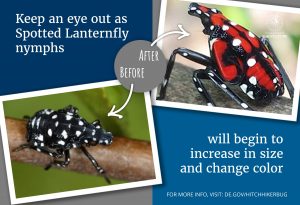
A 3rd instar spotted lanternfly is black with white spots. When it metamorphizes into a 4th instar, it will be black with red on its body and white spots.Homeowners are encouraged to visit Delaware’s spotted lanternfly website at https://de.gov/hitchhikerbug to learn what the quarantine means and how to manage this invasive pest. The Delaware Homeowner Spotted Lanternfly and Treatment Fact Sheet lists pesticides labeled for planthoppers or leafhoppers sold at local home and garden stores, which can be used to kill the insect. Residents can do their part by treating nymphs and adults from May to November and scraping and destroying egg masses from December to May. Homeowners can also hire a commercially licensed turf and ornamental pesticide applicator to treat their properties for these insects.

In Delaware, spotted lanternfly nymphs are in the third and fourth instar stages and will metamorphize into adults before the end of July. From now until early September, trees are actively moving phloem from the trunk into the branches, which feed the tree’s growth. At this time, using a systemic insecticide is preferred because it is absorbed by tree roots, bark, or leaves and is moved through its vascular system to other parts of the tree. This means that no matter what area the spotted lanternfly feeds on, it will ingest the insecticide and die.

Eliminating the tree of heaven helps decrease the spotted lanternfly population. The tree of heaven is found in industrial parks, unmanaged areas, or vacant lots, and along highways and railways. Municipalities and businesses should prioritize destroying the female tree of heaven while leaving some male specimens as trap trees. The average homeowner does not have tree of heaven on their properties, but the homeowner should remove it if identified.

Delaware Spotted Lanternfly Quarantine and Permitting
The general public is encouraged to download and print the Delaware Resident Spotted Lanternfly Compliance Checklist, indicating that you inspected and know that no living life stage of the spotted lanternfly is present on regulated articles before moving them. The checklist is available online at https://de.gov/hitchhikerbug. DDA recommends keeping the checklist in each vehicle’s glove box and noting the date when specific items on the list are inspected before transport.

Examples of regulated articles include:
• Any living life stage of the spotted lanternfly
• Landscaping, remodeling, or construction materials
• Firewood of any species
• Packing materials (e.g., wood crates, boxes)
• All plants and plant parts, including all live and dead trees, perennial and annual plants, and mulch
• Outdoor household articles like RVs, lawnmowers, chairs, grills, tarps, tile, stone, deck boards, and other vehicles not stored indoors.

Any person conducting business for a commercial company, a municipality, or a government agency that requires movement of any regulated item within or from the quarantine area must have a permit, available through the DDA spotted lanternfly website. To obtain a permit, a designated individual from an organization must receive training and pass an online test to demonstrate a working knowledge and understanding of the pest and quarantine requirements. This individual is then required to train other employees to inspect vehicles and products and remove any spotted lanternfly life stages. The permit demonstrates that the individual understands how to identify the pest and ensure the items transported are not carrying the insect.

Reporting Spotted Lanternfly
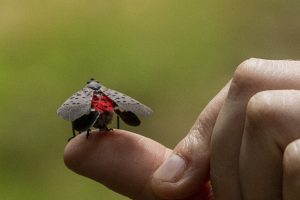
Adult spotted lanternfly on a person's thumb. The adult is about the length from the tip of the thumb to the first joint below the nail.Residents who live near the Dover Air Force Base or in Sussex County are encouraged to report sightings of the spotted lanternfly. Citizen reports help DDA inspectors determine how these insects move and which transportation pathways they utilize. These reports also allow DDA to notify agricultural operations with plants vulnerable to this insect. Residents can make a report by using the online form at https://de.gov/hitchhikerbug or emailing HitchHikerBug@delaware.gov and including the location of the find in the subject line. Due to the high level of reporting, DDA inspectors will not respond to emails but will use the information provided to determine if a new spotted lanternfly population is present.

Additional Information
In March 2019, DDA initially quarantined zip codes in New Castle County, where an established population of reproducing spotted lanternfly was found. The quarantine was expanded in September 2019 to include all areas of New Castle County north of the Chesapeake and Delaware Canal and finally included the entire county in July 2020. DDA quarantined Kent County in October 2020, when established populations of the insect were found in Smyrna, Dover, and Harrington.

###


Kent County added to Delaware’s spotted lanternfly quarantine

DOVER, Del. (October 29, 2020) – Effective October 30, the Delaware Department of Agriculture (DDA) will add Kent County in its entirety to the current spotted lanternfly quarantine of New Castle County. The expansion is due to established populations of spotted lanternfly found in Smyrna, Dover, and Harrington this past week. At this point in the season, a population includes multiple adults or gravid female spotted lanternfly.

The spotted lanternfly is a destructive invasive planthopper that attacks many hosts, including trees, shrubs, orchards, grapes, and hops. The insect is detrimental to Delaware’s agricultural industry, forests, and residential areas. Due to quarantines in other states, interstate commerce will be impacted if the pest is transported out of the Delaware quarantine area.

Quarantine means that residents, businesses, or municipalities cannot move any material or object that could harbor the pest without taking precautions to prevent the spread. Adults can fly, hop, or drop onto a vehicle – meaning that this pest can be easily transported to new areas where it can create another infestation. In September through November, the female spotted lanternfly will lay several egg masses of 30 to 50 eggs wherever it chooses, especially on flat surfaces.

There is extreme concern about the timing of the finds in Kent County. A female spotted lanternfly will lay upward of 200 eggs before she dies due to cold weather. These eggs will overwinter and hatch out in the spring, creating a larger established population in 2021.

“While we understand the frustration residents have with infestations, we must focus on containing the spread of spotted lanternfly to protect Delaware and regional agriculture. Our staff will accomplish this by focusing treatments on priority properties that are pathways for the movement of spotted lanternfly such as highways, railways, public transportation, and distribution centers,” said DDA Plant Industries Administrator Jessica Inhof. “Residents can do their part by removing tree of heaven, treating for nymphs and adults from May to November, and scraping and destroying egg masses from December to May. We are asking every Delaware resident to take part in the effort to stop the spread.”

DDA continues to partner with USDA on conducting surveys and property assessments. While USDA has overseen the treatment of properties identified with the tree of heaven, DDA is unsure if the federal funding for this will be available in the future. To date, 44,423 trees have been treated with insecticides or herbicides to reduce Delaware’s spotted lanternfly population.

The tree of heaven is an important food source for the spotted lanternfly, and eliminating this invasive helps decrease the spotted lanternfly population. The tree of heaven is found in industrial parks, along highways and railways, and in unmanaged areas or vacant lots. Municipalities and businesses should prioritize destroying the female tree of heaven while leaving some male specimens as trap trees.

If identified, homeowners should remove the tree of heaven from their property. This insect will feed and lay egg masses on other species of trees and ornamentals. Currently, homeowners can use any direct contact insecticide labeled for planthoppers or leafhoppers to kill adult spotted lanternfly. We have a listing of insecticides licensed for use in Delaware on our Homeowner Spotted Lanternfly and Treatment Fact Sheet online at https://de.gov/hitchhikerbug. They can also hire a commercially licensed turf and ornamental pesticide applicator to treat their properties for these insects. Residents can help by scraping off egg masses into a bag containing rubbing alcohol or an alcohol-based hand sanitizer and crushing them to destroy the eggs.

Residents are encouraged to report sightings of spotted lanternfly outside of New Castle County. Citizen reports help DDA inspectors determine how these insects are moving and which transportation pathways they are utilizing. These reports also all DDA to notify agricultural operations that have plants vulnerable to this insect. Residents can make a report by emailing HitchHikerBug@delaware.gov and including the location of the find in the subject line. Inspectors may visit the site or area to determine if a new spotted lanternfly population is present.

Any person conducting business for a commercial business, a municipality, or a government agency that requires movement of any regulated item within or from the quarantine area must have a permit, available through the DDA spotted lanternfly website. To obtain a permit, a designated individual from an organization must receive training and pass an online test to demonstrate a working knowledge and understanding of the pest and quarantine requirements. This individual is then required to train other employees to inspect vehicles and products and remove any spotted lanternfly life stages. The permit demonstrates that the individual understands how to identify the pest and ensure the items transported are not carrying the insect.

The general public is encouraged to download and print the Delaware Resident Spotted Lanternfly Compliance Checklist, indicating that you inspected and know that no living life stage of the spotted lanternfly is present, on regulated articles before moving them. The checklist is available online at https://de.gov/hitchhikerbug. DDA recommends keeping the checklist in each vehicle’s glove box and noting the date when specific items on the list are inspected before transport.

Examples of regulated articles include:

  • Any living life stage of the spotted lanternfly
  • Landscaping, remodeling, or construction materials
  • Firewood of any species
  • Packing materials (e.g., wood crates, boxes)
  • All plants and plant parts, including all live and dead trees, perennial and annual plants, and mulch
  • Outdoor household articles like RVs, lawnmowers, chairs, grills, tarps, tile, stone, deck boards, and other vehicles not stored indoors.

For more detailed information regarding the quarantine, permitting, treatment, or to report a spotted lanternfly, visit the Delaware Department of Agriculture’s dedicated spotted lanternfly webpage https://de.gov/hitchhikerbug.

In February 2019, DDA initially quarantined zip codes in New Castle County where an established population of reproducing spotted lanternfly was found. The quarantine was expanded in September 2019 to include all areas of New Castle County north of the Chesapeake and Delaware Canal and finally included the entire county in July 2020.

###

Media Contact: Stacey Hofmann, (302) 698-4542, Stacey.Hofmann@delaware.gov


Emergency quarantine declared for pest threatening Delaware

Photos are available for media use on Flickr.

Dover, Del. – The Delaware Department of Agriculture (DDA) announced today that they are quarantining eleven zip codes in New Castle County to eradicate, control, and prevent the spread of spotted lanternfly in Delaware and to surrounding states.

The spotted lanternfly is a destructive invasive plant hopper that attacks many hosts including trees, shrubs, orchards, grapes, and hops. The insect is detrimental to Delaware’s agricultural industry, forests, and residential areas. Due to quarantines in other states, interstate commerce will be impacted if the pest is transported out of the Delaware quarantine area.

“We understand this quarantine will impact businesses and homeowners; however, it is required if we have any chance to control this non-native, destructive pest. With the hatching of egg masses and the presence of adult lanternflies, the population has grown and requires treatment and control efforts,” said Secretary of Agriculture Michael T. Scuse. “The impact of this pest to Delaware is large with 8 billion dollars of Delaware’s economic activity related to agriculture. When you look at our orchards and vineyards, nursery and landscaping industry, and forestland and timber sales, you are looking at more than 1.9 billion dollars alone. Delaware has a lot to lose if we do not gain control over the spotted lanternfly.”

The following zip codes in New Castle County have been quarantined in their entirety: 19702, 19703, 19707, 19711, 19801, 19802, 19803, 19805, 19807, 19809, and 19810. The quarantine can expand if there is reason to believe that the pest has moved to a non-quarantined area. A quarantine means that any material or object that could harbor the pest cannot be moved without taking precautions to prevent the spread.

The female spotted lanternfly lays egg masses of 30 to 50 eggs wherever it chooses, especially on flat surfaces. All other life stages of this insect from nymphs to adults can fly, hop, or drop onto a vehicle – meaning that this pest can easily be transported to new areas where it can create another infestation.

Examples of regulated articles include:

  • Any living life stage of the spotted lanternfly
  • Landscaping, remodeling, or construction materials
  • Firewood of any species
  • Packing materials (e.g. wood crates, boxes)
  • All plants and plant parts including all live and dead trees, perennial and annual plants, and mulch
  • Outdoor household articles like RVs, lawnmowers, chairs, grills, tarps, tile, stone, deckboards, and other vehicles not stored indoors.

In order to move regulated items, the general public will need to complete a residential compliance checklist indicating that you inspected and know that no living life stage of the spotted lanternfly is present on the articles. The checklist is available online at https://de.gov/hitchhikerbug.

“We have the advantage right now that spotted lanternfly nymphs will not hatch until April and May. We are asking residents to go to our website and download a copy of the compliance checklist,” said DDA Plant Industries Administrator Jessica Inhof. “Then take the time to check all the items you have on the list for egg masses. If you find them, scrape them off into a bag filled with alcohol or an alcohol-based hand sanitizer and crush them to destroy the eggs. You will help Delaware to reduce the potential damage that these pests could inflict this spring and summer.”

Any person conducting business for a commercial business, municipalities, or a government agency that requires movement of any regulated item within or from the quarantine area must have a permit, available through the DDA spotted lanternfly website. To obtain a permit, a designated individual from an organization must receive training and pass an online test to demonstrate a working knowledge and understanding of the pest and quarantine requirements. Training of other employees, inspection of vehicle and products, and removal of living stages of spotted lanternfly must be completed. The permit demonstrates the individual understands how to identify the pest and can ensure the items transported are not carrying the insect.

For more detailed information regarding the emergency quarantine, permitting, treatment, or to report a sighting of spotted lanternfly, visit the Delaware Department of Agriculture’s dedicated spotted lanternfly webpage at https://de.gov/hitchhikerbug or call the dedicated spotted lanternfly hotline at (302) 698-4632. When leaving a message, leave your contact information and, if reporting a sighting, please provide the location of the sighting.

The initial Delaware detection of spotted lanternfly was in Wilmington in the fall of 2017. In 2018, DDA Plant Industries inspectors along with USDA staff conducted surveys around the area where the initial detection was found. The surveys demonstrated that spotted lanternfly had multiple established populations in northern New Castle County.

###

Media Contact: Stacey Hofmann, (302) 698-4542, Stacey.Hofmann@delaware.gov