Statement From Auditor McGuiness On Judge’s Ruling

DOVER, Delaware – Today, Delaware State Auditor Kathleen McGuiness released the following statement in response to the Memorandum Opinion and Order from the court confirming the Auditor’s Office’s power to conduct performance audits:

Judge Karsnitz released his decision in our court case with the Delaware Department of Health and Social Services (DHSS) regarding our requests to audit Medicaid spending. My office fought for nearly two years for access to information needed to conduct a performance audit set within the professional standards and guidelines of the U.S. Government Accountability Office. This audit sought to determine if DHSS’ Division of Medicaid and Medical Assistance (DMMA) complies with federal and state requirements, implements effective internal controls, and incorporates data integrity throughout the program.

Medicaid spending accounts for nearly 1/5 of the state’s annual budget, and Delawareans deserve to know if Medicaid is complying with state and federal requirements when spending these critical funds.

The Auditor’s Office regularly receives confidential data as part of our duties under Delaware Code, and the prior administration conducted a nearly identical performance audit of Medicaid eligibility in 2014. However, despite a history of conducting this work, my staff and I received significant pushback and delays that undermine the independent audit process in our state.

This performance audit was hindered by the Department of Justice (DOJ) and their insistence this audit was not within the Auditor’s scope of authority. My staff was forced to learn to draft a subpoena because the assigned attorney from the Department of Justice declined to provide my office legal representation on this matter. The DOJ initially refused to grant my office outside legal counsel forcing us to represent the office pro se.

I would like to thank Judge Karsnitz for his objective ruling confirming the scope of authority of the Auditor’s Office. I commend Governor John Carney for his judgement in granting the office independent outside legal counsel. I applaud the efforts of Luke Mette of Armstrong Teasdale LLP and his team for their outstanding legal expertise and presentation of the facts.

There’s been a lot of confusion about what this office does or should be doing, but this decision makes it clear; taxpayers deserve to know if they’re getting a fair deal from their state government, and Delawareans should know they have fighters on their side in the State Auditor’s Office working on their behalf for accountability no matter the resistance.

Read the Court’s Memorandum Opinion and Order here.

###

Contact: Tori Parker, Deputy Auditor
tori.parker@delaware.gov


Delaware Aglands Permanently Preserves 3,800 Acres; Largest Number of Inland Bays Easements Ever Selected

HARRINGTON, Del. (July 28, 2022) — During a stop at the Delaware Agriculture Education & Commodities Building at the Delaware State Fair, Governor John Carney announced an additional 3,827 acres on 54 farms are now permanently preserved for future generations.

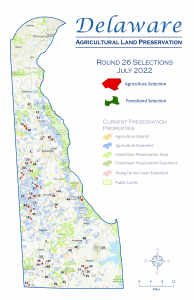
Map of Delaware depicting all the agricultural easements,2022 marks the 26th consecutive year of easement selections by the Delaware Agricultural Lands Preservation Foundation. In this round, three farms in New Castle County, 26 in Kent County, 23 in Sussex County were preserved, and two easements for forestland preservation.

“Preserving Delaware’s farmland is a priority and Delaware Aglands have helped keep farms in production,” said Governor Carney. “The Department of Agriculture has a big year ahead with $20 million allocated to preserve Delaware farms from the ground up. With this year’s average discount rate at 44%, there is no better time for farmers to consider preserving their farms for future generations. I want to thank members of the General Assembly for seeing the importance of protecting agriculture here in our state.”

Along with the state funding, Delaware’s success in preserving farmland would not be possible without the assistance of many county and federal partners. The Delaware Aglands Preservation Foundation has partnered with the USDA Natural Resources Conservation Service Agricultural Conservation Easement Program (ACEP), Sussex County Council, and Kent County Levy Court to purchase easements in this round. New Castle County provided funds this past winter to preserve a New Castle County farm that was not originally selected in Round 25.

“Farmland preservation is not just about preserving Delaware’s number one industry. It’s ensuring our residents have access to Delaware-grown food; that our next generation has a career in agriculture — no matter whether it’s on the farm, working in agribusiness, teaching agriscience to our youth, or developing the latest technology; and the heritage, culture, and beauty of rural Delaware can be enjoyed by residents and visitors alike,” said Secretary of Agriculture Michael T. Scuse. “In this round, nine easements in the Inland Bays watershed were selected, encompassing 486 acres. This is the most Inland Bays easements we have selected in one year and the most acres in the last twenty years. This is a big deal to ensure these communities have local farms providing them healthy food into the future.”

Since 1995, Delaware has preserved 6,873 acres of farmland in the Inland Bays watershed, costing $16.75 million. The easements selected in this year’s round have an estimated cost of $1.7 million. The only round with more acres preserved in this area was Round 5, announced in 2000.

“For the second year in a row, we have been able to accept every offer made by landowners to preserve their farms,” said Aglands Administrator Jimmy Kroon. “This is a significant change from several years ago when the process was much more competitive. Combined with increasing appraisals, we are paying more to preserve farmland, and we’re happy farmers are benefitting from that.”

The Delaware Agricultural Lands Preservation Foundation selects those farms approved for easement purchase using an impartial discounted ranking system that maximizes benefits for taxpayers. The Foundation does not own the land, but rather purchases landowners’ development rights and places a permanent agricultural conservation easement on the property. Landowners must first voluntarily enroll their farm into a 10-year preservation district and are eligible for permanent preservation the year after they apply. In addition to nearly 147,000 acres in permanent easements, Delaware’s Aglands Preservation Program has more than 34,000 acres of land enrolled in 10-year farmland preservation districts.

County governments can partner with the state program and add county funds to select properties in their areas, leveraging state resources for the most significant impact.

Delaware’s statewide program made its first round of easement purchases in 1996 and has since preserved 21 percent of New Castle County farmland, 38 percent of Kent County farmland, and 18 percent of Sussex County farmland.

Delaware farmers interested in preserving their farms should be sure they meet the following eligibility requirements:
• Property must be zoned for agriculture and not subject to any major subdivision plan.
• The property meets the minimum Land Evaluation and Site Assessment (LESA) score of 170. LESA is a process that attempts to estimate the farm’s long-term viability based on the farm’s soil productivity and the land use and agriculture infrastructure on and around the farm. Scores range from 0-300. Aglands program staff calculate the LESA score when applications are received.
• The property has to meet the state’s Farmland Assessment Act (10 acres or more which generate at least $1,000 in agricultural sales annually; farms under 10 acres which create at least $10,000 annually in agricultural sales).
• Farms of 200 acres or more constitute an agricultural district.
• Farms under 200 acres can enter the program if they are within 3 miles of an existing agricultural district. With over 1,154 farms already preserved, it is rare that a farm under 200 acres does not meet these criteria.

Entirely forested properties in managed timber production can also enroll in the Forestland Preservation Program, which purchases Forestland Preservation Easements through a similar process as Aglands Preservation.

For new farms interested in preservation, the deadline to apply and be eligible for Round 27 is October 31, 2022. For more information, visit https://de.gov/aglands.

The Delaware Agricultural Lands Preservation Foundation’s Board of Trustees includes representatives from agriculture and state agencies. Trustees are Mark Collins, chairman; James G. Vanderwende, vice-chairman; Janice Truitt, treasurer; William H. “Chip” Narvel Jr., secretary; Secretary of Agriculture Michael T. Scuse; State Treasurer Colleen C. Davis; Secretary of Natural Resources and Environmental Control Shawn Garvin; Peter Martin; Theodore P. Bobola Jr.; Robert Emerson; and H. Grier Stayton.

###


La DPH De Delaware Informa Dos Casos Nuevos De Viruela Símica; El Riesgo Para El Público Permanece Bajo

DOVER, DE (21 de Julio de 2022) – La División de Salud Pública de Delaware (DPH) anuncia el segundo y tercer caso del virus de viruela símica en el estado. Ambos casos se consideran probables a la espera de pruebas de confirmación por parte de los Centros para el Control y la Prevención de Enfermedades (CDC).

Esta semana, DPH recibió los resultados de pruebas que muestran que un hombre del condado de Sussex de 46 años dio positivo para viruela símica. El paciente no reportó ningún viaje y reportó los primeros síntomas el 18 de Julio. La DPH está trabajando en comunicarse con el paciente para informarle sobre las opciones de tratamiento y entrevistarlo para obtener una lista de posibles contactos.

Además, la DPH recibió los resultados de las pruebas para viruela símica. El paciente no informó ningún viaje y los primeros síntomas se informaron el 14 de Julio. Se le aconsejó al paciente que se autoaislara hasta que las lesiones se hayan caído y aparezca nueva piel.

“El riesgo general para el público es bajo y sigue siendo bajo,” dijo el Director Interino de la DPH, el Dr. Rick Hong. “La viruela símica se transmite a través del contacto íntimo cercano con personas que tienen erupciones o síntomas similares a los de la gripe. Urgimos a que las personas se informen sobre esta rara enfermedad, incluyendo sobre la forma en que se propaga, y ayudar a prevenir la exposición. La DPH continuará trabajando con los proveedores médicos para evaluar e identificar a las personas para la prueba viruela símica. Y daremos prioridad a nuestro suministro limitado de vacunas para las personas que han estado expuestas a la viruela símica para la profilaxis posterior a la exposición (PEP).”

A partir del 21 de Julio, la DPH operará una línea directa para personas con inquietudes específicas debido a síntomas o posible exposición. El número de la línea directa es 866-408-1899 y funcionará en el siguiente horario:

  • Lunes– Viernes desde las 8:30 a.m. hasta las 4:30 p.m.

Actualmente, no existe un tratamiento específico para la infección por el virus de la viruela símica; sin embargo, se pueden recetar antivirales. La DPH ha recibido un suministro limitado de la vacuna, que debe administrarse en dos dosis con 28 días de diferencia. Aquellos que corren el mayor riesgo de exposición al virus incluyen:

  • Personas que han sido identificadas como contacto de alguien con viruela símica
  • Personas que saben que una de sus parejas sexuales en las últimas dos semanas fue diagnosticada con viruela símica
  • Personas que tuvieron múltiples parejas sexuales en las últimas dos semanas en un área donde se sepa de viruela símica

Hasta la primavera de 2022, los casos de viruela símica eran raros en los Estados Unidos. Hoy, hay más de 2300 casos en todo el país, y Delaware anunció su primer caso el 12 de Julio de 2022, que involucra a un paciente de 41 años del condado de New Castle.

Signos y Síntomas

Los síntomas de la viruela símica son similares, pero más leves que los síntomas de la viruela. Los síntomas generalmente comienzan dentro de las tres semanas posteriores a la exposición al virus. La mayoría de las personas que contraen viruela símica desarrollarán una erupción y algunas desarrollarán síntomas similares a los de la gripe de antemano. Los síntomas similares a los de la gripe pueden incluir fiebre, dolor de cabeza, dolores musculares y de espalda, dolor de garganta, tos, ganglios linfáticos inflamados, escalofríos o agotamiento. Si alguien tiene síntomas similares a los de la gripe, por lo general desarrollará una erupción de uno a cuatro días después.

Si sospecha que está sintiendo algún síntoma asociado con viruela símica, debe:

  • Comuníquese con su proveedor de atención médica y discuta sus síntomas y preocupaciones.
  • Autoaíslese hasta que todas las lesiones se hayan resuelto, las costras se hayan caído y se haya formado una nueva capa de piel intacta.
  • Evite tener intimidad con los demás.
  • Haga una lista de tus contactos cercanos e íntimos en los últimos 21 días.

Para prevenir infectarse con viruela símica:

  • Evite el contacto cercano de piel con piel con personas que tengan un sarpullido que se parezca al de la viruela símica.
  • No toque el brote o costras de una persona con viruela símica.
  • No bese, abrace, ni tenga relaciones sexuales con alguien con viruela símica.
  • No comparta cubiertos o platos comer con una persona con viruela símica.
  • No manipule ni toque juegos de sabana, toallas o prendas de una persona con viruela símica.
  • Lávese las manos con frecuencia con agua y jabón o use un desinfectante para manos a base de alcohol.

Para aprender más sobre el manejo, programas y recursos de prevención sobre viruela símica, visite: https://dhss.delaware.gov/dph/epi/emerginginfectiousdiseases.html.


Delaware Division Of Public Health Reports Two New Cases Of Monkeypox; Risk To Public Remains Low

DOVER, DE (July 21, 2022) ­– The Delaware Division of Public Health (DPH) is announcing the state’s second and third cases of the monkeypox virus (MPX). Both cases are considered probable pending confirmatory testing by the Centers for Disease Control and Prevention (CDC).

This week, DPH received test results showing that a 46-year-old Sussex County man tested positive for MPX. The patient did not report any travel, and first reported symptoms on July 18. DPH is working to contact the patient to inform them about treatment options and interview them to obtain a list of possible contacts.

Additionally, DPH received test results this week showing that a 25-year-old Kent County man tested positive for MPX. The patient did not report any travel, and first reported symptoms on July 14. The patient has been advised to self-isolate until lesions have fallen off and new skin appears. 

“The overall risk to the public is low and remains low,” said DPH Interim Director Dr. Rick Hong. “MPX is transmitted through close intimate contact with individuals who have rashes or flu-like symptoms. We urge people to educate themselves about this rare disease, including how it is spread, and to help prevent exposure. DPH will continue to work with medical providers to screen and identify individuals for MPX testing. And we will prioritize our limited supply of vaccine for people who have been exposed to MPX ​for post-exposure prophylaxis (PEP).”

Beginning July 21, DPH will operate a hotline for individuals with specific concerns because of symptoms or possible exposure. The hotline number is 866-408-1899 and the number will operate with the following hours: 

  • Monday – Friday from 8:30 a.m. to 4:30 p.m.

Currently, there is no specific treatment for the monkeypox virus infection​; however, antivirals, can be prescribed. DPH has received a limited supply of the vaccine, which needs to be given in two doses 28 days apart. Those who are at the highest risk of exposure to the virus include:

  • People who have been identified as a contact of someone with MPX
  • People who are aware that one of their sexual partners in the past two weeks was diagnosed with MPX
  • People who had multiple sexual partners in the past two weeks in an area with known MPX

Until spring 2022, MPX cases were rare in the United States. Today, there are more than 2,300 cases nationwide, with Delaware announcing its first case on July 12, 2022, involving a 41-year-old New Castle County patient.

Signs and Symptoms

The symptoms of MPX are similar to but milder than the symptoms of smallpox. Symptoms usually start within three weeks of exposure to the virus. Most people who contract MPX will develop a rash, and some will develop flu-like symptoms beforehand. The flu-like symptoms may include fever, headache, muscle aches and backache, sore throat, cough, swollen lymph nodes, chills, or exhaustion. If someone has flu-like symptoms, they usually will develop a rash one to four days later.

If you suspect you are experiencing any symptoms associated with MPX you should immediately:

  • Contact your health care provider and discuss your symptoms and concerns.
  • Self-isolate until all lesions have resolved, the scabs have fallen off, and a fresh layer of intact skin has formed.
  • Avoid being intimate with others.
  • Make a list of your close and intimate contacts in the last 21 days.

To prevent infection with MPX:

  • Avoid close, skin-to-skin contact with people who have a rash that looks like MPX.
  • Do not touch the rash or scabs of a person with MPX.
  • Do not kiss, hug, cuddle or have sex with someone with MPX.
  • Do not share eating utensils or cups with a person with MPX.
  • Do not handle or touch the bedding, towels, or clothing of a person with MPX.
  • Wash your hands often with soap and water or use an alcohol-based hand sanitizer.

To learn more about MPX management and prevention programs and resources, visit https://dhss.delaware.gov/dph/epi/emerginginfectiousdiseases.html.


After arriving in Delaware in 2017, spotted lanternfly now confirmed in Sussex County

DOVER, Del. (July 12, 2022) — Five years after the first confirmed spotted lanternfly was found in New Castle County in 2017, the spotted lanternfly has made its way to Sussex County, creating a statewide quarantine for this invasive pest.

The spotted lanternfly is a destructive invasive planthopper that attacks many hosts, including trees, shrubs, orchards, grapes, and hops. The insect is detrimental to Delaware’s agricultural industry, forests, and residential areas.

Effective July 12, the Delaware Department of Agriculture (DDA) will expand the quarantine to include Sussex County due to established populations of spotted lanternfly found in Georgetown, Milford, Seaford, Ocean View, and Rehoboth. Quarantine means that residents, businesses, or municipalities cannot move any material or object that could harbor the pest without taking precautions to prevent the spread. Adults can fly, hop, or drop onto a vehicle – meaning that this pest can be easily transported to new areas where it can create another infestation.

“It is practically impossible to eradicate the spotted lanternfly because of its status as a hitchhiker bug,” said Deputy Secretary of Agriculture Nikko Brady. “For a small state, our Spotted Lanternfly Program has done an excellent job in fending off the spread of this invasive insect for five years and are just now finding it in Sussex County.”

Since the initial population of spotted lanternfly was found in 2018, DDA has partnered with USDA to conduct surveys and assessments. Overall, the Spotted Lanternfly Program has treated 23,721 acres with insecticides or herbicides to reduce Delaware’s spotted lanternfly population. Once the females began laying egg masses this past fall, the team scraped 90,147 egg masses with 30-50 eggs in each, significantly reducing this year’s population.

Due to quarantines in other states, interstate commerce will be impacted if the pest is transported out of the Delaware quarantine area. Therefore, DDA’s Spotted Lanternfly Program is focused on priority properties that are pathways for the movement of spotted lanternfly, including highways, railways, public transportation, and distribution centers. The Program’s inspectors use the tree of heaven, an invasive necessary for spotted lanternfly to reproduce, to search for the insect.

Managing Spotted Lanternfly
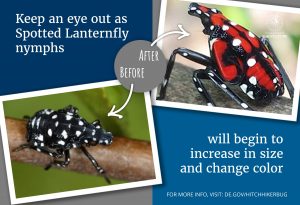
A 3rd instar spotted lanternfly is black with white spots. When it metamorphizes into a 4th instar, it will be black with red on its body and white spots.Homeowners are encouraged to visit Delaware’s spotted lanternfly website at https://de.gov/hitchhikerbug to learn what the quarantine means and how to manage this invasive pest. The Delaware Homeowner Spotted Lanternfly and Treatment Fact Sheet lists pesticides labeled for planthoppers or leafhoppers sold at local home and garden stores, which can be used to kill the insect. Residents can do their part by treating nymphs and adults from May to November and scraping and destroying egg masses from December to May. Homeowners can also hire a commercially licensed turf and ornamental pesticide applicator to treat their properties for these insects.

In Delaware, spotted lanternfly nymphs are in the third and fourth instar stages and will metamorphize into adults before the end of July. From now until early September, trees are actively moving phloem from the trunk into the branches, which feed the tree’s growth. At this time, using a systemic insecticide is preferred because it is absorbed by tree roots, bark, or leaves and is moved through its vascular system to other parts of the tree. This means that no matter what area the spotted lanternfly feeds on, it will ingest the insecticide and die.

Eliminating the tree of heaven helps decrease the spotted lanternfly population. The tree of heaven is found in industrial parks, unmanaged areas, or vacant lots, and along highways and railways. Municipalities and businesses should prioritize destroying the female tree of heaven while leaving some male specimens as trap trees. The average homeowner does not have tree of heaven on their properties, but the homeowner should remove it if identified.

Delaware Spotted Lanternfly Quarantine and Permitting
The general public is encouraged to download and print the Delaware Resident Spotted Lanternfly Compliance Checklist, indicating that you inspected and know that no living life stage of the spotted lanternfly is present on regulated articles before moving them. The checklist is available online at https://de.gov/hitchhikerbug. DDA recommends keeping the checklist in each vehicle’s glove box and noting the date when specific items on the list are inspected before transport.

Examples of regulated articles include:
• Any living life stage of the spotted lanternfly
• Landscaping, remodeling, or construction materials
• Firewood of any species
• Packing materials (e.g., wood crates, boxes)
• All plants and plant parts, including all live and dead trees, perennial and annual plants, and mulch
• Outdoor household articles like RVs, lawnmowers, chairs, grills, tarps, tile, stone, deck boards, and other vehicles not stored indoors.

Any person conducting business for a commercial company, a municipality, or a government agency that requires movement of any regulated item within or from the quarantine area must have a permit, available through the DDA spotted lanternfly website. To obtain a permit, a designated individual from an organization must receive training and pass an online test to demonstrate a working knowledge and understanding of the pest and quarantine requirements. This individual is then required to train other employees to inspect vehicles and products and remove any spotted lanternfly life stages. The permit demonstrates that the individual understands how to identify the pest and ensure the items transported are not carrying the insect.

Reporting Spotted Lanternfly

Adult spotted lanternfly on a person's thumb. The adult is about the length from the tip of the thumb to the first joint below the nail.Residents who live near the Dover Air Force Base or in Sussex County are encouraged to report sightings of the spotted lanternfly. Citizen reports help DDA inspectors determine how these insects move and which transportation pathways they utilize. These reports also allow DDA to notify agricultural operations with plants vulnerable to this insect. Residents can make a report by using the online form at https://de.gov/hitchhikerbug or emailing HitchHikerBug@delaware.gov and including the location of the find in the subject line. Due to the high level of reporting, DDA inspectors will not respond to emails but will use the information provided to determine if a new spotted lanternfly population is present.

Additional Information
In March 2019, DDA initially quarantined zip codes in New Castle County, where an established population of reproducing spotted lanternfly was found. The quarantine was expanded in September 2019 to include all areas of New Castle County north of the Chesapeake and Delaware Canal and finally included the entire county in July 2020. DDA quarantined Kent County in October 2020, when established populations of the insect were found in Smyrna, Dover, and Harrington.

###