$15 million at stake for Delaware survivors, families, shelters, and service providers
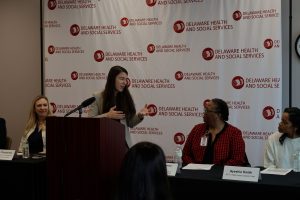
This lawsuit was also announced via a live-streamed
press conference on August 18, 2025.
Attorney General Kathy Jennings today announced that she is co-leading a coalition of 21 attorneys general in suing the Trump Administration over the illegal imposition of conditions on congressionally-authorized Victims of Crime Act (VOCA) grants.
The Trump Administration has illegally declared that states will be unable to access these funds – used to support victims and survivors of crimes – unless they agree to participate in the Trump Administration’s extreme immigration enforcement efforts.
“Victims of crime have already been through enough,” said Attorney General Jennings. “Citizens are not immune from President Trump’s indiscriminate attacks on immigrants. His illegal attempt to condition victim assistance funding on political compliance would dissuade victims from coming forward, threaten millions of dollars’ worth of services and shelter, and add an unmanageable workload for social workers, police, and prosecutors who are already stretched too thin. We’re not going to let it happen.”
“Delaware will always stand up for survivors of crime and the organizations that support them,” said Governor Matt Meyer. “These federal funds are about safety, shelter, and justice for victims and their families, and threatening to take away this lifeline in order to advance an immigration agenda is both cruel and unlawful. I am proud to join Attorney General Jennings in fighting to protect these resources and to make sure every survivor in Delaware has the support they need to rebuild their lives.”
Laura C. Graham, Esq., Deputy Director of Community Legal Aid Society, Inc. (CLASI) said, “As a civil legal service provider representing vulnerable Delawareans – including victims and survivors of domestic violence, sexual assault, human trafficking, and other forms of violence and exploitation – CLASI believes all survivors of crime should have access to life-saving safety net services, including civil legal representation, shelter, community and system-based advocacy, and support from the Victims’ Compensation Assistance Program. Placing unlawful requirements on these programs undermines victim safety by making victims less likely to seek help, report crimes, and access the care that they need, which in turn makes our State less safe for all Delawareans. Life-saving services, including civil legal representation, shelter, community and system-based advocacy, and support from VCAP, are a safety net that provides necessary services to Delawarean survivors of crime. These services help victims and survivors in Delaware achieve safety and begin to rebuild their lives. CLASI stands with all survivors of abuse in Delaware, and applauds the Delaware Department of Justice for taking steps to protect victims and survivors in Delaware, and for addressing unlawful federal policies that undermine the safety and well-being of our community and our State.”
Sue Ryan, Executive Director of the Delaware Coalition Against Domestic Violence said, “VOCA and the funding provided through this act supports essential services to victims of crime throughout Delaware. Importantly, as required by VOCA, these services are available to all victims of crime, regardless of immigration status. This is critical protection for victims of crime because offenders target those who are most vulnerable in our communities. Services for crime victims must be available to all crime victims, otherwise the criminals win. The Trump Administration has added language into the VOCA FY25 Services grant requiring agencies to give ‘access to DHS (ICE) agents.’ This is in violation of the VOCA statute and federal confidentiality protections. Undocumented victims of domestic violence would be afraid to seek shelter and services for fear that they would be arrested by ICE. This attempt to undermine the safety protections afforded by VOCA emboldens abusers and offenders who can then use the system to do more harm. DCADV supports Delaware’s efforts to protect all crime victims.“
VOCA, signed into law in 1984 by President Reagan, provides a series of grant programs through which states provide critical resources and services to help victims and survivors of crime restore normalcy in their lives. These services include victim and witness advocacy services, emergency shelter, medical, funeral, and burial expenses, crime scene cleanup, sexual assault forensic exams, and much more.
In Delaware, VOCA grants are principally administered through the Attorney General’s Victims Compensation Assistance Program (VCAP) and the State’s Criminal Justice Council (CJC).
VCAP, which is funded both by federal grants and State court fees, distributed more than $1.6 million in federally-funded victim assistance in FY 2025. These included but were not limited to reimbursements for:
- funeral expenses, burial expenses, and grief counseling for the families of homicide victims
- temporary housing expenses for domestic violence survivors and others fleeing unsafe housing
- medical and dental expenses not covered by insurance
- lost wages for victims who missed work due to injury or caregiving responsibilities, or lost support for the dependents of homicide victims
- sexual assault nurse examinations
VCAP is a particularly critical resource for the survivors of domestic violence who rely on it as a financial bridge in their escape from unsafe housing and/or abusive partners on whom they rely for income. Nearly 30% of VCAP claims in FY 2025 were for survivors of domestic violence.
The total amount of federal funding at stake exceeds $14.7 million supporting 24 programs, including:
- group and family therapy for post-traumatic stress disorder (PTSD) and unresolved grief, and trauma-based cognitive behavioral therapy for children;
- rape crisis services, including 24/7 hotlines, intervention (hospital, police, and prosecution), and aftercare/support;
- police department embedded victim service advocates to work with law enforcement by supporting victims of violent crimes;
- assisting victims of domestic violence through a sexual assault therapist, filing for Protection from Abuse (PFA) orders, and safety planning;
- arranging housing, employment, and support for crime victims, including emergency shelter of domestic violence victims;
- direct services to elderly victims, including protection from financial exploitation and elder abuse;
- ongoing logistical and emotional support to victims with the criminal justice system, including case management, prosecution, court, and liaison services.
These funds would be extremely difficult or impossible to replace through the State budget. Losing them would effectively cripple the State’s justice and victim support systems. Organizations supported by VOCA grants include:
ContactLifeline, which runs a 24/7 rape crisis hotline and provides aftercare support services, counseling, and advocacy for rape survivors
Child Inc. and People’s Place II, which provide shelters and bi-lingual hotlines to women and children fleeing domestic violence
The Children’s Advocacy Center of Delaware, which coordinates with law enforcement, child protection, health care workers, and social services to interview child victims of sexual abuse, domestic violence, and extreme neglect
If allowed to stand, those program cuts would be further compounded by the chilling effect that immigration verification services would have on victims of crime, who often are already fearful to come forward.
These funding streams—totaling more than a billion dollars a year nationwide—have long ensured that States could fulfill their most fundamental duties: to protect public safety and redress harm to their residents. States use these funds to assist nearly 9 million crime victims per year and to provide compensation for more than 200,000 victims’ claims per year. Congress has required the distribution of nearly all VOCA funding to States based on fixed statutory formulas and has repeatedly acted to ensure sufficient funding for crime victims, including after the 9/11 terrorist attacks.
However, the Trump Administration, through the U.S. Department of Justice (USDOJ), has declared that States, along with the victims and survivors they serve, will be blocked from these funds unless they comply with the Administration’s political agenda – namely its immigration enforcement priorities. In order to receive these funds, States must assist the U.S. Department of Homeland Security (DHS) with civil immigration enforcement efforts – a federal, not state government responsibility.
This directive conflicts with core principles of American governance – the separation of powers, and federalism. Congress did not authorize USDOJ to impose conditions on these grant programs that coerce States to devote their resources to enacting the Administration’s immigration agenda. As such, Attorney General Jennings and the coalition are requesting that the Court permanently enjoin the Trump Administration from implementing or enforcing these illegal conditions.
AG Jennings is a lead plaintiff on this lawsuit, along with New Jersey Attorney General Matthew J. Platkin, California Attorney General Rob Bonta, Illinois Attorney General Kwame Raoul, and Rhode Island Attorney General Peter Neronha. They are joined by the attorneys general of Colorado, Connecticut, Hawaii, Maine, Maryland, Massachusetts, Michigan, Minnesota, Nevada, New Mexico, New York, Oregon, Vermont, Washington, Wisconsin, and the District of Columbia
###