



















Department of Insurance Issues First-Ever GLP-1 Report
Captive | Captive Insurance | Insurance Commissioner | Date Posted: Thursday, September 4, 2025

 Property Reassessment & Your Insurance: What Really Drives Premium Costs
 Amid Hints of Spring, DNREC Reminds Delawareans of Yard Waste Options, Including Beneficial Reuse
 Governor Matt Meyer Returns from India Trade Mission with New Investment and Innovation Opportunities
 DNREC Now Soliciting Community Water Quality Improvement Grant Project Proposals
 Delaware Officials Highlight DTRN360, Innovative Behavioral Health Care Coordination Platform
 AG Jennings sues Trump Administration to stop latest round of illegal tariffs Delaware Policy Leaders Take Aim at Primary Care Reform, Health Care Affordability
 Women and Tavern Keeping on the Dover Green at the Archives’ March First Saturday Program
 Delaware Governor Matt Meyer Proclaims March 9-13, 2026 Severe Weather Awareness Week
 DNREC to Resume Sand Bypass Operations At Indian River Inlet After Signing Contract With First State Crane Service
 Attention Ag Insurance Agents: Subsidy issues subject of Monday, March 9 virtual Q&A with USDA Risk Management Agency AG Jennings intervenes in USPS case that would allow guns to be mailed with virtually no limits
 Delaware Department of Education sets measurable targets to accelerate student achievement statewide AG Jennings blocks another Trump Admin attempt to defund SNAP, collect personal data
 Delaware Entradas a las fiestas para ver los partidos de la Copa Mundial de la FIFA 2026 saldrán
 Delaware Lt. Gov Gay, Education Secretary Marten celebrate 302 Day with fourth graders Governor Matt Meyer Issues Statement on the Unanimous Upholding of Senate Bill 21 by the Delaware Supreme Court
 DSHA announces participants in zoning and land use reform pilot program Governor Matt Meyer Signs Executive Order Streamlining State Permitting Regulations
 DNREC Closes The Point at Cape Henlopen March 1 to Protect Nesting, Migrating Birds
 DHSS, DNREC Reopen PFAS Awareness and Outreach Grant Opportunity Through March 27
 Diverse Histories Virtual Exhibit Launches, Expanding Delaware’s Story Beyond 1776 AG Jennings, DOJ employee to accompany Rep. Sarah McBride and Sen. Lisa Blunt Rochester to State of the Union Address
 15th Annual State Employee Art Exhibition Now Open at Delaware State University
 Delaware 250 to Host “Celebrate Delaware” Black-Tie Celebration at Hotel Du Pont
 Fee Season to Begin March 1, Kicking off Year-Long 75th Anniversary Celebration at Delaware State Parks
 State of Delaware Announces 10 a.m. Opening for Kent and Sussex Counties on February 24, 2026
 State of Delaware Announces Office Operations for Tuesday, February 24, 2026
 Kent and Sussex County Downgraded to Level 2 Driving Restriction, New Castle County Remains at Level 1 Driving Warning
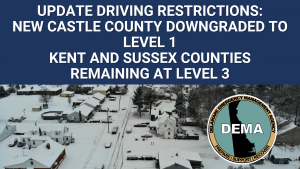 Driving Restrictions Update: New Castle County Downgraded to Level 1, Kent and Sussex Counties Remaining at Level 3
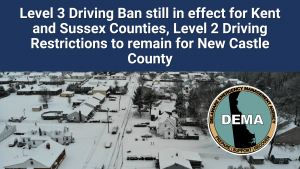 Level 3 Driving Ban for Kent County, Level 2 Driving Restriction for New Castle County to remain in effect
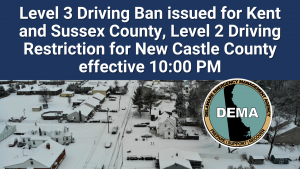 Level 3 Driving Ban for Kent and Sussex Counties, Level 2 Driving Restrictions for New Castle County Starting at 10 pm
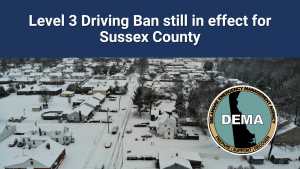
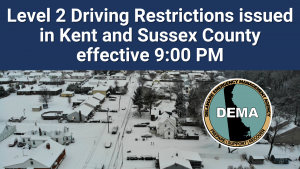 Level 2 Driving Restriction Issued for Kent and Sussex Counties Effective at 9pm.
 State of Delaware Offices Will Be Closed on Monday, February 23, 2026
 State of Emergency Declaration National Guard Activated for Winter Storm Response
 Significant Storm Expected to Bring Heavy Snow, Strong Winds, and Coastal Flooding to Delaware
 Downtown Development District Rebate Program opening application process for new District designations
 DPH Reports Measles Exposure at Nemours Children’s Hospital Emergency Department in Wilmington Statement from AG Jennings and Gov. Meyer on victory over Trump tariffs at SCOTUS
 Governor Meyer, DSHA, Apennine celebrate start of new housing in Georgetown
 Delaware Holds Career Fair to Expand Youth Pathways and State Employment Opportunities
 Spring Pond Trout Season to Open With Youth-Only Day March 7, Followed by Regular Downstate Opener March 8
 Charter School Accountability Committee recommends revocation of BASSE’s charter
 Join DOC’s Spring 2026 Citizens Academy for an insider’s look at Delaware’s correctional system
 Governor Meyer Orders the Lowering of Flags to Honor the Lives of George Bunting and John Viola; Rev. Jesse Jackson
 Governor Matt Meyer Presents Order of the First State to Five Delawareans
 DPA Calls for Extension of PJM Capacity Price Cap to Protect Consumers
 Delaware School Safety Center Hosts School Security Officer Training for Delaware School Constables LEADelaware welcomes 11 new members for Class VIII, celebrates Class VII graduation
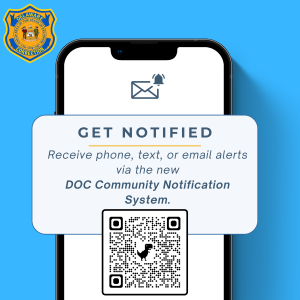 Department of Correction launches enhanced community notification system
 Delaware Announces Second Annual “Futures in the Arts” Celebration Announced
 Delaware Behavioral Health Consortium to Create a Comprehensive State of the State of Perinatal Health Report
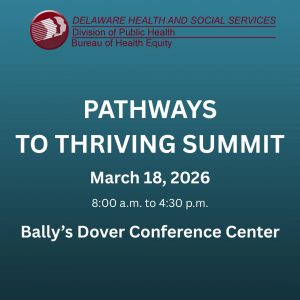 DPH to Host Summit on Building Healthy, Strong Communities in Delaware
 Delaware Department of Labor Marks Successful Paid Leave Launch in January
 Delaware Division of the Arts Announces 10 Finalists for Delaware’s 2026 Poetry Out Loud State Finals
 Delaware Organ and Tissue Donor Awareness Board Announces 2026 Video Scholarship Contest for High School Students
 DNREC Reopens Indian River Bay to Clamming and Shellfish Harvesting After Millsboro Sewage Release Delaware schools recognized for strong performance and progress in closing achievement gaps
 DOC Announces leadership promotions at Bureau of Community Corrections and Baylor Women’s Correctional Institution
 Spring Turkey Season Lottery Attracts Record Number of Applicants for Hunting State Wildlife Areas AG Jennings secures $17.85 million settlement with Lannett and Bausch over conspiracies to inflate prices
 State Employees’ Charitable Campaign Seeks Delaware Nonprofits for 2026 Giving Campaign
 DNREC Expands Paid Summer Internship Program for College Students and Recent Graduates
Captive | Captive Insurance | Insurance Commissioner | Date Posted: Thursday, September 4, 2025
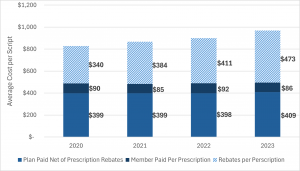
Prices for the medications were relatively flat, after subtracting rebates, the analysis of data provided to the OVBHCD by Delaware’s three largest pharmacy benefit managers found. Rebates are payments typically made by a pharmaceutical manufacturer to a pharmacy benefit manager, who then shares all or some of rebate with the health insurer or employer.
Driven by the increase in use, total spending on GLP-1 medications more than doubled over the reviewed period. GLP-1 medications accounted for about 6 percent of all pharmacy spending for the Delaware commercial fully insured market. The trends in Delaware mirror those nationally.
In the coming months, the OVBHCD will expand its analysis of pharmacy spending to include all medications, offering further context to pharmacy spending among the commercial, fully insured population.
This report does not provide State of Delaware Group Health Insurance Plan GLP-1 data. Such data is not available in a manner that is inclusive of rebates, and solely reporting on spending can be inherently misleading due to the significant value of rebates received and fully retained by the State. In future contracts, the State’s PBM will be required to submit OVBHCD pharmacy data templates so information can be similarly analyzed by this expert team.
The Department of Insurance remains committed to supporting evidence-based care, improving access to effective treatments, and promoting transparency in the health care market. The Office’s findings will inform ongoing conversations about how to balance innovation with affordability in Delaware’s health care system.
Access the Report: Utilization Not Cost of GLP-1 Medications Drives Increased Spending

Keep up to date by receiving a daily digest email, around noon, of current news release posts from state agencies on news.delaware.gov.
Here you can subscribe to future news updates.
Captive | Captive Insurance | Insurance Commissioner | Date Posted: Thursday, September 4, 2025
Prices for the medications were relatively flat, after subtracting rebates, the analysis of data provided to the OVBHCD by Delaware’s three largest pharmacy benefit managers found. Rebates are payments typically made by a pharmaceutical manufacturer to a pharmacy benefit manager, who then shares all or some of rebate with the health insurer or employer.
Driven by the increase in use, total spending on GLP-1 medications more than doubled over the reviewed period. GLP-1 medications accounted for about 6 percent of all pharmacy spending for the Delaware commercial fully insured market. The trends in Delaware mirror those nationally.
In the coming months, the OVBHCD will expand its analysis of pharmacy spending to include all medications, offering further context to pharmacy spending among the commercial, fully insured population.
This report does not provide State of Delaware Group Health Insurance Plan GLP-1 data. Such data is not available in a manner that is inclusive of rebates, and solely reporting on spending can be inherently misleading due to the significant value of rebates received and fully retained by the State. In future contracts, the State’s PBM will be required to submit OVBHCD pharmacy data templates so information can be similarly analyzed by this expert team.
The Department of Insurance remains committed to supporting evidence-based care, improving access to effective treatments, and promoting transparency in the health care market. The Office’s findings will inform ongoing conversations about how to balance innovation with affordability in Delaware’s health care system.
Access the Report: Utilization Not Cost of GLP-1 Medications Drives Increased Spending
Keep up to date by receiving a daily digest email, around noon, of current news release posts from state agencies on news.delaware.gov.
Here you can subscribe to future news updates.
Delaware's Governor
State Agencies
Elected Officials
General Assembly
Delaware Courts
State Employees
Cities & Towns
Delaware State Code
State Regulations
Business First Steps
Phone Directory
Locations Directory
Public Meetings
Voting & Elections
Transparency
Delaware Marketplace
Tax Center
Personal Income Tax
Privacy Policy
Weather & Travel
Contact Us
Corporations
Franchise Tax
Gross Receipts Tax
Withholding Tax
Delaware Topics
Help Center
Mobile Apps
E-mail / Text Alerts
Social Media


Built by the Government Information Center
©MMXXVI Delaware.gov
