






























Take C.H.A.R.G.E. of Lithium-ion Battery Safety
State Fire Marshal | Date Posted: Monday, December 1, 2025


 Division of Historical and Cultural Affairs Announces Deputy Director and PIO Appointments
 Delaware Releases Strategic Framework for Contaminants of Emerging Concern and First PFAS Implementation Plan
 Turkey Hunting Season to Offer an Extra Day; Season Opens April 4 and 5 with Youth and Non-ambulatory Hunts
 Delaware Veterans Connect, Create, and Showcase Their Work Through Free Statewide Art Classes
 Court rules with State, clears way for offshore wind substation critical to Delaware’s energy future
  Governor Meyer Orders Lowering of Flags to Honor Former State Senator Nancy Cook
 DOJ announces arrest of Delmar officer in stalking, sexual contact investigations
 Delaware Division of the Arts Announces 15th Annual State Employee Art Exhibition Winners DOJ secures life sentences, additional time for two men involved in the murder of Shiheem Durham
 Lt. Governor Kyle Evans Gay Sits Down with Small Business Leaders Across the State
 Results of OHS’ St. Patrick’s Day Weekend DUI Checkpoint and Sober Rides Program
 Delaware Senators Move One Step Closer to Protecting Civil Rights for Individuals with Disabilities
 Public Advocate Names New Deputy and Key Staff to Strengthen Consumer Advocacy
 Bring Your Family History to Life at the Archives’ Community Digitization Days
 Registration Now Open for DNREC-Sponsored Christina River Watershed Cleanup
 Delaware accelerates statewide early literacy strategy with more than $8m to strengthen classroom reading instruction
 Upstate Trout Season to Open in New Castle County Streams with Youth-Only Day Set for April 4
 Delaware Division of the Arts Seeks Public Input in New Statewide Strategic Planning Process
 DNREC Announces 2025-‘26 Deer Harvest Totals, Launches New Interactive Game Harvest Dashboard
 Property Reassessment & Your Insurance: What Really Drives Premium Costs
 Amid Hints of Spring, DNREC Reminds Delawareans of Yard Waste Options, Including Beneficial Reuse
 Governor Matt Meyer Returns from India Trade Mission with New Investment and Innovation Opportunities
 DNREC Now Soliciting Community Water Quality Improvement Grant Project Proposals
 Delaware Officials Highlight DTRN360, Innovative Behavioral Health Care Coordination Platform AG Jennings sues Trump Administration to stop latest round of illegal tariffs Delaware Policy Leaders Take Aim at Primary Care Reform, Health Care Affordability
 Women and Tavern Keeping on the Dover Green at the Archives’ March First Saturday Program
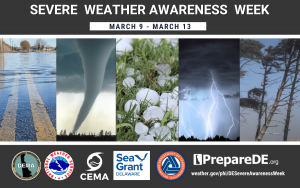 Delaware Governor Matt Meyer Proclaims March 9-13, 2026 Severe Weather Awareness Week
 DNREC to Resume Sand Bypass Operations At Indian River Inlet After Signing Contract With First State Crane Service
 Attention Ag Insurance Agents: Subsidy issues subject of Monday, March 9 virtual Q&A with USDA Risk Management Agency AG Jennings intervenes in USPS case that would allow guns to be mailed with virtually no limits
 Delaware Department of Education sets measurable targets to accelerate student achievement statewide AG Jennings blocks another Trump Admin attempt to defund SNAP, collect personal data
 Delaware Entradas a las fiestas para ver los partidos de la Copa Mundial de la FIFA 2026 saldrán
 Delaware Lt. Gov Gay, Education Secretary Marten celebrate 302 Day with fourth graders Governor Matt Meyer Issues Statement on the Unanimous Upholding of Senate Bill 21 by the Delaware Supreme Court
 DSHA announces participants in zoning and land use reform pilot program Governor Matt Meyer Signs Executive Order Streamlining State Permitting Regulations
 DNREC Closes The Point at Cape Henlopen March 1 to Protect Nesting, Migrating Birds
 DHSS, DNREC Reopen PFAS Awareness and Outreach Grant Opportunity Through March 27
 Diverse Histories Virtual Exhibit Launches, Expanding Delaware’s Story Beyond 1776 AG Jennings, DOJ employee to accompany Rep. Sarah McBride and Sen. Lisa Blunt Rochester to State of the Union Address
 15th Annual State Employee Art Exhibition Now Open at Delaware State University
 Delaware 250 to Host “Celebrate Delaware” Black-Tie Celebration at Hotel Du Pont
 Fee Season to Begin March 1, Kicking off Year-Long 75th Anniversary Celebration at Delaware State Parks
 State of Delaware Announces 10 a.m. Opening for Kent and Sussex Counties on February 24, 2026
 State of Delaware Announces Office Operations for Tuesday, February 24, 2026
 Kent and Sussex County Downgraded to Level 2 Driving Restriction, New Castle County Remains at Level 1 Driving Warning
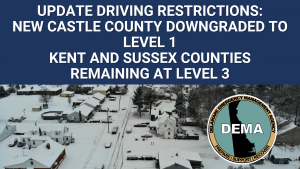 Driving Restrictions Update: New Castle County Downgraded to Level 1, Kent and Sussex Counties Remaining at Level 3
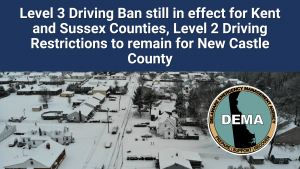 Level 3 Driving Ban for Kent County, Level 2 Driving Restriction for New Castle County to remain in effect
State Fire Marshal | Date Posted: Monday, December 1, 2025
As holiday wish lists fill with the latest tech gadgets, the Delaware State Fire Marshal’s Office joins the Fire Safety Research Institute (FSRI), reminding shoppers of the unique fire risks lithium-ion batteries pose and how to prevent fires through proper storage, charging, and recycling.
Lithium-ion batteries are commonly found in household items like personal shavers, remote control toys, drones, laptops, handheld power tools, e-scooters and lawn equipment. While lithium-ion battery-powered devices have many benefits, such as longer charge time and higher efficiency, they also pose unique fire risks. They store energy more densely than traditional batteries and can become unstable if damaged (punctured, swollen), improperly used (overcharged) or exposed to extreme temperatures. This instability can lead to overheating, sparking, and even explosions.
Fire departments worldwide are experiencing an increase in fire incidents, injuries and deaths involving lithium-ion battery-powered devices. According to data from UL Solutions, since 2022 there have been 188 explosions and more than 3,000 fires caused by consumer products powered by lithium-ion batteries.
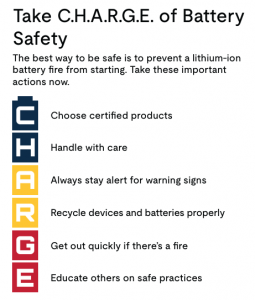
For people giving or receiving tech gifts this holiday season, FSRI’s Take C.H.A.R.G.E. of Battery Safety tips outline how to properly select, care for and dispose of lithium-ion battery-powered devices:
1. Choose Certified Products: Prioritize your safety by selecting lithium-ion
battery-powered devices certified by a nationally recognized testing laboratory to ensure they meet important safety requirements.
2. Handle Lithium-Ion Battery-Powered Devices with Care: Always follow manufacturer guidelines and use the provided charger for lithium-ion battery-powered devices. Avoid modifying batteries or chargers and charge your devices in safe environments away from extreme temperatures, direct sunlight and flammable materials. For larger devices, such as e-bikes, charge in a location that does not block your exit path, separate from sleeping areas and ideally outside your home. Refrain from overnight charging of large devices.
3. Always Stay Alert for Warning Signs: Regularly inspect devices for any signs of damage, such as swelling or punctures. Be aware of unusual sounds like hissing or popping. Watch out for excessive heat or a strange odor. White or gray wispy smoke indicates there is immediate danger of fire. If you notice any of these warning signs, immediately stop using the lithium-ion battery-powered device.
4. Recycle Devices and Batteries Properly: Responsibly dispose of old or damaged batteries and devices by taking them to a designated battery recycling center. Never discard batteries, chargers or battery-powered devices in regular trash bins.
5. Get Out Quickly if There’s a Fire: Know the warning signs to look and listen for and get out if you see or hear them. Follow your home fire escape plan to leave immediately, closing doors behind you as you exit, and call 9-1-1.
6. Educate Others on Safe Practices: Help protect your friends and loved ones by sharing how they can Take C.H.A.R.G.E. of Battery Safety.
To fully Take C.H.A.R.G.E. of Battery Safety, it is crucial to see these guidelines not as individual tips, but as interconnected steps. Each measure supports and reinforces the others. Embracing and adhering to all these guidelines can significantly reduce risk and create a safer home or work environment. For more information, visit batteryfiresafety.org.

Keep up to date by receiving a daily digest email, around noon, of current news release posts from state agencies on news.delaware.gov.
Here you can subscribe to future news updates.
State Fire Marshal | Date Posted: Monday, December 1, 2025
As holiday wish lists fill with the latest tech gadgets, the Delaware State Fire Marshal’s Office joins the Fire Safety Research Institute (FSRI), reminding shoppers of the unique fire risks lithium-ion batteries pose and how to prevent fires through proper storage, charging, and recycling.
Lithium-ion batteries are commonly found in household items like personal shavers, remote control toys, drones, laptops, handheld power tools, e-scooters and lawn equipment. While lithium-ion battery-powered devices have many benefits, such as longer charge time and higher efficiency, they also pose unique fire risks. They store energy more densely than traditional batteries and can become unstable if damaged (punctured, swollen), improperly used (overcharged) or exposed to extreme temperatures. This instability can lead to overheating, sparking, and even explosions.
Fire departments worldwide are experiencing an increase in fire incidents, injuries and deaths involving lithium-ion battery-powered devices. According to data from UL Solutions, since 2022 there have been 188 explosions and more than 3,000 fires caused by consumer products powered by lithium-ion batteries.
For people giving or receiving tech gifts this holiday season, FSRI’s Take C.H.A.R.G.E. of Battery Safety tips outline how to properly select, care for and dispose of lithium-ion battery-powered devices:
1. Choose Certified Products: Prioritize your safety by selecting lithium-ion
battery-powered devices certified by a nationally recognized testing laboratory to ensure they meet important safety requirements.
2. Handle Lithium-Ion Battery-Powered Devices with Care: Always follow manufacturer guidelines and use the provided charger for lithium-ion battery-powered devices. Avoid modifying batteries or chargers and charge your devices in safe environments away from extreme temperatures, direct sunlight and flammable materials. For larger devices, such as e-bikes, charge in a location that does not block your exit path, separate from sleeping areas and ideally outside your home. Refrain from overnight charging of large devices.
3. Always Stay Alert for Warning Signs: Regularly inspect devices for any signs of damage, such as swelling or punctures. Be aware of unusual sounds like hissing or popping. Watch out for excessive heat or a strange odor. White or gray wispy smoke indicates there is immediate danger of fire. If you notice any of these warning signs, immediately stop using the lithium-ion battery-powered device.
4. Recycle Devices and Batteries Properly: Responsibly dispose of old or damaged batteries and devices by taking them to a designated battery recycling center. Never discard batteries, chargers or battery-powered devices in regular trash bins.
5. Get Out Quickly if There’s a Fire: Know the warning signs to look and listen for and get out if you see or hear them. Follow your home fire escape plan to leave immediately, closing doors behind you as you exit, and call 9-1-1.
6. Educate Others on Safe Practices: Help protect your friends and loved ones by sharing how they can Take C.H.A.R.G.E. of Battery Safety.
To fully Take C.H.A.R.G.E. of Battery Safety, it is crucial to see these guidelines not as individual tips, but as interconnected steps. Each measure supports and reinforces the others. Embracing and adhering to all these guidelines can significantly reduce risk and create a safer home or work environment. For more information, visit batteryfiresafety.org.
Keep up to date by receiving a daily digest email, around noon, of current news release posts from state agencies on news.delaware.gov.
Here you can subscribe to future news updates.
Delaware's Governor
State Agencies
Elected Officials
General Assembly
Delaware Courts
State Employees
Cities & Towns
Delaware State Code
State Regulations
Business First Steps
Phone Directory
Locations Directory
Public Meetings
Voting & Elections
Transparency
Delaware Marketplace
Tax Center
Personal Income Tax
Privacy Policy
Weather & Travel
Contact Us
Corporations
Franchise Tax
Gross Receipts Tax
Withholding Tax
Delaware Topics
Help Center
Mobile Apps
E-mail / Text Alerts
Social Media


Built by the Government Information Center
©MMXXVI Delaware.gov
