



















Delaware announces presumptive positive avian influenza case in Kent County commercial flock
Department of Agriculture | Newsroom | Date Posted: Saturday, January 10, 2026

 Historical and Cultural Affairs Presents Arts & Education Programs for the Month of April Division of Historical and Cultural Affairs Announces Deputy Director and PIO Appointments
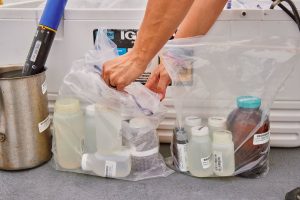 Delaware Releases Strategic Framework for Contaminants of Emerging Concern and First PFAS Implementation Plan
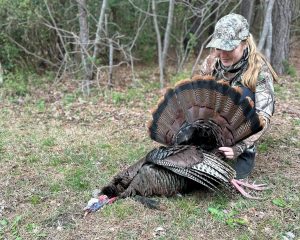 Turkey Hunting Season to Offer an Extra Day; Season Opens April 4 and 5 with Youth and Non-ambulatory Hunts
 Delaware Veterans Connect, Create, and Showcase Their Work Through Free Statewide Art Classes
 Court rules with State, clears way for offshore wind substation critical to Delaware’s energy future
 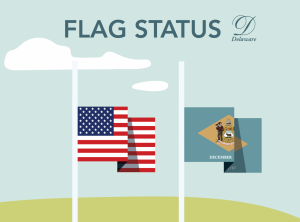 Governor Meyer Orders Lowering of Flags to Honor Former State Senator Nancy Cook
 DOJ announces arrest of Delmar officer in stalking, sexual contact investigations
 Delaware Division of the Arts Announces 15th Annual State Employee Art Exhibition Winners DOJ secures life sentences, additional time for two men involved in the murder of Shiheem Durham
 Lt. Governor Kyle Evans Gay Sits Down with Small Business Leaders Across the State
 Results of OHS’ St. Patrick’s Day Weekend DUI Checkpoint and Sober Rides Program
 Delaware Senators Move One Step Closer to Protecting Civil Rights for Individuals with Disabilities
 Public Advocate Names New Deputy and Key Staff to Strengthen Consumer Advocacy
 Bring Your Family History to Life at the Archives’ Community Digitization Days
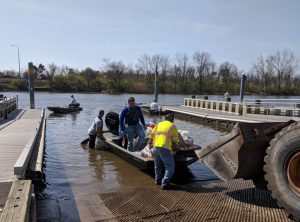 Registration Now Open for DNREC-Sponsored Christina River Watershed Cleanup
 Delaware accelerates statewide early literacy strategy with more than $8m to strengthen classroom reading instruction
 Upstate Trout Season to Open in New Castle County Streams with Youth-Only Day Set for April 4
 Delaware Division of the Arts Seeks Public Input in New Statewide Strategic Planning Process
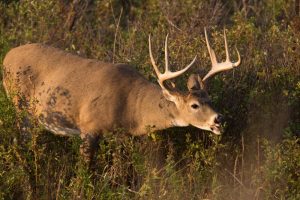 DNREC Announces 2025-‘26 Deer Harvest Totals, Launches New Interactive Game Harvest Dashboard
 Property Reassessment & Your Insurance: What Really Drives Premium Costs
 Amid Hints of Spring, DNREC Reminds Delawareans of Yard Waste Options, Including Beneficial Reuse
 Governor Matt Meyer Returns from India Trade Mission with New Investment and Innovation Opportunities
 DNREC Now Soliciting Community Water Quality Improvement Grant Project Proposals
 Delaware Officials Highlight DTRN360, Innovative Behavioral Health Care Coordination Platform AG Jennings sues Trump Administration to stop latest round of illegal tariffs Delaware Policy Leaders Take Aim at Primary Care Reform, Health Care Affordability
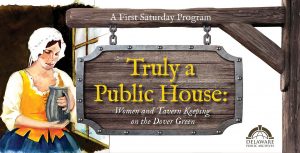 Women and Tavern Keeping on the Dover Green at the Archives’ March First Saturday Program
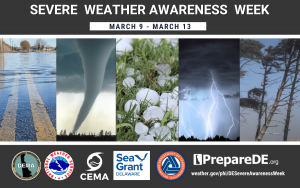 Delaware Governor Matt Meyer Proclaims March 9-13, 2026 Severe Weather Awareness Week
 DNREC to Resume Sand Bypass Operations At Indian River Inlet After Signing Contract With First State Crane Service
 Attention Ag Insurance Agents: Subsidy issues subject of Monday, March 9 virtual Q&A with USDA Risk Management Agency AG Jennings intervenes in USPS case that would allow guns to be mailed with virtually no limits
 Delaware Department of Education sets measurable targets to accelerate student achievement statewide AG Jennings blocks another Trump Admin attempt to defund SNAP, collect personal data
 Delaware Entradas a las fiestas para ver los partidos de la Copa Mundial de la FIFA 2026 saldrán
 Delaware Lt. Gov Gay, Education Secretary Marten celebrate 302 Day with fourth graders Governor Matt Meyer Issues Statement on the Unanimous Upholding of Senate Bill 21 by the Delaware Supreme Court
 DSHA announces participants in zoning and land use reform pilot program Governor Matt Meyer Signs Executive Order Streamlining State Permitting Regulations
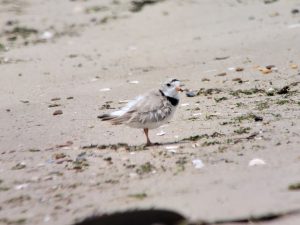 DNREC Closes The Point at Cape Henlopen March 1 to Protect Nesting, Migrating Birds
 DHSS, DNREC Reopen PFAS Awareness and Outreach Grant Opportunity Through March 27
 Diverse Histories Virtual Exhibit Launches, Expanding Delaware’s Story Beyond 1776 AG Jennings, DOJ employee to accompany Rep. Sarah McBride and Sen. Lisa Blunt Rochester to State of the Union Address
 15th Annual State Employee Art Exhibition Now Open at Delaware State University
 Delaware 250 to Host “Celebrate Delaware” Black-Tie Celebration at Hotel Du Pont
 Fee Season to Begin March 1, Kicking off Year-Long 75th Anniversary Celebration at Delaware State Parks
 State of Delaware Announces 10 a.m. Opening for Kent and Sussex Counties on February 24, 2026
 State of Delaware Announces Office Operations for Tuesday, February 24, 2026
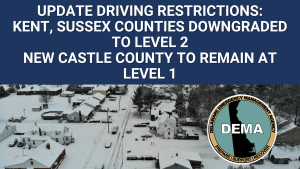 Kent and Sussex County Downgraded to Level 2 Driving Restriction, New Castle County Remains at Level 1 Driving Warning
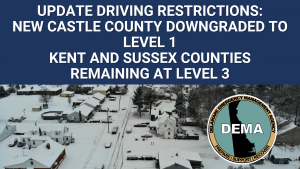 Driving Restrictions Update: New Castle County Downgraded to Level 1, Kent and Sussex Counties Remaining at Level 3
Department of Agriculture | Newsroom | Date Posted: Saturday, January 10, 2026

DOVER — The Delaware Department of Agriculture announced today that preliminary testing of a commercial broiler flock in Kent County has returned presumptive positive for H5 HPAI (avian influenza).
State officials have quarantined the affected premises, and the birds on the property are being depopulated to prevent the spread of the disease. Birds from the affected flock will not enter the food system.
Avian influenza is a highly contagious airborne respiratory virus that spreads quickly among birds through nasal and eye secretions and manure. The virus can be spread from flock to flock, including flocks of wild birds, through contact with infected poultry, equipment and the clothing and shoes of caretakers. This virus affects poultry, like chickens, ducks, and turkeys, and some wild bird species, such as ducks, geese and shorebirds.
This is the first Delaware detection of avian influenza in a commercial flock during the 2025-26 waterfowl migratory season. The Delaware Department of Agriculture, with the help of the University of Delaware laboratory system, performs active surveillance and testing of birds for avian influenza within the state every day. Surveillance is conducted at commercial poultry operations, exhibition and backyard flocks, and at livestock and poultry auctions.
Key Tips:
All poultry owners should increase their vigilance in protecting their flocks from contracting avian influenza by following these steps:
Commercial poultry producers should follow the procedures of contacting the company they grow for when they notice signs of disease.
Delaware backyard flock owners who notice any unusual symptoms in their flock should email poultry.health@delaware.gov or call the Delaware Poultry Health Hotline at 302-698-4507 and provide your contact information, size of flock, location, and concerns. Find helpful tips here: https://agriculture.delaware.gov/poultry-animal-health/avian-flu-graphics/.
If Delaware residents see a sick or dead bird, report sightings through the DNREC Division of Fish and Wildlife’s sick and injured wildlife reporting form.
The H5N1 virus has infected a small number of people across the United States. Division of Public Health (DPH) officials emphasize that the risk to the general population is low. A few individuals may be exposed through their work or through contact with sick wild birds. When such exposures are identified, DPH works with such individuals to take protective measures to protect their health. Poultry and poultry products remain safe to eat when properly handled and cooked. While this detection may be concerning for residents, these response measures are standard practice and are intended to protect animal health, the poultry industry, and public health. DPH recommends that members of our community (especially children, immunocompromised persons, persons with chronic health conditions and pets) should be kept away from wild birds and bird droppings.
Avian Influenza Breakdown:
Avian influenza is caused by an influenza type A virus that can infect poultry (such as chickens, turkeys, pheasants, quail, domestic ducks, geese, and guinea fowl) and is carried by free-flying waterfowl and wild birds, such as ducks, geese, raptors, and shorebirds.
Avian influenza viruses are classified by a combination of two groups of proteins: hemagglutinin or “H” proteins, of which there are 16 (H1–H16), and neuraminidase or “N” proteins, of which there are 9 (N1–N9). Many combinations of “H” and “N” proteins are possible.
Each combination is considered a different subtype and can be further broken down into different strains that circulate within flyways/geographic regions. Avian influenza viruses are further classified by their pathogenicity (low or high) — the ability of a particular virus strain to produce disease in domestic poultry.

Keep up to date by receiving a daily digest email, around noon, of current news release posts from state agencies on news.delaware.gov.
Here you can subscribe to future news updates.
Department of Agriculture | Newsroom | Date Posted: Saturday, January 10, 2026
DOVER — The Delaware Department of Agriculture announced today that preliminary testing of a commercial broiler flock in Kent County has returned presumptive positive for H5 HPAI (avian influenza).
State officials have quarantined the affected premises, and the birds on the property are being depopulated to prevent the spread of the disease. Birds from the affected flock will not enter the food system.
Avian influenza is a highly contagious airborne respiratory virus that spreads quickly among birds through nasal and eye secretions and manure. The virus can be spread from flock to flock, including flocks of wild birds, through contact with infected poultry, equipment and the clothing and shoes of caretakers. This virus affects poultry, like chickens, ducks, and turkeys, and some wild bird species, such as ducks, geese and shorebirds.
This is the first Delaware detection of avian influenza in a commercial flock during the 2025-26 waterfowl migratory season. The Delaware Department of Agriculture, with the help of the University of Delaware laboratory system, performs active surveillance and testing of birds for avian influenza within the state every day. Surveillance is conducted at commercial poultry operations, exhibition and backyard flocks, and at livestock and poultry auctions.
Key Tips:
All poultry owners should increase their vigilance in protecting their flocks from contracting avian influenza by following these steps:
Commercial poultry producers should follow the procedures of contacting the company they grow for when they notice signs of disease.
Delaware backyard flock owners who notice any unusual symptoms in their flock should email poultry.health@delaware.gov or call the Delaware Poultry Health Hotline at 302-698-4507 and provide your contact information, size of flock, location, and concerns. Find helpful tips here: https://agriculture.delaware.gov/poultry-animal-health/avian-flu-graphics/.
If Delaware residents see a sick or dead bird, report sightings through the DNREC Division of Fish and Wildlife’s sick and injured wildlife reporting form.
The H5N1 virus has infected a small number of people across the United States. Division of Public Health (DPH) officials emphasize that the risk to the general population is low. A few individuals may be exposed through their work or through contact with sick wild birds. When such exposures are identified, DPH works with such individuals to take protective measures to protect their health. Poultry and poultry products remain safe to eat when properly handled and cooked. While this detection may be concerning for residents, these response measures are standard practice and are intended to protect animal health, the poultry industry, and public health. DPH recommends that members of our community (especially children, immunocompromised persons, persons with chronic health conditions and pets) should be kept away from wild birds and bird droppings.
Avian Influenza Breakdown:
Avian influenza is caused by an influenza type A virus that can infect poultry (such as chickens, turkeys, pheasants, quail, domestic ducks, geese, and guinea fowl) and is carried by free-flying waterfowl and wild birds, such as ducks, geese, raptors, and shorebirds.
Avian influenza viruses are classified by a combination of two groups of proteins: hemagglutinin or “H” proteins, of which there are 16 (H1–H16), and neuraminidase or “N” proteins, of which there are 9 (N1–N9). Many combinations of “H” and “N” proteins are possible.
Each combination is considered a different subtype and can be further broken down into different strains that circulate within flyways/geographic regions. Avian influenza viruses are further classified by their pathogenicity (low or high) — the ability of a particular virus strain to produce disease in domestic poultry.
Keep up to date by receiving a daily digest email, around noon, of current news release posts from state agencies on news.delaware.gov.
Here you can subscribe to future news updates.
Delaware's Governor
State Agencies
Elected Officials
General Assembly
Delaware Courts
State Employees
Cities & Towns
Delaware State Code
State Regulations
Business First Steps
Phone Directory
Locations Directory
Public Meetings
Voting & Elections
Transparency
Delaware Marketplace
Tax Center
Personal Income Tax
Privacy Policy
Weather & Travel
Contact Us
Corporations
Franchise Tax
Gross Receipts Tax
Withholding Tax
Delaware Topics
Help Center
Mobile Apps
E-mail / Text Alerts
Social Media


Built by the Government Information Center
©MMXXVI Delaware.gov
