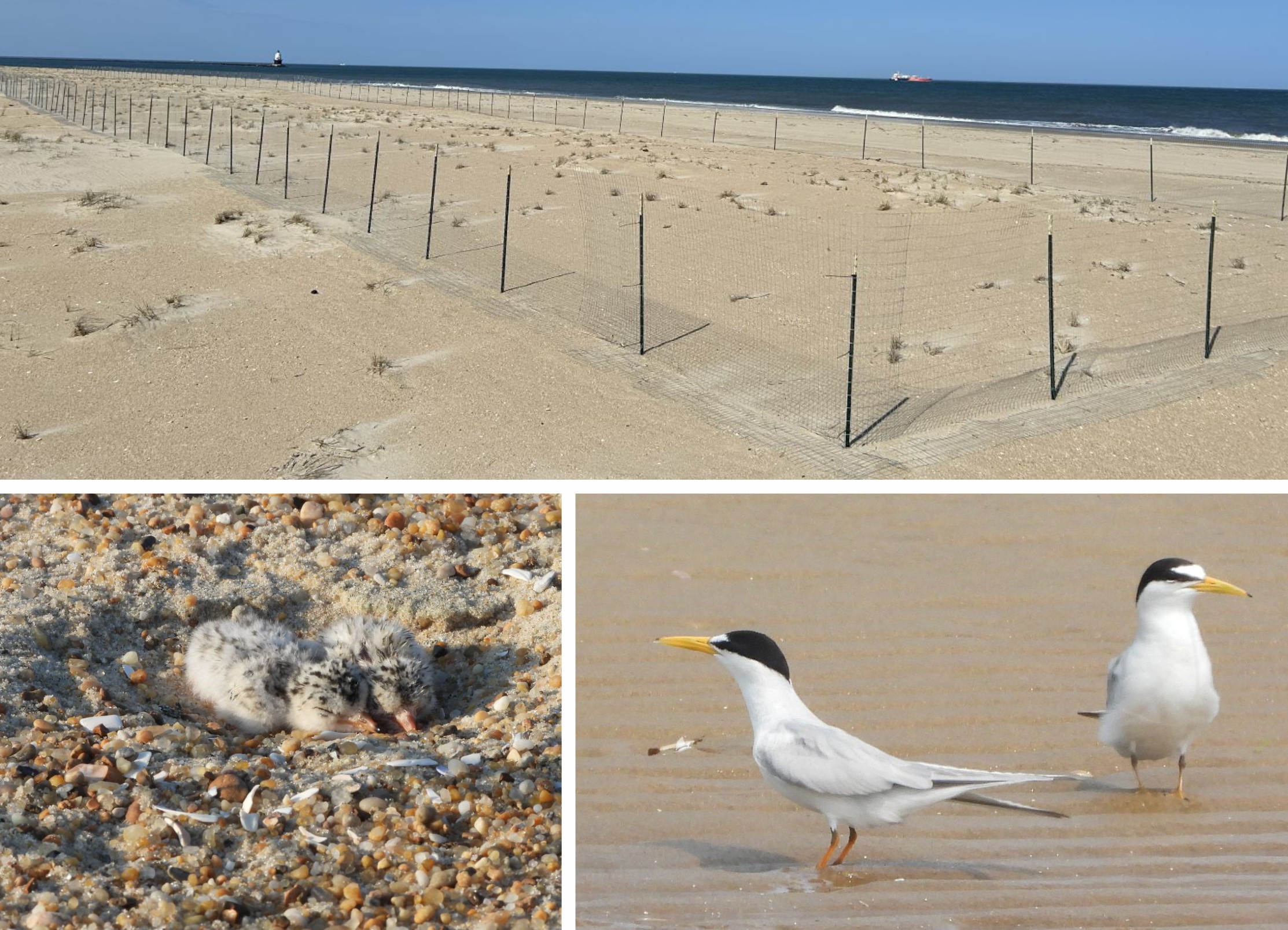
New exclosure fencing (top photo) will help deter predators and offer protection for least terns nesting on The Point
at Cape Henlopen. /DNREC photo montage-Liz Turner-Jessica McNulty
Least terns, a bird historically found each summer along many of Delaware’s bay and Atlantic Ocean beaches, have faltered in recent years into their current listing as a state endangered species – leading the Department of Natural Resources and Environmental Control to take a new approach for giving the birds a lift into a better future.
Identified by their small size, silvery-gray back and wings, yellow bill, and black cap with a white triangle on their forehead, least terns can be a common sight at Cape Henlopen State Park from May through August. A beach-nesting species, the terns form small colonies above the high tide line where breeding pairs typically lay two eggs on the sand in small scrapes – putting their nests at risk from predation and severe weather events.
To improve their chances of survival at Cape Henlopen, the DNREC Division of Fish and Wildlife and Division of Parks and Recreation have teamed to create two nesting plots, or exclosures, for least terns at The Point within the state park. The new habitat is located within an area of The Point that is seasonally closed to protect another beach-nesting bird, the federally-listed threatened piping plover.
“The motivation for the project is that added protection can make least tern nests and fledglings less vulnerable to predation, and also bring back their numbers at a location historically favored by the species,” said DNREC Wildlife Section Administrator Joe Rogerson. “Although least terns are commonly observed throughout the summer at Cape Henlopen and The Point, up to now the productivity of nesting colonies remains very low, with high rates of nest and chick failures.”
Over the past 20 years, the DNREC Beach-Nesting Bird Program has recorded statewide lows of five pairs of least terns in 2012, 2013 and 2015. (There was also a statewide high of 127 least tern pairs in 2025 – most of them recorded at nearby Fowlers Beach on Prime Hook National Wildlife Refuge, whose restoration in 2016 after Hurricane Sandy has benefitted Delaware’s beach-nesting bird populations).
Meanwhile, least tern breeding populations at The Point are known to fluctuate, with no breeding at all in 2023 and a smaller breeding colony with 16 nest attempts identified in 2024. In 2025, state biologists identified 53 nesting attempts at Cape Henlopen and though many hatched least tern nests were confirmed, no fledglings were known to survive from the colony at The Point – with risks from severe summer heat, red foxes, coyotes and other species heavily impacting chick survival.
DNREC expects that these risks can be largely abated by the new exclosures protective of least tern nesting habitat on the ocean side of The Point. To create the plots, a team from the two DNREC divisions installed 6-foot welded-wire fencing, with a 2-foot skirt along the bottom to prevent digging, and protecting 2.65 acres of safe nesting habitat.
Besides their state-endangered species status, least terns are also a Tier 1 Species of Greatest Conservation Need identified in the 2025 Delaware Wildlife Action Plan. Meaning the terns need all the help they can get in the state – with DNREC committed to providing it. That includes audio-visual assistance by Division of Fish and Wildlife staff who, with least terns now arriving in Delaware for the summer, are deploying decoys and sound playback to encourage the little birds to use the exclosures for growing their colony at The Point.
“The joint effort between the DNREC divisions aims to provide a safe and nurturing space that will enable successful nesting and fledging of least terns and create a template for additional beach-nesting bird projects in the future,” said Chris Bennett, DNREC Division of Parks and Recreation Environmental Stewardship Program Manager. “With the essential elements for species’ recovery order here – including conservation, protection, habitat and commitment from the public to give it the best chance of success – we’re optimistic about what can happen at The Point this year and into the future.”
For more information about least terns, piping plovers and other bird species living the beach life, visit the de.gov/beachnesters webpage.
About DNREC
The Delaware Department of Natural Resources and Environmental Control protects and manages the state’s natural resources, protects public health, provides outdoor recreational opportunities, and educates Delawareans about the environment. The DNREC Division of Fish and Wildlife conserves and manages Delaware’s fish and wildlife and their habitats, and provides fishing, hunting, wildlife viewing and boating access on more than 75,000 acres of public land owned or managed by the Division of Fish and Wildlife. The DNREC Division of Parks and Recreation oversees more than 26,000 acres in 17 state parks and the Brandywine Zoo and the Indian River Marina. For more information, visit the website and connect with @DelawareDNREC on YouTube, Facebook, Instagram, X, YouTube or LinkedIn.
Media Contacts: Michael Globetti, michael.globetti@delaware.gov; Nikki Lavoie, nikki.lavoie@delaware.gov
###